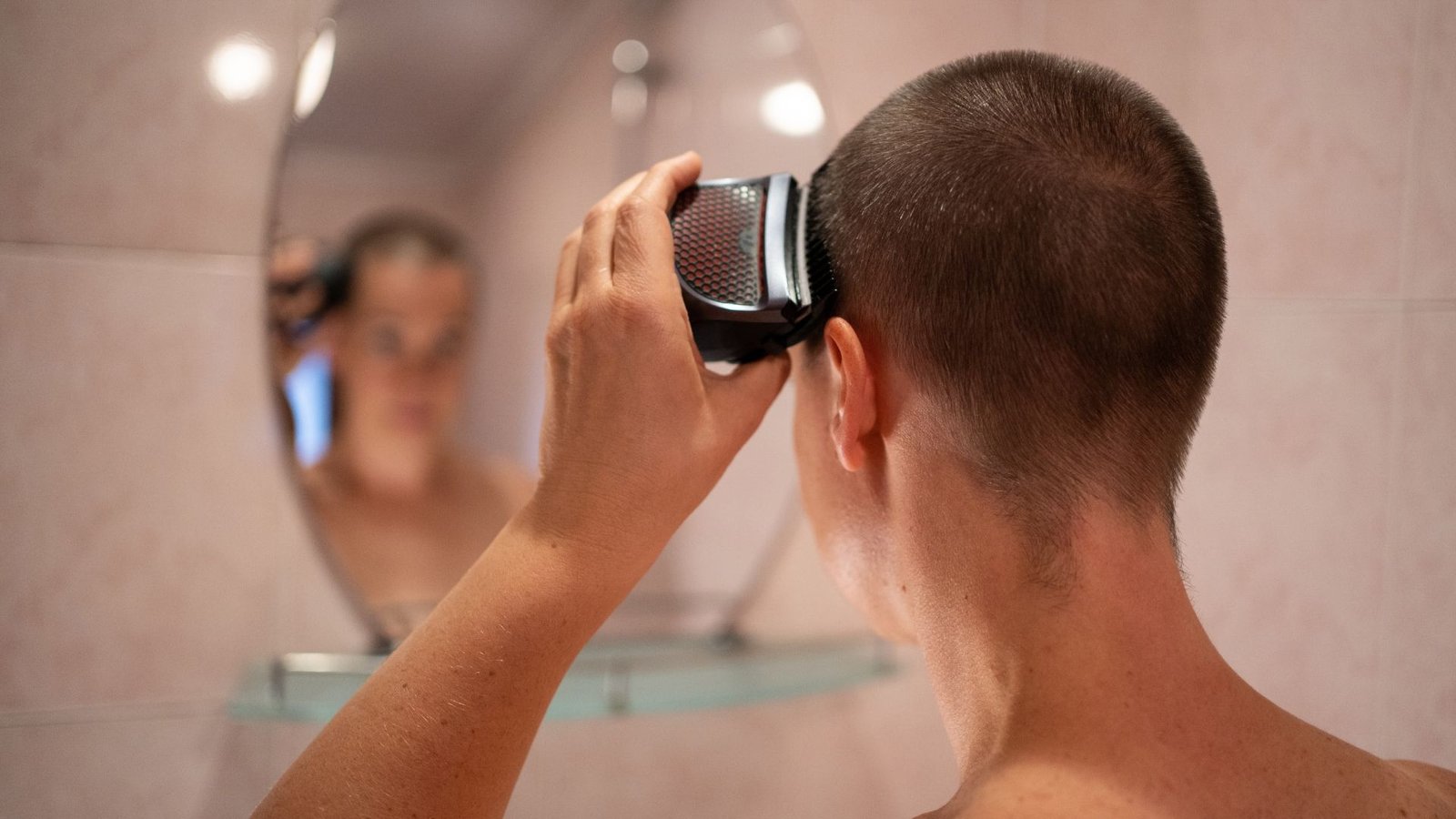
“Did you actually cut your hair off?!” I texted Lael Wilcox this week.
The 39-year-old Alaskan is known for a lot of things: her extensive palmarès in ultra-endurance racing and her Around the World women’s record, but also her contagious giggle, the fact that she rides a million miles in chamois-less bibs, and that she happily drinks milk mid-ride. So shaving her head for marginal gains seemed a tad extreme for her—a move more typical of a WorldTour time trialist than an ever-smiling ultra-endurance rider preparing to pedal around the planet.
But Wilcox insists the haircut isn’t about marginal watt savings; it’s about minutes spared through practicality.
“I’m planning to buzz [my hair] before the big ride,” Wilcox told Cycling Weekly. “It’s more about time savings: not having to wash and brush it, I’d save 10 minutes a day. That’s 13 hours in 78 days!”
For a rider preparing to take on Mark Beaumont’s Around the World record of 78 days, 14 hours and 40 minutes, 13 hours is a tremendously valuable chunk of time.
And Wilcox is leaving nothing to chance for this next attempt. Earlier this week, she spent a day at Specialized’s headquarters in Morgan Hill, California, undergoing wind tunnel testing to see where and how these valuable minutes can be gained back.
“I’m thinking about everything in time savings,” Wilcox said. “I had never really thought about this stuff before.”
Back for another lap around the world
Wilcox will set off on June 7 for an attempt at the overall circumnavigation record currently held by Mark Beaumont. To take the record, she’ll need to chop 30 days off the time she set during her 2024 ride.
It’s an enormous ask. But she believes it’s possible.
“I feel good about it,” she said.
The biggest difference between then and now lies not only in her training and equipment but also in her intent.
In 2024, Wilcox approached the ride in classic Lael fashion: fun-first and community-driven. She rode with people. She stopped often. She played tourist and added massive hills to her route simply because she loves climbing.
This time will be different.
To qualify for an Around the World record, riders must cycle a minimum of 18,000 miles in one direction, start and finish at the same location and traverse at least two antipodal points. Air and sea travel between continents is allowed, but only the miles ridden count toward the total.
To beat Beaumont’s record, Wilcox will need to ride roughly 240 miles per day for 78 days. Wilcox shared that her goal is to pace herself at 15mph (24kph) for 16 hours a day or, if possible, 16mph (25.8kph) for 15 hours a day, which would give her more recovery.
The math leaves little room for inefficiency. But as Wilcox is learning, in ultra-endurance cycling, marginal tweaks can lead to significant gains.
Marginal gains, ultra results
(Image credit: SRAM)
On Monday, at the Specialized headquarters, engineers ran Wilcox through a full day of wind-tunnel testing.
The team tested nearly everything: bags, clothing, aero bars and, yes, even her hair.
“I was curious if aerodynamics play a major factor in my around-the-world attempt,” she shared afterwards. “It turns out that it all matters.”
The goal, she explained, is simple: save minutes anywhere possible.
“A mile an hour faster saves me a whole hour every day,” she said.
The testing revealed some insightful results: An aerobar bar bag, for example, turned out to be faster than riding without one. She’ll likely use 32mm tyres. And hairdos matter too: a bun proved faster than a ponytail and a buzz cut fastest of all.
But her position on the bike might prove the biggest gain of all.
“The aero position saves me a lot,” Wilcox told Cycling Weekly. “I tried to stay in it as much as I could [in a training ride today] and ride 30 minutes faster on the same route.”
That’s exactly the kind of improvement she’s looking for, but despite all the aero talk, she’s not planning to go all-in on the time-trial equipment.
When I asked if she’d considered using the Specialized Tarmac or, even, the Specialized Shiv TT machine, her answer came down to the realities of ultra distance.
“I think it probably isn’t comfortable enough,” she said.
Instead, she’s leaning toward the Specialized Roubaix, a bike built for long days on rough roads.
“I’ve been riding the Tarmac for the Shootout [—America’s fastest group ride—] and other local rides but the Roubaix is so comfortable for longer stuff with its suspension and a relaxed position,” she said. “Plus the big tyre clearance if I need it for rough roads.”
Comfort, after all, is speed when you’re riding for 16 hours a day.
In January, she began experimenting with weekly 230-plus-mile training days, tracking recovery metrics and dialling back when her resting heart rate crept too high.
The Around the World in 78 Days project has become a giant equation.
– Twenty-four hours in a day.
– Six hours minimum sleep.
– 18,000 miles to tackle.
– Minutes saved wherever possible.
“These simple math equations could drive you crazy,” Wilcox said. “But ultimately, we want to put our best feet forward.”

