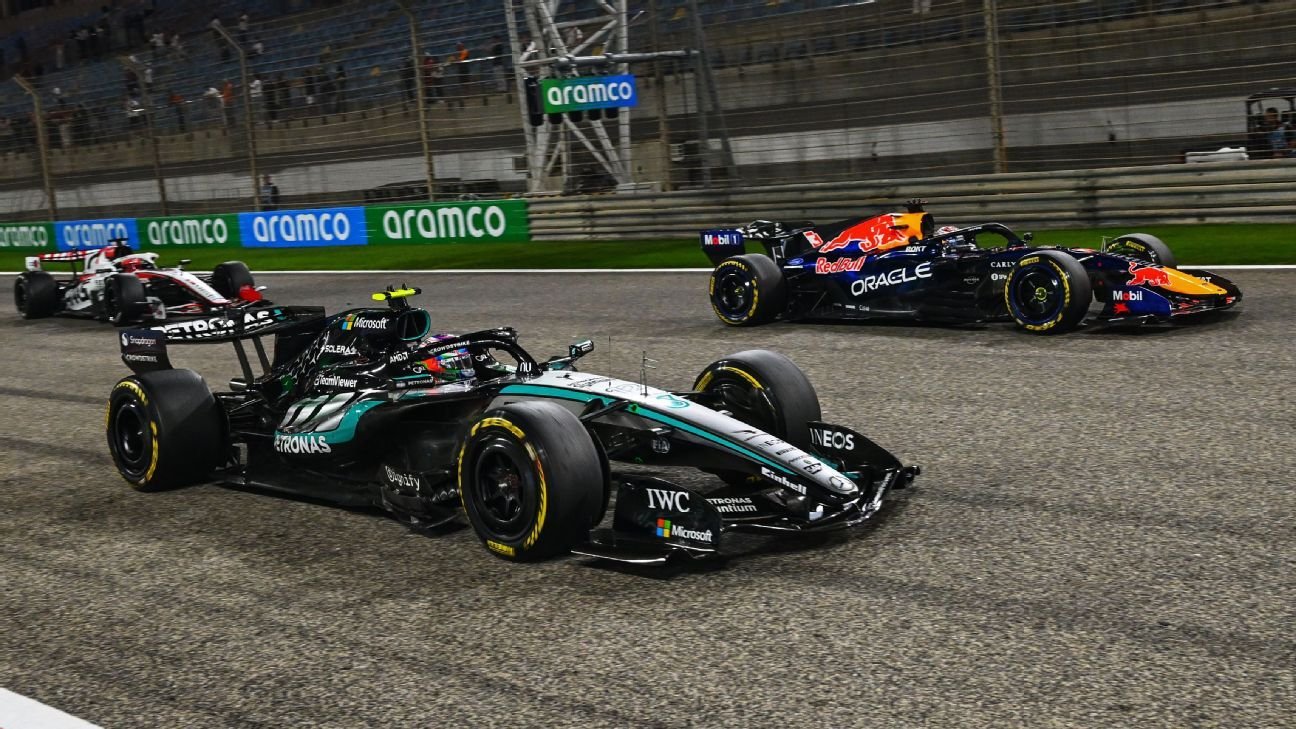
Formula 1 has undergone the biggest regulation change in its history ahead of the 2026 season, with new rules impacting the car’s power units, aerodynamics, tires and fuel.
If you’re struggling to get your head around the changes or you simply haven’t paid attention to F1’s news cycle since Lando Norris was crowned the champion last year, the scale of the change can seem a little overwhelming. In just one winter, the new rules have spawned a full lexicon of buzzwords and acronyms, seemingly aimed at taking an already-complex sport and making it less accessible than ever.
“It’s ridiculously complex,” seven-time world champion Lewis Hamilton said during the recent preseason tests in Bahrain. “I sat in a meeting the other day and they’re taking us through it, and it’s like you need a degree to fully understand it all.”
As has been the case throughout F1’s existence, it won’t be necessary to fully understand the rules to enjoy the sport. Racing is still racing after all, and following Sunday’s Australian Grand Prix, there will still be clear winners and clear losers — just like any other season opener in the sport’s history.
But the nature of the new rules means it is more likely that success and failure will be dictated to some extent by convoluted elements of the regulations. Therefore, having a basic understanding of what the drivers are dealing with and what the engineers are talking about will likely be more important than ever for those hoping to engage with F1.
For that reason, we have detailed the main areas of change you should be aware of ahead of the first race. It’s not an exhaustive list, but it aims to provide a cheatsheet for anyone hoping to get up to speed ahead of this weekend’s opening round in Melbourne.
Power unit
What’s changed? The core challenge (and limitation) of the 2026 regulations is entirely of the rule makers’ own creation. A desire to have cars that are powered 50% by sustainable fuels and 50% by electric power has created knock-on effects for aerodynamics, tire and sporting regulations — to the point that former Red Bull team principal Christian Horner warned the new cars would be “Frankenstein” creations.
While the reality is not quite that extreme, understanding the latest generation of turbo-hybrid power units is key to understanding the changes to the regulations as a whole. F1 cars have used hybrid power since 2014, but the power budget was set at an easier-to-achieve 80/20 split between the internal combustion engine (ICE) and the energy recovery system (ERS). To get as close as possible to the new 50/50 target, the deployment of electrical power via the ERS’s motor generator unit – kinetic (MGU-K) has been increased nearly threefold from 120kW (161 hp) to 350kW (469 hp) while the potency of the ICE has been reduced from upwards of 550kW (738 hp) to roughly 400kW (536 hp) — mainly through limitations on fuel flow and a lower compression ratio.
Despite the significant increase in the potential of the MGU-K, the total amount of usable energy stored in the battery at any one time will remain capped at 4 megajoules (MJ), meaning a fully charged battery can now be depleted three times more quickly than last year. To keep the battery topped up around the lap, the MGU-K can recover energy at a higher maximum rate of 350kW (also up from last year’s 120kW) and as much as 8 MJ to 9 MJ (depending on the circuit) of electrical harvesting is permitted per lap — up from 2 MJ under the 2014-2025 regulations.
Energy harvesting via the rear axle can be achieved in four ways: under braking, while on partial throttle, while coasting (when the driver is off the throttle and off the brake) and by diverting energy from the V6-turbo when the driver is on full throttle (this is known as “super-clipping” and is capped at a rate of 250kW under the regulations). Most of the above will be controlled by the car’s software, although drivers will be able to override the power unit if they need more power, and lift and coast can only be initiated by the driver lifting off the throttle.
Another significant change from the last generation of power units is the removal of the motor generator unit – heat (MGU-H). Attached by a shaft to the turbocharger, the MGU-H was an advanced bit of kit that harvested excess energy from the turbo when the driver was on throttle. It was also capable of working in reverse, meaning electrical power could be used to spin the turbo up to the optimum RPM to minimize turbo lag.
Why has it changed? The 50/50 goal for the new power units was decided at a time when governments around the world were legislating against the long-term future of internal combustion engines and forcing car manufacturers to commit to the production of electric vehicles. In an effort to retain the involvement of major automotive manufacturers in F1 and attract new ones, the sport felt the need to mirror the industry’s shift toward electrification while also providing a battleground in which sustainable fuels could be developed for the billion or so petrol cars that will likely remain on the world’s roads for years to come.
The strategy was immediately successful in that it attracted Audi to commit to the new engine regulations while also convincing Honda to u-turn on its decision to completely quit F1 at the end of 2025. Although not entirely due to the change in regulations, General Motors has also put its name on a power unit program, which is targeting an engine supply for the new Cadillac team by 2029, while Ford partnered with Red Bull’s in-house engine project that was also set up with the new regulations in mind.
Key to the arrival of Audi and Red Bull as power unit suppliers was the deletion of the MGU-H, which was costly and complex to engineer, creating a clear barrier to entry for new manufacturers under the previous set of regulations.
What impact will it have on racing? The instant power delivery offered by the MGU-K will provide rapid acceleration out of corners, but the limited capacity of the battery means it will be incredibly easy to deplete all of the electrical energy before the end of a straight. That will make energy management a key factor in race — as well as some qualifying sessions — as drivers look to harvest energy without sacrificing lap time and then deploy that energy as effectively as possible on the straights to lower the overall lap time. The difficulty of balancing that equation will vary from race to race depending on the ratio of braking zones to straights around the lap.
The concern is that the cars will ultimately be energy starved, meaning a fast qualifying lap might be as much about energy management as it is about pushing the car to the limit. Those concerns were among the reasons Max Verstappen labeled the new formula “anti-racing” and like “Formula E on steroids.” During races, drivers will have to tactically manage the deployment of energy so as not to become easy targets, saving enough of it in the battery to make tactical overtakes — potentially in places where we haven’t seen much overtaking before.
Car weight and dimensions
What’s changed? F1 cars are smaller and lighter this year, thanks to the FIA’s “Nimble Car Concept,” which mandates reduced regulatory limits in length and width as well as a lower minimum weight. The maximum wheelbase length has been reduced by 20cm (7.8 inches) and the car’s track width by 10cm (3.9 inches), resulting in cars that look noticeably smaller and better proportioned. A 30kg (66 pounds) reduction in the overall weight limit represents the first attempt to make the cars lighter in recent memory, although whether teams are able to hit the new target of 770kg (1,697 pounds) remains to be seen, especially as the minimum weight of the power unit has increased by 34kg (74 pounds).
Why has it changed? Drivers have long complained about the gradual increase in the weight of F1 cars from 642kg (1,415 pounds) in 2013 to 800kg (1,763 pounds) by 2025. Heavier cars are naturally less nimble than lighter cars, and the dimensions, which have also increased substantially since wider cars were permitted in 2017, make them more difficult to race wheel to wheel. While close-quarters racing at F1’s tightest circuits, such as Monaco, will still prove difficult, the hope is that the smaller cars will improve the show and make wheel-to-wheel racing easier. Lighter cars with a smaller frontal area will also contribute to efficiency gains that will help the energy-starved power unit.
What impact will it have on racing? Drivers said the reduction in weight and size was noticeable from behind the wheel during preseason testing, which bodes well for a slight improvement in racing. The numbers involved were never going to revolutionize the sport (a lack of overtaking was still a problem when the cars were considerably lighter and smaller in the mid-2000s), but it represents a step in the right direction.
Active aerodynamics
What’s changed? Cars will now have two wing settings: one for straights and one for corners. On the straights, the upper elements of the front and rear wings will rotate to reduce drag before snapping back into their normal high-downforce position for corners. The straight setting will only be available in FIA-designated zones (marked by boards displaying “SM,” straight-line mode, at the side of the track) and will be driver activated from the cockpit. In the wet, activation will be limited to the front wing only to maintain rear downforce.
Why has it changed? Put simply: efficiency gains to make battery power go further. Without straight-line mode, a great deal of electrical energy would have been wasted through aerodynamic drag acting on the car, creating an even greater energy deficit for drivers to manage around the lap. The active aero offers the best of both worlds, ensuring the cars are still smothered in downforce in corners while making them slippery enough on the straights to eke out the limited battery power around the lap.
What impact will it have on racing? Straight-line mode will be available to all drivers on every lap, meaning it isn’t designed to act as an overtaking aid despite its visual similarities to the outgoing Drag Reduction System (DRS). However, we have already seen different teams take different approaches to the device, with Ferrari testing a design in Bahrain that rotates the rear wing to the point that the upper element is turned fully upside down. Any gain in efficiency on the straights will be significant given the innate limitations of the power unit, while there have been suggestions that having a wing that rotates like the Ferrari’s could work a useful air brake as it returns to its cornering position under braking.
Overtake mode
What’s changed? Overtake mode replaces the DRS overtaking aid that served F1 for 15 years from 2011 to 2025. Now influenced by electrical deployment rather than reduced drag, overtake mode gives a chasing driver access to more electric power at higher speeds while the defending car’s power tapers off. Like DRS, a driver will gain the use of overtake mode by being within a second of the car in front at a detection point, but unlike DRS, it will be available at any point around the lap rather than on a designated straight.
Without overtake mode activated, the car’s permitted electrical deployment will progressively taper away once it is over 290 kph (180 mph) and reach zero by the time the car is traveling at 355 kph (220 mph). This was in part a safety feature to stop cars hitting dangerously high top speeds through a combination of the electric boost and straight-line mode, but is also crucial for the purposes of offering an advantage to a car with overtake mode.
Activating overtake mode allows the driver to override that tapering of electrical power to gain a speed advantage, with the full 350kW deployment available up until 337km/h. It’s hoped that the resulting difference in top speed will allow the chasing car to have enough of an advantage to launch a passing move under braking. In order to make up for the extra energy used by activating overtake mode, the driver will be allowed to recover an extra 0.5 megajoules per lap above the usual limit.
Why has it changed? The introduction of straight-line mode meant DRS was effectively available to all cars on every lap and could no longer present an advantage to the chasing car. The extra emphasis on electrical power provided the opportunity to create a differentiator in performance by limiting deployment for the lead car and allowing maximum deployment for the chasing car.
What impact will it have on racing? This remains a big question going into the opening round of the season. In theory overtake mode should provide overtaking opportunities above 290 kph (209 mph), but only if the chasing car still has enough available energy in its battery toward the end of a straight to take advantage of it. What’s more, depleting the battery to complete an overtake may leave the car vulnerable later in the lap if it hasn’t been able to recover the fully recover the spent energy. The effectiveness is likely to vary from circuit to circuit depending on how many braking zones there are to recover energy and the passing opportunities on the sections of track after the cars go over 290 kph.
Boost mode
What’s changed? Boost mode allows drivers to gain access to the full 350kW from the MGU-K at the press of a button (up until the point the power automatically tapers off above 290 kph). It is designed to be used in wheel-to-wheel combat when a driver wants to ignore the car’s usual power deployment or harvesting regime in order to fight with a rival. The same function existed under the previous set of regulations, but the less powerful MGU-K meant a maximum boost of 120kW was on offer rather than 350kW.
Why has it changed? The hope is drivers will use the more powerful boost mode tactically in wheel-to-wheel racing to create the kind of variations in performance that lead to overtaking.
What impact will it have on racing? Using boost mode comes with a similar cost/benefit equation to overtake mode: Use too much of it to make a pass, and you’ll be left without the necessary battery power to hold the position further round the lap. Deciding where to use it and for how long will add an additional tactical element to races. It could offer up overtaking opportunities at parts of the track where overtaking has previously been difficult.
Tires
What’s changed? Pirelli’s tires are narrower this year — by 25mm (0.9 inch) at the front and 30mm (1.1 inches) at the rear — but they remain on 18-inch wheels. As was the case last year, three dry-weather compounds will be available for use at each round, although the total family of compounds has been reduced from six to five as Pirelli has attempted to increase the performance gap between each compound. The tires have been designed to target similar degradation characteristics to those used in recent seasons.
Why has it changed? The narrower tires will reduce drag and weight — two factors that are the enemy of F1’s new energy-starved power units. Despite the change, which has resulted in a smaller contact patch, Pirelli has attempted to keep the characteristics of the tires as close to last year’s to avoid a further complication for the teams.
What impact will it have on racing? The increased performance gaps between compounds are designed to create a tactical variable and encourage more exciting races — similar to last year when Pirelli often skipped a compound in its selection at certain races. It’s possible tires will get overlooked early in the season with all the other changes in F1, but good tire preparation will still be a major factor in qualifying and the right strategy will still have the potential to decide races.
Reduced downforce
What’s changed? By rewriting the regulations that determine each car’s bodywork, the FIA has targeted a 30% reduction in downforce and a 55% reduction in drag. Once again, the main objective is tied into efficiency gains to aid the power unit, but the FIA has also applied lessons from the last set of regulations to tidy up the turbulent wake that makes it difficult for cars to follow one another.
The front wing has been reprofiled and bargeboards have been added ahead of the car’s sidepods to minimize the teams’ attempts to direct dirty airflow outward (known as outwash). The latest regulations also mandate a return of flat-bottomed cars, bringing an end to a short-lived ground effect era (2022-2025) in which Venturi tunnels on the underside of the car generated significant levels of downforce.
Why has it changed? Aside from reducing drag, the FIA also hopes the new aerodynamic regulations will make it easier for cars to follow. Turbulent air streaming from the rear of an F1 car has long created issues for competitors behind, who inevitably lose downforce without a clean flow of air over their own aerodynamic surfaces.
Although downforce has been reduced overall, the FIA hopes it has been cut in such a way that a car 20 meters behind a rival retains 90% of its total downforce. At the start of the previous set of regulations in 2022, cars retained 80% to 85% of their downforce when 20 meters behind a rival, but that number slipped to 70% by the end of last year as the cars became increasingly aero sensitive and teams looked to create outwash with the front wing.
The new generation of flat-bottomed cars should also be more pleasant to drive, as they will not be so sensitive to ride height and will be less susceptible to bouncing and porpoising.
What impact will it have on racing? If the new regulations make it easier for cars to follow one another, it could result in a big improvement in racing. During testing, drivers didn’t report a major difference, but even a small improvement on last year will be a step in the right direction after the previous generation of car became increasingly sensitive in the wake of another between 2022 to 2025.
The flat floors should also make the cars more drivable and easier to catch when they start to slide at high speed. The ground effect cars offered more downforce and higher cornering speeds, but when the car started to slide, the loss of grip was almost instantaneous and incredibly difficult to catch. A number of drivers have already commented on how much nicer the cars feel due to a combination of the reduced dimensions and wider setup windows.
Advanced sustainable fuels
What’s changed? Formula 1 is trading fossil fuels for a new blend of advanced sustainable fuels in 2026. Put simply, the fuel used in the cars must not add to the amount of carbon in the atmosphere and the process to create the fuel must rely solely on renewable energy.
Rather than dig hydrocarbons out of the ground and release them into the atmosphere when the fuel is burned, the sustainable fuel will rely on sources such as carbon capture (taking CO2 directly from the air or industrial emissions), municipal waste and non-food biomass. The end product must be certified as fully sustainable by a third party on behalf of the FIA before it is used at a grand prix weekend.
Why has it changed? In 2020, the FIA set the target of racing with fully sustainable fuels by 2026 as part of a much wider push to make its motorsport activities net zero by 2030. Motorsport has long been seen as a laboratory for road car technology, and the fuels used in F1 must have “drop-in” capability, meaning they would work in existing internal combustion engines already in production.
The big problem with synthetic fuel is the cost of making it, with some reports claiming the new blends could cost in excess of $200 a liter. Making the technology scalable while also permitting competition between the different fuel suppliers could prove a difficult balancing act for F1 and a product that has limited use for the wider world.
What impact will it have on racing? Given the infancy of the technology, there is the potential for fuel to become a major performance differentiator at the start of the season. Having said that, knowing exactly how much lap time is coming from the fuel versus other elements of the power unit, the chassis or any other factor dictating performance is pretty much impossible without taking the teams (and their marketing departments) on their word.

