-
Jeff Legwold
-
Rich Cimini
Close
Rich Cimini
ESPN Staff Writer
- Rich Cimini is a staff writer who covers the New York Jets and the NFL at ESPN. Rich has covered the Jets for over 30 years, joining ESPN in 2010. Rich also hosts the Flight Deck podcast. He previously was a beat writer for the New York Daily News and is a graduate of Syracuse University.
Multiple Authors
One of the most proficient passers in NFL history and one of the league’s most prolific pass catchers highlight the Pro Football Hall of Fame’s Class of 2026.
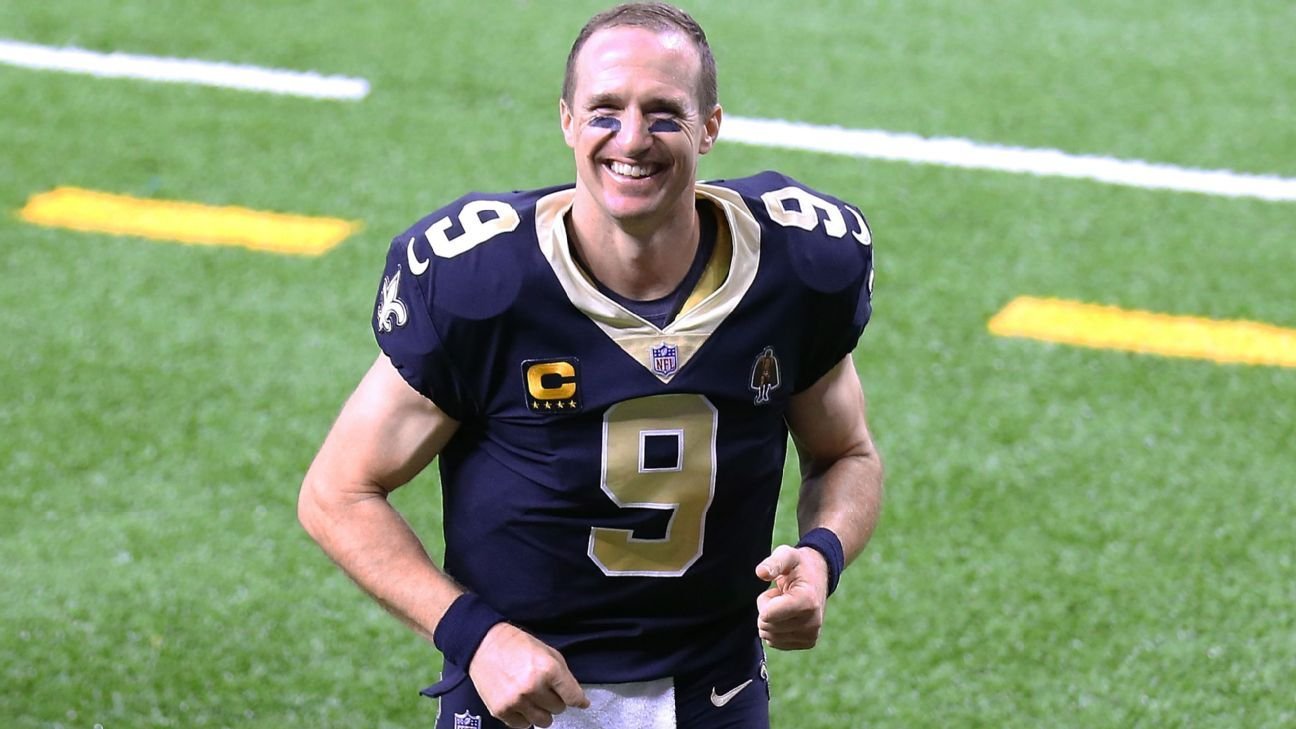
The class, announced Thursday night as part of the NFL Honors show in San Francisco, is led by quarterback Drew Brees, one of two quarterbacks in league history to throw for more than 80,000 yards, and wide receiver Larry Fitzgerald, who finished his career second only to Hall of Famer Jerry Rice in career receptions and receiving yards.
Joining them will be linebacker Luke Kuechly and kicker Adam Vinatieri. Running back Roger Craig, one of the three Seniors finalists, will also be in the 2026 Hall class.
Brees and Fitzgerald are in their first year of eligibility, and Kuechly and Vinatieri are in their second year. Not in the class is former Patriots coach Bill Belichick, who was the finalist from the coaches’ sub-committee, and New England owner Robert Kraft, the finalist from the contributors’ sub-committee.
This year’s class was chosen by the Hall’s board of selectors in a virtual meeting. The new Hall of Famers will be enshrined on Aug. 8 in Canton, Ohio.
Here is a closer look at the Class of 2026.

Drew Brees, quarterback
San Diego Chargers, 2001-2005; New Orleans Saints, 2006-2020
Brees was relatively small in stature (6-foot, 209 pounds), but he compensated with uncanny accuracy and instincts in the pocket, not to mention a computer-like ability to read defenses. It wasn’t an easy road for Brees, a second-round pick by the Chargers in 2001. He was replaced by Philip Rivers and suffered a major throwing-shoulder injury in 2005, prompting many to wonder if he’d ever be the same. As it turned out, he got better. He signed with the Saints in 2006 and led them to their only Super Bowl championship three years later.
Why he was selected: Brees is second all-time in passing yards (80,358), touchdown passes (571) and completions (7,142), and he’s third in completion percentage (67.7%). He made 13 Pro Bowls and was twice named NFL Offensive Player of the Year. He threw for more than 5,000 yards in a season an NFL-record five times. With Sean Payton designing the offense and calling the plays, Brees once went 54 consecutive regular-season games with a touchdown pass. Quite frankly, he owns too many passing marks to list.
Signature moment: A no-brainer — Super Bowl XLIV in Miami after the 2009 season. With precision passing (32-for-39, 288 yards, two touchdowns), Brees was named MVP for his performance in the Saints’ 31-17 win over the Indianapolis Colts. It capped a dual-redemption story for Brees and the city of New Orleans, which was devastated by Hurricane Katrina in 2005. — Cimini
Quotable: “One of his greatest strengths was in the pocket. He was a real good foot athlete. He could subtly move and deliver. Decision-making, make the proper throws in the biggest moments and as tough and courageous player as I’ve ever been around — all of it.” — former Saints and current Denver Broncos coach Sean Payton
Roger Craig, running back
San Francisco 49ers, 1983-1990; Los Angeles Raiders, 1991; Minnesota Vikings, 1993
Craig was a four-time Pro Bowl selection who played on three Super Bowl-winning teams in San Francisco. Hall of Fame 49ers coach Bill Walsh considered him a transformational player at the position and one of the key pieces of the 49ers’ offense. Craig was the first player in NFL history to rush for at least 1,000 yards and have at least 1,000 yards receiving in the same season. He did it in 1985, hauling in a league-leading 92 passes for 1,016 yards and six touchdowns while rushing for 1,050 yards and another nine scores.
Only two others have accomplished that feat — Hall of Famer Marshall Faulk (1999) and Christian McCaffrey (2019).
Why he was elected: The way Walsh used Craig forced defenses to adjust how they played and how they aligned against all eligible players in the formation. He was a template for how running backs could be used as rushing and receiving threats in the following decades.
Craig was named to the 1980s All-Decade team and made the postseason in every season of his career. Until his enshrinement, he was the only running back who was on either the 1970s, 1980s or 1990s All-Decade teams who was not in the Hall of Fame.
Signature moment: Craig’s high-knee stride was his trademark, but his 16-yard catch-and-run touchdown in Super Bowl XIX was an enduring image — knees churning with the ball held high as he crossed the goal line for the 49ers’ final score in their 38-16 win over the Miami Dolphins. Craig had 135 yards from scrimmage with three touchdowns in the game (one rushing, two receiving) and was the first player to score three touchdowns in a Super Bowl. — Legwold
Quotable: “I was never really caught up in the glamour, as far as trying to be the featured man on the team.” — Craig
Larry Fitzgerald, wide receiver
Arizona Cardinals, 2004-2020
For 17 seasons, Fitzgerald defined excellence. Drafted No. 3 overall by the Cardinals in 2004, he was consistent, durable, explosive and historically prolific. The wide receiver’s job, in its simplest form, is to catch the ball. Very few did it better than Fitzgerald, who was incredibly surehanded. He had only 35 drops.
His 1,431 receptions and 17,492 receiving yards are not only better than everyone not named Jerry Rice, but Fitzgerald is more than 100 receptions and 1,500 yards clear of the next-best player.
Why he was selected: Fitzgerald was one of the most decorated receivers of his generation. He was named one of the NFL’s 100 all-time greatest players, highlighting a resume that also includes 11 Pro Bowls and a selection to the 2010s All-Decade team. The most remarkable thing about Fitzgerald was his longevity. He led the league in catches at age 22 (103), and he did it again at 33 (107). The 11-year gap is the widest in history.
And unlike Rice, Fitzgerald wasn’t blessed with a Hall of Fame quarterback throughout his career. He had Kurt Warner for five seasons, but there were also several years of musical quarterbacks in his offense. Fitzgerald rose above it all, bringing credibility to a franchise that had been to the playoffs once (1998) in the 21 seasons before his arrival.
Signature moment: Some might say his 75-yard catch-and-run in overtime to spark the Cardinals’ 2015 divisional-round win over the Green Bay Packers, but it’s impossible to ignore his 2008 postseason run. In four games, including Super Bowl XLIII, Fitzgerald was utterly dominant — 30 receptions, 546 yards and seven touchdowns. It’s one of the greatest postseasons in history, regardless of position. — Cimini
Quotable: “Greatness! I have coached a bunch of great wide receivers in my time, but never have I seen one with hands as good as Larry. You rarely ever heard the ball hit his hands. What he did throughout both seasons I was with him was phenomenal, but what he did in the 2008 playoff run up to the Super Bowl — and then in the Super Bowl game itself — was extraordinary. He put the whole team on his back and carried us until about two minutes, 30 seconds away from a Super Bowl title.” — former Cardinals offensive coordinator Todd Haley to ESPN
Luke Kuechly, linebacker
Carolina Panthers, 2012-2019
It was all about quality over an eight-year career. He was a seven-time Pro Bowl selection, a five-time All-Pro and an All-Decade selection for the 2010s.
He was also named Defensive Player of the Year in 2013, his second year in the league. Kuechly suffered at least three reported concussions in his career, and after the 2019 season he said retiring was “the right thing to do.”
Why he was elected: Kuechly and Hall of Famer Lawrence Taylor are the only linebackers to have won Defensive Rookie of the Year as well as the Defensive Player of the Year. A three-down, sideline-to-sideline force, he had at least 100 tackles in all eight of his seasons and led the league in tackles twice — 2012 and 2014. Beyond the tackles, Kuechly deflected a staggering 67 passes and had 18 interceptions.
Signature moment: He was so good he even doubled up signature moments. In the Panthers’ run to Super Bowl 50 in the 2015 season, Kuechly returned interceptions for touchdowns in both the divisional round win over Seattle and the NFC Championship Game win over Arizona. — Legwold
Quotable: “There is only one way to play this game since I was a little kid, play fast, play physical and play strong.” — Kuechly, on his retirement
Adam Vinatieri, kicker
New England Patriots, 1996-2005; Indianapolis Colts, 2006-2019
Vinatieri set every meaningful kicking record in his 24-year career. He holds all-time records in field goal attempts (715), made field goals (599), games played (365), consecutive field goals made (44) and scoring (2,673 points).
He made 29 game-winning field goals in his career, including a record 10 in overtime. Oh, and he also holds NFL postseason records for most points (238), most field goal attempts (69) and most made field goals (56).
Vinatieri was named to the NFL’s 100th anniversary team and became the third pure place-kicker to be enshrined in the Hall with Jan Stenerud and Morten Andersen.
Why he was elected: Beyond the piles of records, his postseason reliability is the stuff of legend. In his 10 seasons with the Patriots, the team went to four Super Bowls and won three of them, as Vinatieri delivered game-winning kicks in two of the title-game wins.
In his 14 seasons with the Colts, the team went to two Super Bowls and won one. Vinatieri scored 11 of the Colts’ points in Indianapolis’ rain-soaked 29-17 Super Bowl XLI win over the Bears.
Signature moment: His 45-yard field goal in a raging blizzard sent the 2001 divisional game against the Raiders — the “Tuck Rule” game — into overtime. He then kicked the game-winner in OT. The Patriots advanced to the Super Bowl and Vinatieri also kicked the game-winner as New England, a 14.5-point underdog, beat the Rams 20-17 to begin its dynastic run. — Legwold
Quotable: “Adam Vinatieri is the greatest kicker of all time who made the greatest kick of all time.” — Belichick when Vinatieri retired from the NFL

