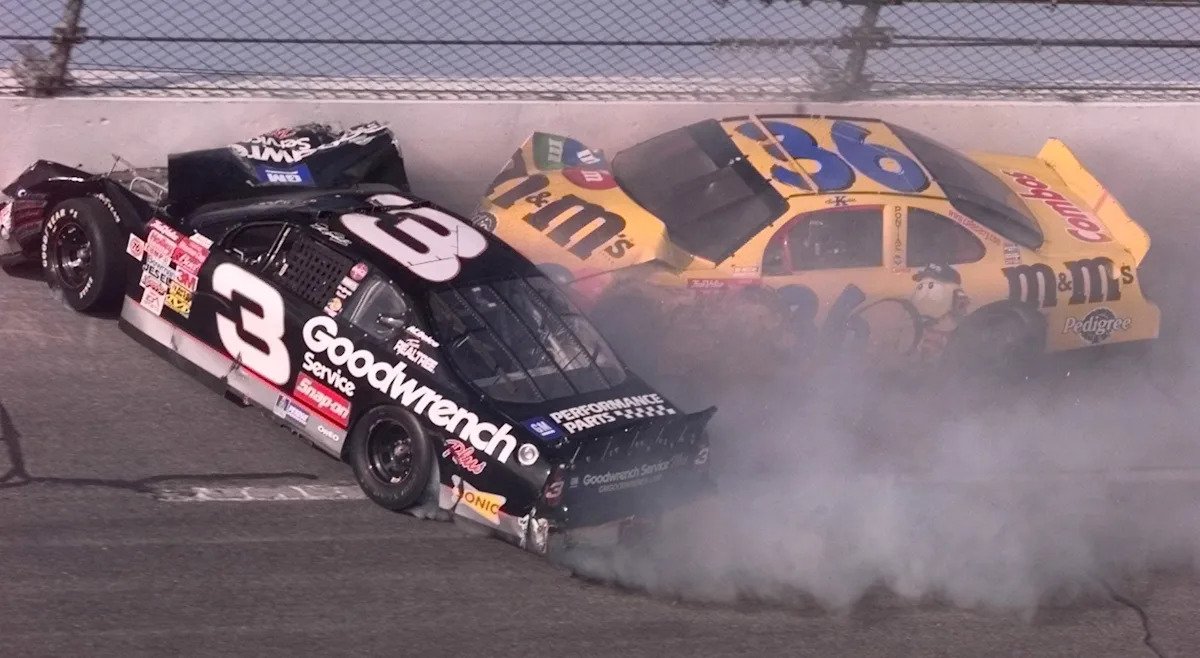
On Feb. 18, 2001, NASCAR racing changed forever when one of its biggest stars, Dale Earnhardt, died in a crash on the final lap of the 200-lap Daytona 500, known as “The Great American Race.”
On that day, in front of 150,000 fans at Daytona International Speedway and 17 million more watching on TV, Earnhardt’s No. 3 Goodwrench Chevrolet was bumped by Sterling Marlin’s No. 40 Coors Light Chevrolet, hitting Ken Schrader’s No. 36 M&M’s Pontiac Grand Prix before crashing head-on into the wall in the final turn at the famed raceway.
Advertisement
“I knew he was dead, yeah,” Schrader — the first person to reach Earnhardt’s car — told the Times-Union in early 2011, 10 years after the incident.
“I didn’t want to be the one who said, ‘Dale is dead,’ ” Schrader said. “The hardest thing I ever had to do was face Richard [Childress, Earnhardt’s car owner] in the infield care center after the crash. He pulled the curtain back and asked what was going on. I told him it was bad. He wanted to know if Dale was going to be out for a while and I looked at him and said, ‘No Richard, it’s really bad.’ I couldn’t say it.”
The 49-year-old Earnhardt died instantly from a basilar skull fracture, the Volusia County Medical Examiner’s Office would later rule. But it took NASCAR nearly three hours to announce Earnhardt’s death that day.
In 2011, to mark the 10-year anniversary of the tragedy, the Times-Union’s Don Coble wrote a series of stories on the crash, its aftermath and its place in NASCAR history. Here’s a look back at that series.


Sterling Marlin’s bump of Dale Earnhardt changed everything
The only laps Sterling Marlin makes in retirement are on a tractor at his Tennessee farm. The solitude offers a welcomed, less stressful reprieve from a NASCAR career that spanned 34 years.
Advertisement
He has time to think about winning the Daytona 500 twice. He can think about contending for the championship in 2002.
But too often, he remembers the day Dale Earnhardt died. | Continue reading
Memories of Dale Earnhardt remain fresh for friends and fans
Whether you were sitting in Turn 4 of the Daytona International Speedway or watching from your couch, the memory of Dale Earnhardt’s death on the final lap of the Daytona 500 remains vivid to a lot of people.
Everyone saw the same thing: Earnhardt’s car moving left to block the advance of Sterling Marlin; the cars touching, sending Earnhardt’s car into a spin on the apron and back across the track; the car striking Ken Schrader’s car and ramming head-first into the outside wall.
Advertisement
At first, it seemed like hundreds of other crashes. Everyone expected Earnhardt to climb out of his car, wave in approval of Michael Waltrip’s victory or shake his fist in disgust.
Nobody expected what really happened – Schrader running to the car and instantly waving for help; emergency crews using a blue tarp to hide the extrication; the ambulance leaving the scene and driving directly to Halifax Medical Center; Schrader’s ashen expression as he tried to tell Michael Waltrip in Victory Lane.
And NASCAR president Mike Helton delivering those gut-wrenching words: “Undoubtedly, this is one of the toughest announcements I’ve ever personally had to make. After the accident in Turn 4 at the end of the Daytona 500, we’ve lost Dale Earnhardt.” | Continue reading
NASCAR safer at any speed after Earnhardt tragedy
Elliott Sadler should be dead.
Advertisement
His impact with the Pocono Raceway wall last August was harder and more vicious than accidents that have killed hundreds of other race car drivers in the past. His Ford disintegrated into a thousand pieces after it plowed into the inside wall nearly head-on. The engine rolled down the track apron like a runaway train, spewing white clouds of smoke and steam.
Before the first ambulance arrived, however, Sadler already was out of his car. He sat on the track trying to catch his breath, taking a quick inventory of his senses.
Not long ago, such an impact would have been deadly. Sadler’s crash was nearly twice as violent as Dale Earnhardt’s crash 10 years ago on the final lap of the Daytona 500. But Sadler had the decided advantage of new safety initiatives spawned by Earnhardt’s death. | Continue reading
Dale Earnhardt’s death left a huge hole in his son’s heart
Dale Earnhardt Jr. won’t be bothered by a winless streak that stretches back to the 2008 season while he’s at Daytona International Speedway during the next two weeks.
Advertisement
There won’t be as much pressure to be the face of NASCAR, especially in an age when television ratings and attendance figures continue to fall. He will avoid the normal appearances that come with the biggest race of the season.
The pain of his father’s death 10 years ago on the final lap of the Daytona 500 still is too fresh, too deep.
Dale Earnhardt was a lot of things to a lot of people. He was a hero. He was a champion. He was the common man who never forgot his roots. | Continue reading
Fight over Dale Earnhardt’s autopsy photos leads to victory for family privacy
Bill Posey received more than 10,000 e-mails when he led a push in the Florida Senate to seal Dale Earnhardt’s autopsy photographs, but none more lasting than a simple and heartfelt “thank you” from Kristen Bonnett.
Advertisement
From that moment, the Earnhardt Family Protection Act was more than a matter of law for Posey. It was an obsession.
Bonnett, the daughter of stock car racing legend Neil Bonnett, already had endured the horrific pain of losing her father in an accident Feb. 11, 1994, while he practiced for the Daytona 500. But the pain for Kristen and the rest of her family was magnified by the release of photos of her dead father’s autopsy on the Internet.
Posey, a racer himself, wanted to make sure nobody’s privacy, even in death, would be violated again.
“When I heard people were lining up to get copies of Dale Earnhardt’s autopsy photos, it made me sick,” Posey said. “A family has the right to protect its dignity.” | Continue reading
Advertisement
Dale Earnhardt built an incredible marketing machine
One of the legendary tales involving Dale Earnhardt came one quiet afternoon after practice at the Talladega Superspeedway. He came to the infield media center to tell jokes with Darrell Waltrip, and anyone still hanging around became a target.
Waltrip bragged he could sign more autographs in an hour, so Earnhardt used a stopwatch to time one signature. Others computed the time into figure out exactly how many requests Waltrip could fill in 60 minutes.
Waltrip handed the pen to Earnhardt, but the seven-time champion put it down. He wasn’t going to be timed.
Advertisement
“So how many can you sign in an hour?” Waltrip asked.
“Ten thousand dollars’ worth,” Earnhardt said without flinching. | Continue reading
Pondering what-ifs: What NASCAR might look like without the fatal crash
What if Dale Earnhardt had walked away from the crash in his No. 3 Chevrolet a decade ago on the final lap of the Daytona 500?
Would NASCAR be different than what it is now?
Would drivers be as safe? Would television ratings and attendance figures continue to fall? Would his son, Dale Earnhardt Jr., be a legitimate championship contender? Would Richard Childress Racing have cut into the success of Hendrick Motorsports during the last decade?
Advertisement
Of course it’s impossible to know for sure, but these are questions many of us have asked. At 59, he’d be retired (or would he?), but we’ve all wondered during the last 10 years: “What would Dale do here?” or “Would Earnhardt have allowed that?” | Continue reading
This article originally appeared on Florida Times-Union: Dale Earnhardt’s death at Daytona: The crash, aftermath, and legacy

