Apple explicitly states that: Apple AirTags are designed to help users locate personal items using the Find My network. Apple does not market or support AirTags as a tool for recovering lost or stolen property, and the successful location of an item is not guaranteed.
If you’re a bike thief, please stop reading this article right now. For everyone else, this guide is intended to highlight a variety of products that utilise Apple’s AirTags and the Find My network to track your bike or bicycles.
Being able to track an object can be especially useful while travelling or if your bike becomes separated from you for any reason. Bicycles can be misplaced or separated from their owners in many ways, and AirTags have been a great tool for recovery, like this AirTag that led to a large-scale bike theft recovery in Vail, Colarado last year. The best bike locks, best bike storage, and good habits all help reduce the risk of loss, though none are completely foolproof.
The best GPS bike trackers, such as Apple’s AirTags, are about the size of a large coin and weigh only 11 grams. Due to their size, they can easily be attached to or concealed on a bicycle. Apple designed them to be waterproof to a maximum depth of 1 meter for up to 30 minutes, providing sufficient protection for typical cycling conditions.
I tested 6 products designed to either hide an AirTag on your bicycle or utilise Apple’s Find My tracking network. These products vary in cost, size, and complexity but provide options for people interested in adding tracking to their bicycles. For an additional layer of security, you could consider hiding multiple AirTags on your bike.
Best AirTag bike holders 2026: I tested 6 surreptitious mounts
Best Overall AirTag Holder

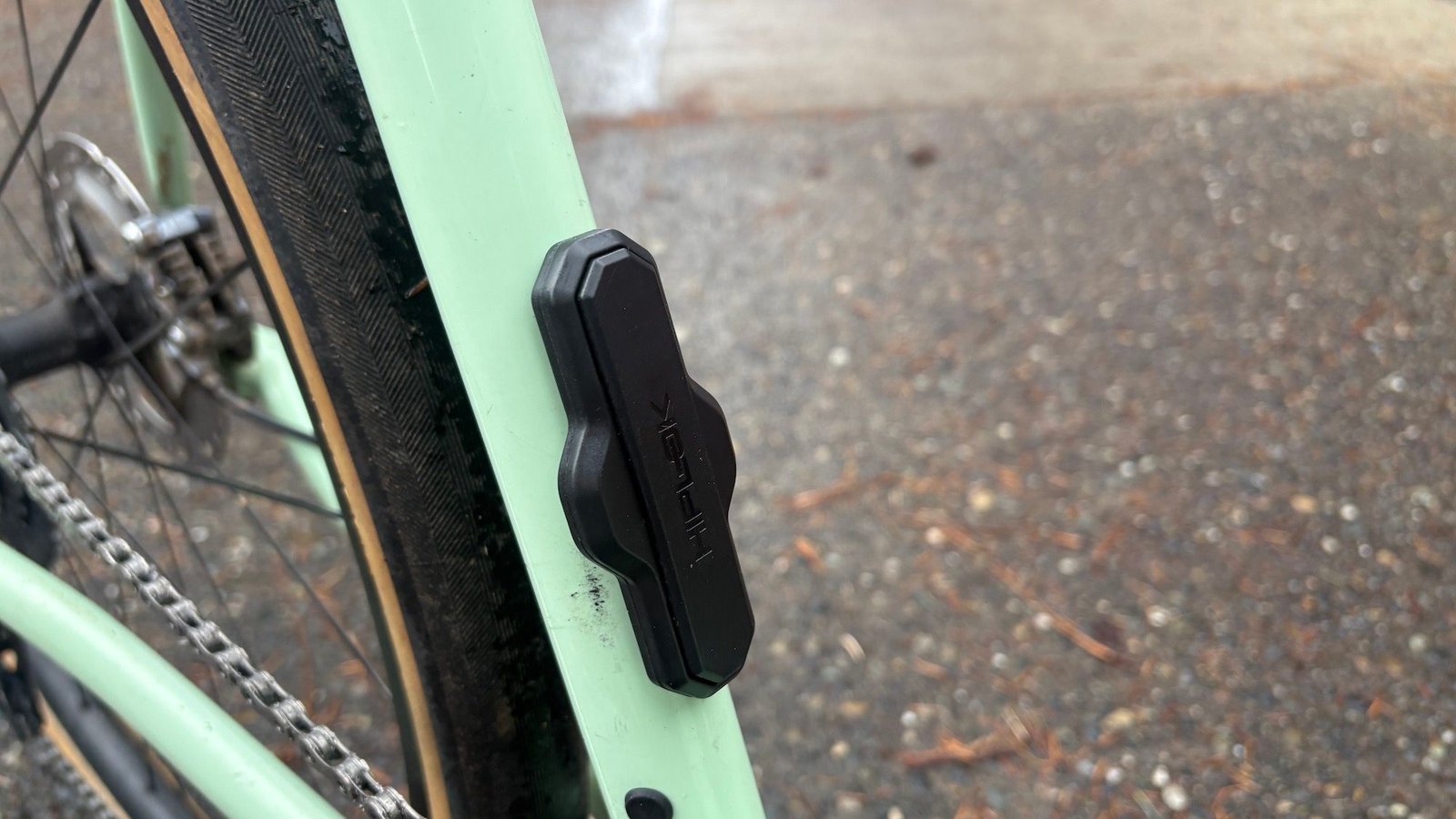
The Hiplok Track AirTag Holder can be concealed behind a bottle cage.
(Image credit: Tyler Boucher for Future)
Hiplok is a company best known for locks like the DX1000 Matt tested last year, so it’s no surprise that it offers an AirTag-compatible product.
Hiplok’s AirTag mounting bracket can be utilised with a lock mount for a very tidy, integrated system, or alternatively be mounted beneath a water bottle cage or on its own. This versatility is excellent, and the design is fairly tamper-proof with the included security bolts. The AirTag holder portion is secured by two 2 mm hex bolts, which are hidden under the mount. Removing the tracker requires several steps and multiple specific tools, and really, that’s as much as you can ask for in terms of buying time as a theft deterrent.
Mounting the AirTag holder was straightforward—I opted to hide it underneath a bottle cage. Since the entire device is a uniform thickness, it works well with any cage style and is impressively svelte.
Overall its a very well-executed design that holds an AirTag securely and can be used in a variety of applications. It’s lightweight, inexpensive and secure. The only downside is that the Hiplok AirTag holder is easily identifiable as an AirTag holder to someone looking for one.
Best for solution for road bikes

(Image credit: Tyler Boucher for Future)
The 4iiii Precision 3+ is one of our best power meters and supports Apple’s Find My network via its software. It doesn’t use an AirTag, but functions in exactly the same way. The device is a small pod permanently attached to the non-drive crank arm. It uses internal strain gauges to measure power output.
My test unit is a Ultegra 8100 non-driveside crank arm with a Precision 3+ Power Meter pre-installed, which was an easy swap, and paired with my best bike computer without trouble. Pairing the power meter with Apple’s Find My app was more challenging, however. This required me to remove and replace the battery three times in order to enter a special Apple-specific mode. Once set up with Find My, it performed flawlessly.
This is clearly very different from all the other devices I tested, which are standalone products intended to hide AirTags. In terms of functionality, 4iiii provides an excellent way to track a bike without drawing attention to itself. Because it is a power meter first and foremost, this is far and away the priciest option here.
Someone looking for a cheap, easy way to track their bicycle may not want to invest in something like this, but for those who are already considering a Power metre or upgrading an older model, it adds an extra level of functionality.
Most Concealed

(Image credit: Tyler Boucher for Future)
Muc-Off’s Stealth Tubeless Tag Holder provides an ingenious way to hide an AirTag on a bike. The AirTag compartment is located on the inside stem of a tubeless valve. As a result, it is completely hidden from view, with no external clues. Placing it inside the tyre allows the signal to broadcast without issue; however, the AirTag is in a somewhat vulnerable position. Should you suddenly experience a flat tyre, or even hit a significant bump the wrong way, it could cause the tracker to fail.
Muc-Off’s tubeless valve is one of our best tubeless valves but is fairly standard offering. Also does however, included different rubber gasket shapes to suit a variety of rim shapes and, are available in multiple lengths.
It’s a little tricky to assemble, but once it’s assembled, it shouldn’t need to be disassembled until the AirTag battery runs out. A hard plastic disc separates the AirTag from the valve, and a pink rubber top fits over the entire capsule, sort of like a shower cap. It is a a great concept and I found It worked very well.
There are some limitations to the sneakiness of the system. The holder’s size, it will only work on tyres over 38 mm and, It doesn’t work with tyre inserts or bikes with tubes. As well, Muc-Off specifies that the AirTag holder should only be installed on a rear wheel, presumably so that it doesn’t interfere with steering should anything go awry.
Best integration with a light

(Image credit: Tyler Boucher for Future)
Concentric Cycling is a small manufaturer that specialises in 3D-printed cycling mounts and accessories to solver all manner of cross-compatabilty, that normally wouldn’t be possible.
Rear-facing radars, such as the Garmin Varia RearVue 820, have become more and more popular. One shortfall of many of these systems, however, is the lack of refinement of the stock mounts that come with them, espcially when used with aerodynamically shaped seatposts. Concentric’s design, made of carbon nylon, is sleek and well-executed. It works very well with the Varia radar unit, in my opinion, and houses a special compartment tucked between it and the clamp for your AirTag.
This little drawer hides the AirTag unit, which can pop in and out without tools or removing the mount. This makes it easy to use, but sadly not very secure. I would prefer it if the whole mount needed dissassembling in order to get at the tracker.
Overall its a well-executed mount that can be used with a variety of seatpost shapes and sizes, as well as a number of different lights and radar systems.
Best integration with a bottle cage

(Image credit: Tyler Boucher for Future)
The Lezyne Matrix Air Cage is a bottle cage with an integrated AirTag chamber stealthily tucked in the base. The AirTag needs to be installed before mounting the cage, which adds a layer of security, as it would require fully removing the cage to access the tracker.
The cage itself functions exactly as it should, allowing a bottle to be placed into it easily from either side. I had no issues with bottles being lost during testing. The mounting holes allow for some slight adjustment, and special Torx security bolts are included with the tool to fit them. Because the AirTag compartment is placed against the frame, the cage may not fit on all bikes. One of my bikes, for example, has a front derailleur band clamp, which sits between the cage bolts, and unfortunately, the Lezyne cage doesn’t play nicely with that at all.
Lezyne sent a single cage for testing, which was more than adequate for assessing it; for aesthetic reasons, though, I like my cages to match. You could pair it with a standard Lezyne Air Cage, or, for optimal security, use two of these cages with AirTags installed in both and affix them with different types of security bolts. This way, a would-be thief will need more time and tools to remove the trackers.
Overall, the Lezyne Air cage is a functional bottle cage that also houses an AirTag. It’s an easy-to-use product that offers a reasonable amount of security against a tracker being quickly removed. It’s not the most aesthetically appealing bottle cage, likely a little chunky for a higher-end bike.
Hiding in plain sight

(Image credit: Tyler Boucher for Future)
Rockbros offers an impressively (actually, incomprehensibly) wide variety of bicycle accessories, including, by my count, seventeen different bicycle bells. This particular bell is unique in its integration of an AirTag-sized compartment tucked between the bell’s dome and the handlebar mount. Installing the AirTag is very easy, as it only requires unthreading the bell from the base; however, the flip side is that it is equally easy for someone to remove the AirTag in the same way.
The bell itself has a good tone and functions as it should, though it feels cheap; however, given its cost, I guess this is to be expected.
Instead of producing a single product that fits multiple handlebar sizes, which seems like a more straightforward option, Rockbros instead offers multiple, size-specific products. You can choose a clamp designed for either 22.2 or 31.8 mm bars, but it cannot be swapped between the two. The test bell Rockbros provided was sized for a 22.2 mm bar, which is not compatible with any of my drop-bar bikes. I was able to test it on a cargo e-bike, where it came in handy, alerting pedestrians to my presence.
On the street, most passersby are unlikely to notice the hidden compartment, making it a relatively sneaky way to hide an AirTag.
Also tested…
- Topeak Cage Mount for AirTag ★★★☆☆- While the Topeak and the Hiplok, which I awarded best overall, are very similar, near identical from the outside, Hiplok has managed to make theirs work with a bottle cage, which immediately makes it more usable.
- Knog Scout ★★★★★- The Scout wasn’t part of my test, but it is worth mentioning as it utilises the Find My network; however, it boasts additional features such as an alarm, is rechargeable, and is rated as our best overall GPS bike tracker.

(Image credit: Daniel Palma)
How I tested AirTag holders
As with all the products we review here at Cycling Weekly, our primary focus is on a product’s functionality. For the best AirTag holders, I considered ease of use, the mount’s security, and how well each product disguises its function. I also tested each product and its placement to ensure it didn’t interfere with an AirTag’s signal. This is easily done with the ‘Precision Finding’ within the Find My app.
For products with additional purposes, I also tested the use of those functions to ensure they performed as expected. This is not an exhaustive list of every product on the market, but it includes many of the most popular options and assesses their functionality.
To test functionality, I used all three tools available to anyone via the Find-My app. First of all, using the ‘churp’, or sound emitted by AirTags, to see if any of the mounts muffled the sound. Secondly, the Precision Finding tool, heading away from where I left my bike and using the arrow to find its exact location. Finally, the tracking location: I stood still while someone moved my bike around to check for live tracking and updates.
For more information on how we test, visit our comprehensive guide.
Meet the tester

Tyler Boucher
I have experience testing nearly every type of cycling product available, many of which I have reviewed directly for Cycling Weekly. Prior to this test, I would always stash an AirTag in my saddlebag to track my bicycles, either for their security or so my family knew where I was. I found that when travelling by air, Apple’s Find My app becomes invaluable for keeping an eye on where your bike is and whether it made it onto the plane.
How to choose the right AirTag holder for you
There is no denying that bike thieves are becoming more savvy; the use of angle grinders is a good example. Quick, fast and, as Tech Writer Matt pointed out, when he tested the best angle-grinder resistant locks, they are also often stolen.
Stealth: It’s everything when it comes to hiding anything that could allow you to track your bike. Thats why all the mounts that scored well in this guide really offer high levels of secrecy, be that because they are well hidden and offer no clues, like the Muc-Off or if they hide in plain sight, like the RockBros Bell.
Compatibility: The biggest hurdle for many will be compatibility with your bike and the accessories you choose, which can be adapted. For example, if you use bottle cages, mounting the Knog underneath or using the Lezyne cages is an easy swap or upgrade. Again, very similar if you use a bell, or a rear radar light, very easy swaps. It gets more complicated if you aren’t running tubeless tyres or a power meter, of course, but relatively easy if you are already.
Accessibility and battery life: Worth considering how easily the AirTag is to replace its battery. While for many, that will be infrequent, roughly every 6-12 months, if you’re not handy with tools, the simpler solutions are, of course, those like a light mount or bell. Just remember, these are also easier to locate if your bike is stolen. Largely, they are a set-and-forget unit, with prompts from Apple when the battery is running low. For example, the Muc-Off valve solution, every 6-12 months, is a good time to top up your best tubeless sealant anyway.
Frequently asked questions about Apple AirTags
How do Apple AirTags work?
How does this tracking system work, exactly? According to Apple, “Your AirTag sends out a secure Bluetooth signal that can be detected by nearby devices in the Find My network. These devices send the location of your AirTag to iCloud—then you can go to the Find My app and see it on a map. The whole process is anonymous and encrypted to protect your privacy. And itʼs efficient, so thereʼs no need to worry about battery life or data usage.”
Each Apple account is limited to 32 AirTags, so if you own more than 32 bikes and wish to track them all, you’re sadly out of luck.

(Image credit: Apple)
What are the shortcomings of AirTags?
There are some additional shortcomings: The entire system only works when AirTags are in reasonably close proximity to Apple phones, and can be easily thwarted by simply staying away from Apple’s network or by removing the batteries from the tracker. Despite Apple’s claims, battery life is finite, and though batteries can be easily replaced, you need to keep an eye on each AirTag’s battery health. Expect roughly a year of use. One of the most significant issues is the lack of signal strength—AirTags that are enclosed inside dense materials (metal, thicker carbon) won’t be able to transmit their location. Thus, hiding one inside a bicycle doesn’t work as well.
Should I put an AirTag on my bike?
I can only speak from personal experience, but I have found having an AirTag on my bike invaluable, espcially when travelling with my bike. I am able to keep an eye on it even when I know I have to relinquish control over it at the Airport and during transfers, for example.
It’s also a useful tool for finding your bike at busy transport hubs or in unfamiliar surroundings, without needing to remember exactly where you left it.
I am fortunate to have never had to use one to find a stolen bike, but given the positive news stories about how often bikes are found using the technology, it certainly adds another layer of protection and a good chance of recovery if used correctly.
How long does an AirTag battery last?
Like anything that utilises a battery, espcially one as small as the one found in AirTags (CR2032), it depends on how often you’re using it, or, in this case, the Find My app to locate it, and the conditions it’s regularly stored in.
Regular use will drain the battery more quickly, with many suggesting it will last between 6 and 12 months. For me, it is much longer; I rarely use them day to day and regularly get significantly more than that. I have previously removed them from my bike when not in use and stored them indoors.
If you store them on the bike outdoors, particularly where I live in the PNW through winter, you can expect them to drain the battery much more quickly.

