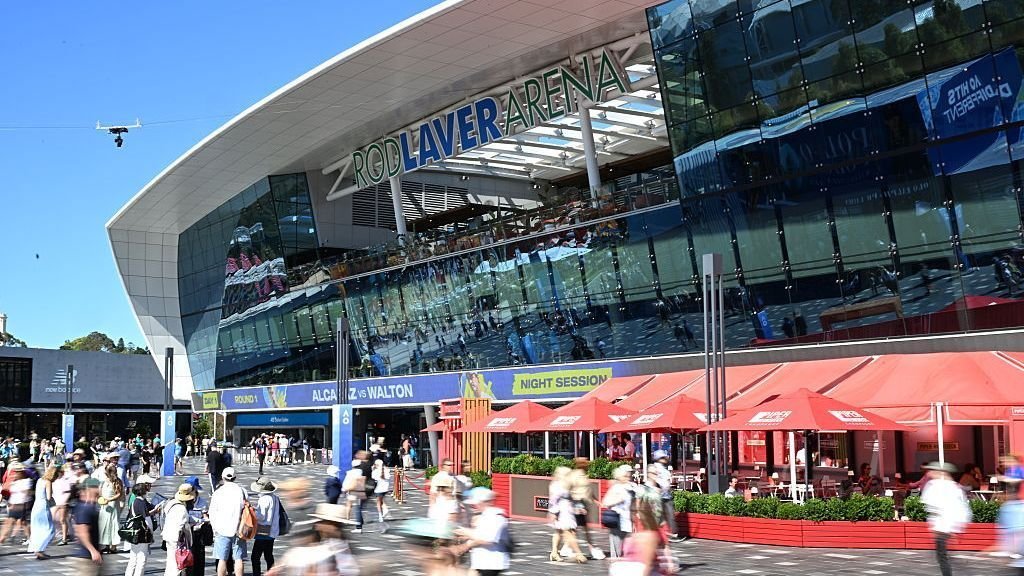
MELBOURNE, Australia — Just how much prize money will the best tennis players on the planet share in at the 2026 Australian Open?
An eye-watering AU$111.5 million (US$75 million) will be dished out during the 15-day tournament at Melbourne Park, marking a sharp 16% increase on last year’s prize pool. This year’s Australian Open will now feature the second-highest prize purse in Grand Slam history, trailing only the record AU$134 million (US$90 million) on offer at last year’s US Open.
The 2026 men’s and women’s Australian Open singles champions will collect cheques for AU$4.15 million (US$2.7 million), runner-ups are set to take home AU$2.15 million (US$1.4 million), while semifinalists and quarterfinalists pocket AU$1.25 million (US$835,000) and AU$750,000 (US$501,000), respectively. But how about those who won’t feature in the second week? You know, the players who don’t often take any of tennis’ spotlight and will likely be competing in front of just a handful of spectators on the minor show courts. What sort of potential life-changing pay day awaits them?
Once again, upping the remuneration of these players has been a major focus for Tennis Australia. First round losers at the 2026 Australian Open will cash AU$150,000 (US$100,000), while a second round appearance at the year’s first tennis major guarantees at least AU$225,000 (US$150,400).
The rapid growth in tennis tournament prize money over the past decade has been impossible to ignore, with purses consistently rising and new records set year after year. At the 2016 Australian Open, the entire prize pool was AU$44 million (US$29 million), almost a third of what it has swelled to today.
That year, singles winners Novak Djokovic and Angelique Kerber received cheques for AU$3.4 million (US$2.2 million), a somewhat similar 82% of what this year’s champions will take home. However, first and second round losers cashed just AU$38,500 (US$25,700) and AU$67,000 (US$44,700), respectively, 26% and 29% of what’s on offer these days.
Significantly increasing the pay days of those not necessarily fighting in the second week for tournament silverware is what allows the tennis circus to roll on and for deep fields to be assembled. Without it, many players simply couldn’t afford to cover the rising costs associated with being a professional athlete competing around the world.
“This increase demonstrates our commitment to supporting tennis careers at every level. We’re ensuring professional tennis is sustainable for all competitors,” said Tennis Australia CEO Craig Tiley ahead of the tournament. “The prize money uplift is part of Tennis Australia’s $135 million investment across the summer of tennis, reinforcing the commitment to support hundreds of professional athletes’ careers.
“This investment strengthens tennis’s foundation, ensuring the sport’s long-term health and commercial growth. By supporting players at all levels, we’re building deeper talent pools and more compelling storylines for fans.”
Prize money at the 2026 Australian Open:
Men’s and women’s singles:
Champion: AU$4.15 million (US$2.7 million)
Runner-up: AU$2.15 million (US$1.4 million)
Semifinalists: AU$1.25 million (US$835,000)
Quarterfinalists: AU$750,000 (US$501,000)
Fourth round: AU$480,000 (US$320,000)
Third round: AU$327,750 (US$220,000)
Second round: AU$225,000 (US$150,400)
First round: AU$150,000 (US$100,000)
Men’s and women’s doubles (per team):
Champion: AU$900,000 (US$600,000)
Runner-up: AU$485,000 (US$324,000)
Semifinalists: AU$275,000 (US$184,000)
Quarterfinalists: AU$158,000 (US$105,000)
Third round: AU$92,000 (US$61,500)
Second round: AU$64,000 (US$43,000)
First round: AU$44,000 (US$29,400)
Men’s and women’s qualifying singles:
Third round: AU$83,500 (US$55,800)
Second round: AU$57,000 (US$38,000)
First round: AU$40,500 (US$27,000)

