MIAMI GARDENS, Fla. — Moments before kickoff here, while on the podium during ESPN College GameDay’s live segment, Nick Saban offered millions of people watching from home his theory on the Big Ten’s most recent dominance of this sport.
In short, Saban attributed the Big Ten’s latest success to its schools using the loosening of athlete-compensation rules to coax Southern athletes — traditionally staying nearby in the SEC — to move north of the Mason-Dixon Line.
Advertisement
“You’ll never convince me otherwise,” Saban said, “because people in the South would not go to the North unless you paid them.”
Twisting in the knife, Saban then slipped on the hat of the team he predicted would win it all: Miami.
Four hours later, as red and white confetti rained from the skies of Hard Rock Stadium, the Indiana Hoosiers, of all programs, perhaps the most unlikely champion in decades given their past doldrums, a basketball school in the Midwest, beat up on one of those Southern programs to win the national championship.
And, in doing so, the Hoosiers — a confounding 16-0 two years after finishing 3-9 — delivered the Big Ten (those Northerners!) a remarkable and unexpected third consecutive title for the first time in 73 years.
Advertisement
“People down South … they play some great ball and they’re very physical,” Indiana offensive lineman Carter Smith said afterward, “but, you know, some people just need to open their eyes and see what’s going on up here.”
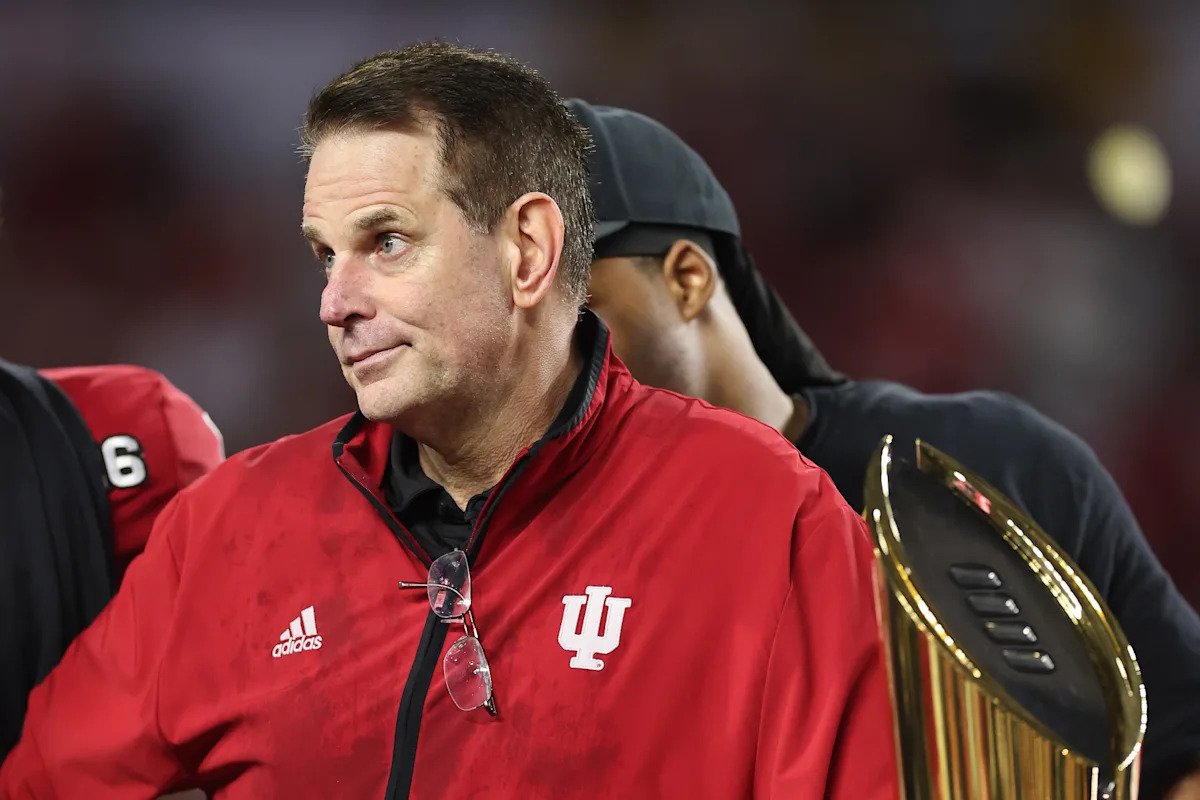
Indiana head coach Curt Cignetti has turned a historic losing program into a national champion in just a two-year span.
(Carmen Mandato via Getty Images)
Up here? The land of cornfields and cattle. Motown and deep-dish. The Great Lakes and the Breadbasket. The Motor City and snowplows.
This is a place of hardworking, blue-collar folks who say things like, “You betcha” and “Uff da!” They slurp “pop” with their cheese curds and, on many weekend nights, get “schnockered” on some of the best beer you’ll ever drink.
But on this Monday, in one of the deepest geographically southern places in America, amid a perfect 60-degree day (a brisk summer night for Midwesterners), Indiana, the place of farmland and fall foliage, polished off one of the most dramatic turnarounds in industry history.
Advertisement
“College football has changed quite a bit, the balance of power also,” Indiana coach Curt Cignetti said at the postgame news conference here.
Perhaps a new villain of college football is emerging — a conference so dominant that many nationally shake their fists in fury.
While the SEC failed to advance to a national championship game for a third straight year, the Big Ten three-peated — a stunning about-face in college football’s pecking order. A league that won three titles in 25 years, from 1997-2022, has claimed a trio.
“Just maybe another conference isn’t all superior in all the land,” says one Big Ten official, a jest at the SEC. “Just maybe!”
Advertisement
Afterward, Big Ten officials, flooding the field in celebration, held up their ring, middle and index finger.
Three.
Michigan. Ohio State. And, the least likely of them all, Indiana.
The last three football national champions derive from contiguous states inside a 300-mile radius mostly incorporating southern Indiana, central Ohio and southeastern Michigan.
“It’s unbelievable,” Big Ten commissioner Tony Petitti said. “It means so much for Indiana, but it means a lot for the entire league. What Indiana has done in two years, I’ve never seen anything like it in all of the years I’ve been in sports.”
Advertisement
Said Petitti about the Big Ten’s three titles: “I feel like we’re just getting started.”
To put the Big Ten’s stretch in perspective, consider this: The last time the league won three straight football titles, the Nazis were gearing up for a takeover in Germany, the Manhattan Project began developing the atomic bomb and the iconic film Casablanca premiered.
In fact, it was so long ago that the Ohio State team that capped the three-year run in 1942 beat that season an independent football club called “Iowa Preflight,” and the Buckeyes’ only loss that year was attributed to a mass outbreak of an intestinal disorder from players drinking unsanitary water from a fountain.
You betcha, the Big Ten is back!
Advertisement
“It’s Tony Petitti! He’s our guy!” Indiana athletic director Scott Dolson screamed with glee into a reporter’s recorder.
Dolson’s quote came with intent, directing praise to a man who for many months now has been the target of national criticism for ideas (not all his but the league’s as a whole) that often rattle cages: a 24-team playoff format and the pursuit of private-equity, just to name a couple.
Some might say that Petitti is the bull and college sports is the china shop. But behind him is a league of administrators who are supporting and encouraging the decisions.
And now before him on the field is yet another one of his schools winning it all.
Advertisement
“The Indiana story. I don’t think there’s anything else that’s been like this,” Petitti said. “What it means for Indiana and the fans … the transformation around this. Look at the turnout and what happened in the Rose Bowl, in Atlanta and what we’ve seen tonight.”
Despite playing in its opponent’s home stadium, Indiana fans — its red-clad legion — out-numbered Miami fans nearly 2-to-1.
Afterward, Dolson stood shocked.
“I can’t believe it,” he barely uttered out of his mouth.
Five years ago, Dolson and school president Pamela Whitten made a decision: Indiana must be good in football. Whitten said the staff “realigned the whole athletic department” and raised funds to transition to the world of NIL, the transfer portal and revenue sharing.
Advertisement
The final piece happened two years ago, when the school spent $15 million to fire Tom Allen and replace him with the 60-something-year-old coach from James Madison.
“We happened to hire the best coach in America,” said Whitten, herself a southern lady, raised in Tennessee and educated in south Louisiana. “Indiana is the best university in the country and now we have the best football team in the country.”
The best school, the best coach, the best university.
The biggest alumni base in the country, too (more than 800,000).
Cignetti, his players and this crew of administrators managed to turn the losingest program in college football into the most winning in the last two seasons: 27-2.
Advertisement
“It was because there wasn’t an emphasis on football,” Cignetti said afterward, explaining IU’s history. “Basketball school. You got to be good in football nowadays. We’ve got a president that comes from the South who loves football and an AD who is a tremendous fundraiser and the largest alumni base in the country.”
There’s one thing that Cignetti would like to get off his chest, too, he says.
In a comment maybe directed at his former boss, Saban, or others who point to cash as a reason for the success, the coach quipped, “Our NIL is nowhere what people think it is, so you can throw that out.”
Is the Big Ten back?
Advertisement
You betcha.

