Are we about to see airbags deploying under riders’s clothing when they crash? The technology currently being developed by Belgian company Aerobag has been gaining attention of late, and the company’s co-founder and business development manager Quinton van Loggerenberg has now confirmed that both PicNic Post NL and Visma Lease a Bike are ready to start testing.
“I can confirm that Visma Lease a Bike will take delivery of AeroBag systems this week.” Van Loggerenberg told us. “The team has been involved with our project very closely and supported us from our prototype development stage.”
Nalini are set to be the first brand to market an AeroBag-certified product, with at least two others to follow. According to Van Loggerenberg, “The other partners are working very closely with WorldTour teams they supply – the demand is very much driven from within the WorldTour.”
Part of the airbag system is designed to sit on the rear of the bib-shorts
(Image credit: AeroBag)
The catalyst for change
There’s no doubt that bike racing can be dangerous. As riders are exposed to technical courses raced in close proximity at breakneck speeds, crashes are part and parcel of the sport.
When there’s a touch of bars, a slamming on of brakes or a mistimed corner, the results can be anything from skin abrasions to broken bones. The UCI made the wearing of helmets mandatory in 2003, but much of the rest of a rider’s body has nothing more than millimetre thin lycra covering it.
That might however be about to change. Leading the development of a production-ready airbag system for cycling is the Belgium-based company AeroBag. Their kit gained a lot of attention at the recent Velofollies trade show in Belgium, but could now be fast-tracked to market thanks to clothing giant Nalini.
The Italian company has got significantly behind the new tech, and has said it will offer an AeroBag-certified bib short model before summer 2026. One year earlier than planned, we’re told.
Adoption, especially at pro level, is one of the biggest barriers to success for any new technology, so this partnership could represent a turning point for the kit, and potentially result in the most significant development in cycle safety since the mandatory introduction of road bike helmets.

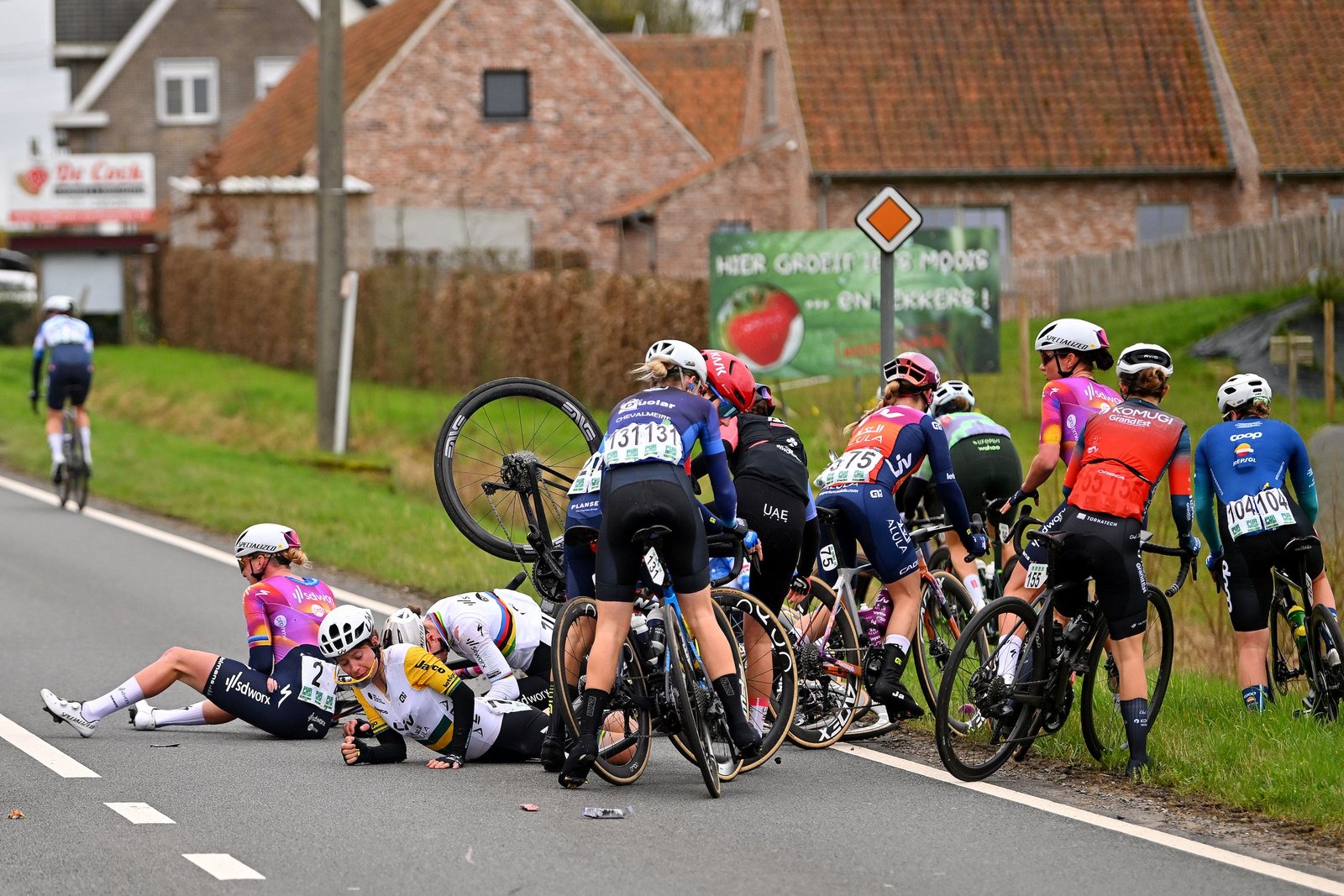
Crashes are all too common in the peloton
(Image credit: Getty Images)
The idea that sparked the AeroBag was the tragic crash of Bjorg Lambrecht, who died following an incident during Stage 3 of the 2019 Tour de Pologne. One of AeroBag’s founders, Bert Celis, was conducting aerodynamic testing with Bjorg just a few days before the race, and news of his passing deeply affected his outlook on the future of cycling and the industry as a whole.
The tragedy led to Bert’s resignation from the Wind Tunnel Project, which he had started in BikeValley, Belgium, and kick-started his quest to find a better way to make races and riders safer. AeroBag was founded by three members: Quinton Van Loggerenberg, Robin Deleener, and Sam Ratajczak.
The project drew interest from Fundracer Capital, a firm founded in 2024 by bike industry stalwarts René Wiertz, Gérard Vroomen, and Andy Ording. Fundracer joined at a crucial point in the start-up phase after evaluating six other airbag companies for potential investment. The rest, as they say, is history.
“Airbags just work; they are in everything else because they provide significant protection for the worst possible case accidents,” said van Loggerenberg.
“The real trick is making them small enough, light enough, and comfortable enough to wear. The analogy of the helmet, in fact, comes to mind – the helmet does make your head hotter, it does weigh a bit, it is awkward to carry, wear, and often not exactly cool to look at, but that one time you really need to protect your head, they work. So every other ‘compromise’ or excuse to not wear one is irrelevant, and we believe the AeroBag will become widely used and follow the same philosophy.”

Aerobag is designed to be light and unobtrusive
(Image credit: AeroBag)
WorldTour debut, rider and UCI buy-in
Asked when we can expect the AeroBag to make its WorldTour debut, Van Loggerenberg was optimistic about its imminent arrival, but many processes must align to fast-track its adoption into the pro peloton.
“We are in active consultation with UCI and fully support their efforts to protect their athletes. Racing use depends on this partnership between the UCI, AeroBag, and the apparel partners. This process has been underway for some time, and I fully expect rapid progress among partners on this critical safety issue. We are only one part of a sport-wide initiative to make the peloton safer.”
A lot of questions hinge around its reliability – and the reality of comfort concerns, including accidental deployment during races.
CW says ….
There are plenty of other questions still to be answered. Perhaps the most obvious being, will pros actually sign up to wear the system? They will want to know how it feels to wear, what happens after it has deployed in the event of a crash, and what is the risk of false deployments. Something that could result in a crash in the middle of a nervous peloton.
But, with at least two pro-teams now working with the companies making this tech, and Nalini signed up to make kit that works for the public, we could be at the start of one of the most impactful safety developments in cycling for years. If the UCI deems it safe and pros do adopt it, will it then be mandatory in racing, as helmets now are?
We also need to consider the knock-on effects of safety gear aimed at cyclists. The act of riding a bike is not dangerous. Racing is more dangerous of course, but when riding on the open road the main danger facing cyclists is the action of those driving cars, or other vehicles. Placing the onus on cyclists to protect themselves is victim blaming, a point of view which can have a detrimental effect on road safety as it ignores the role of drivers and infrastructure.
Adam Hansen, president of the Cyclistes Professionnels Associés, (CPA) and board member of the UCI SafeR committee will be pivotal when it comes to adoption by the pro peloton.
“As a former rider, I would ride with a system like this if it were comfortable, didn’t affect my riding, and it worked. I would definitely use a system like this – who would say no to that?”
“For the riders to use this, it needs to be done very carefully and should be voluntary at the beginning, because we need to work out the protocols and systems to be put in place for such a system.”
“For example, what happens if there is a mass crash and your airbags have deployed – can you continue the race, or must you wait for a new system? And what happens if there is an accidental/faulty deployment? These protocols need to be defined before you make something like this mandatory,” Hansen explains.
Van Loggerenberg, however, is confident in the product, its electronic and software algorithms, and assures us that rider safety should come first.
“The system triggers via an algorithm and the sensors. Triggering the AeroBag does not damage clothing or disrupt the rider. In fact, in testing, riders just keep pedalling; the deployment does not cause any accidents, or even affect the rider’s ability to just keep going or stay upright.”
Hansen also has concerns about the AeroBag’s impact on the racing narrative, particularly at pivotal moments, including Grand Tours.
“Let’s say you have a crash 10-15km from the finish and you need to get up quickly and get back to the peloton through the convoy as fast as possible. If you have to wait 2-3 minutes to repack the system, or change it, or get the okay from the doctor; this could be a disadvantage for such a system.”
“But, if it improves safety, it’s comfortable, and it doesn’t interfere with the way you ride, then it will be welcomed – there are riders interested in something like this. In fact, I’ve had riders write to me and send me links to airbag companies.”

The airbag system is getting a lot of attention
(Image credit: AeroBag)
The trickle-down effect – AeroBag bib shorts is just the starting point
While high-performance sports have always been the starting point for technological innovation, these breakthroughs eventually filter down to the consumer, if airbags take off in the pro-peloton, and work, it won’t be long before we see them on the roads.
“We are already seeing development of commuter jackets, for example, and MTB/downhill/gillet/vest/aerosuit/triathlon solutions. Bib shorts are easy and quick to get off the line, but jacket/backpack/gillet/shell concepts are already being worked on in studios.”

(Image credit: AeroBag)

