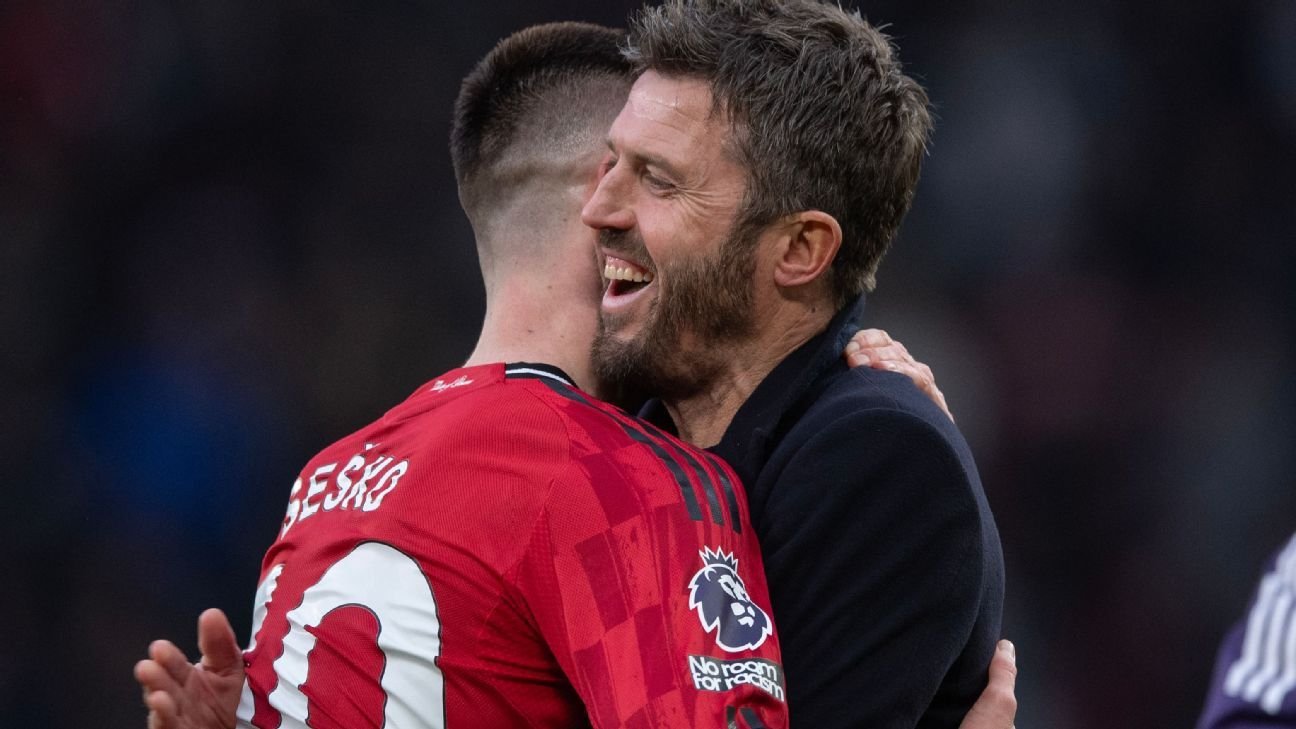
It is too early to talk of a “red revival” or the end of the bad times for Manchester United, but something interesting is happening under the guidance of interim coach Michael Carrick. Three wins in three games, including a Manchester derby and a 3-2 thriller at Arsenal, have changed the mood at a previously downbeat Old Trafford. And while Sunday’s win over Fulham was a little less convincing, United triumphed in the kind of dramatic finish that was a regular fixture in the trophy-laden Sir Alex Ferguson era.
United fans are daring to dream again — a win over Tottenham on Saturday would edge them closer to a long-awaited five-game winning streak — but you suspect few are ready to crack open the champagne. The question is whether the uptick in performance is the result of a new manager bounce, or the start of something bigger and sustainable. One thing is certain: Carrick, 44, whose sweet midfield passing was at the heart of five Premier League title wins under Ferguson, seems to have pressed the right buttons with a squad that often looked lost during the Ruben Amorim era.
– Dawson: Grab your popcorn: it’s City and Arsenal in the Carabao Cup final
– Marcotti: Why Liverpool’s January transfer window makes no sense
– Ogden: Stick with Carrick? Hire another coach? Man Utd must decide now
Amorim, a devotee of the 3-4-2-1 system even when it seemed ill-suited to the players, left the club with the worst goals-per-game and lowest percentage of clean sheets of any manager in United’s Premier League history.
Carrick could hardly be more different. You sense his arrival was welcomed by players who respect what he did as a United player, and appreciate how he understood that expectation levels at Old Trafford can make that shirt seem heavy. Where Amorim called the players out publicly, calling his squad “possibly the worst team in United’s history,” Carrick brings a cool demeanor. His expression behind the stubble rarely changes as he stands in his smart overcoat on the sideline. His news conferences tend to be calm and low-key, with straight answers. Unlike Amorim, he doesn’t generate silly headlines that put United at the center of a new soap opera.
Players watching those news conferences will have been impressed that their leader gives an ego-free, professional performance. Yet more than that, Carrick has made some important tactical changes.
Chief among them, he has dispensed with Amorim’s ill-fated system to revert to a back four with two defensive midfield players, and a fluid front four. This has crucially allowed the captain and United’s most dangerous player, Bruno Fernandes, to play far closer the opposition goal, where he can do more damage. Witness the dummy he sold to Fulham’s Calvin Bassey before setting up the stoppage-time winner for Benjamin Sesko last weekend.
The abandonment of the wingback idea also gets the best of the menacing Amad Diallo, who was required to do too much defensive work under Amorim. Now Amad can play as an out-and-out winger creating trouble at the other end of the pitch.
Carrick has also rescued Kobbie Mainoo from the footballing Siberia to which he had been banished under Amorim. It had looked like the young England international would be transferred to another club, but he is happily back in the fold, bringing extra class into the center of midfield.
The interim boss has also recalled Harry Maguire to marshal his back four, and switched Luke Shaw to his natural home at left back. Having Lisandro Martínez fit again to play alongside Maguire has helped too.
Bryan Mbeumo, so proud to be a United player, seems happy to play as a fluid “false No. 9” at the top of Carrick’s new-look team, while Matheus Cunha brings an X-factor, as his two excellent goals demonstrate.
United’s attack is working. Under Carrick, they have scored eight goals in three games and only trail the top two in the scoring charts.
In essence, Carrick has simply put round pegs in round holes and let the players perform. Common sense has prevailed.
That is not to say Manchester United are suddenly world beaters, or that they can climb from fourth place into the title race. This team is not ready for that. Even finishing in the top four and qualifying for next season’s UEFA Champions League will be a tall order, with Liverpool, Chelsea and Aston Villa all in the mix.
United have a need to get a defensive midfield player with aggression, a big engine and decent creative instincts too. Someone like Crystal Palace‘s Adam Wharton or Elliot Anderson of Nottingham Forest.
Bottom line: United and Carrick have proved nothing yet. But they have established a launch pad to get back into the Champions League, which must be the aim this season.
If Carrick can complete that mission, his case to land the job permanently will be strong. He served a long apprenticeship and did a pretty good job at Middlesbrough, and now he is working with better players. He is no rookie.
Should United slip back into their old mediocrity between now and May, they know some high profile bosses are likely to be available in the summer, chiefly the current England supremo Thomas Tuchel or perhaps someone like Cesc Fabregas, who is doing impressive work at Como in Italy.
Will Carrick rescue his old club from the traumas of recent seasons? United fans will hope so, but do they believe?

