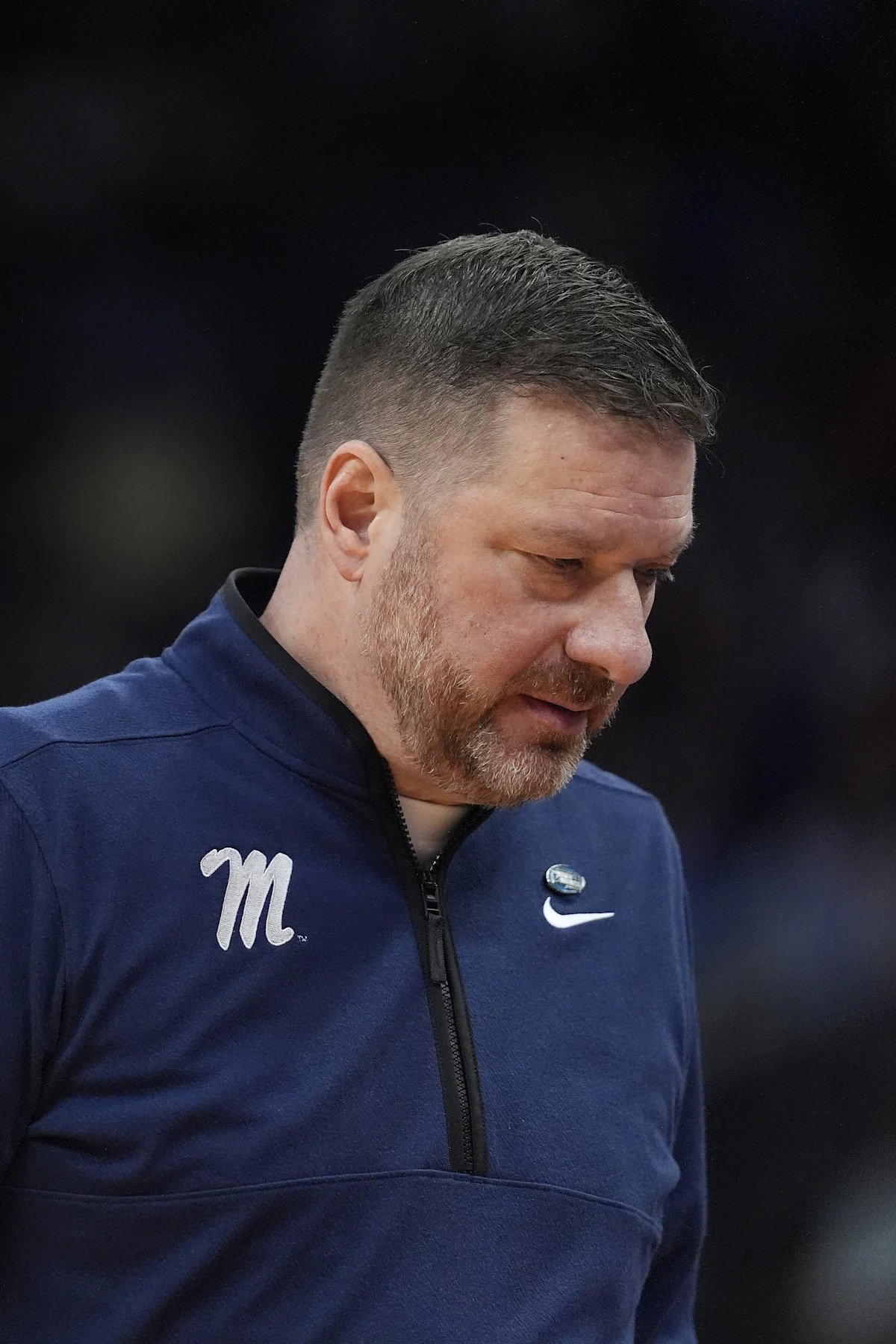
AUSTIN, Texas — Welcome back, Chris Beard.
Oh, okay then.
We’ve certainly seen Beard’s stripes before — literally and figuratively — as the disgraced former Texas Longhorns head coach returns to the Moody Center on Saturday with his Ole Miss Rebels for the first time since he was fired a little more than three years ago following his felony domestic violence charge.
Advertisement
Since the Rebels made the shameful decision to hire Beard months after his for-cause termination by the Longhorns, he missed the NCAA Tournament in his first season in Oxford before leading Ole Miss to the Sweet 16 last year, falling just short of a trip to the Elite Eight in a three-point loss to No. 2 seed Michigan State.
Beard was named the 2025 Jim Phelan National Coach of the Year award as the Sweet 16 appearance tied the deepest tournament run in program history.
But after turning over the senior-heavy roster from last season, the rebuild hasn’t gone smoothly for Beard. Currently 12th in the SEC with a 3-6 conference record thanks to four straight losses, Ole Miss is reeling after an 18-point road loss to Tennessee on Tuesday that featured a trademark Beard moment — a red-faced temper tantrum on the court that earned him an ejection.
Beard was upset with the discrepancy in foul calls and free throws, but perhaps he should opt for some accountability with his team, instead — the Rebels rank 315th in opposing free-throw rate thanks to an apparent fouling virus similar to the one plaguing the Longhorns.
Advertisement
The inability to defend without fouling isn’t the only fatal flaw with the Ole Miss defense because Beard’s team is also extremely poor at ending possessions with a rebound, producing an adjusted efficiency that ranks No. 72 nationally, at odds with Beard’s historic success fielding hard-nosed defenses and all the more remarkable because his coaching staff features longtime assistant and defensive guru Mark Adams for a second straight season.
Less surprising is the offensive mediocrity of the Rebels, who play at a slow pace, don’t take many threes, and often rely on one-on-one basketball. Like Texas, Ole Miss doesn’t turn the ball over, but is much less efficient — Beard’s team doesn’t shoot the ball particularly well from anywhere and doesn’t crash the offensive glass.
The scoring depth isn’t there compared to last season, although transfer guard AJ Storr has bounced from back his mediocre season last year at Kansas by averaging 14 points per game and shooting 38.4 percent from three. Frenchman Ilias Kamardine is the primary ball handler, but has shot poorly as the team’s highest-volume shooter from beyond the arc. The more dangerous shooter is freshman Patton Pinkins, who is hitting 45.5 percent from three with almost half of his shots coming from distance.
In the frontcourt, Malik Dia is the team’s best returning player and second-leading scorer at 13.5 points per game as the team’s highest-usage player despite a low assist rate. He’ll get his shots up, averaging 11.2 attempts per game. Dia is also a strong shot blocker on a good shot-blocking team, another consistent trait of Beard’s defenses.
Advertisement
For Texas, senior guard Jordan Pope is among what head coach Sean Miller described as five or six players who are looking to win three straight conference games for the first time in their respective careers. With an 81-percent win probability for Saturday’s home game, according to Bart Torvik, that’s certainly the expectation as the Longhorns try to generate some real momentum at the midway point in SEC play and get off the NCAA Tournament bubble.
Thursday’s Bracketology update from ESPN still has Texas as one of the last four teams in, but not the last team in, which marks significant progress for a team whose tournament odds cratered at 6.3 percent following the loss to Tennessee amidst an 0-2 start in SEC games. Those odds now stand at 65.3 percent.
The opening defeat remains the most disappointing — the overtime home loss to Mississippi State, which only has conference victories against cellar-dwelling Oklahoma and LSU in addition to the win over Texas.
Tuesday’s home win against South Carolina had some similarities to that loss to MSU when guard Meechie Johnson went off for 35 points and looked unstoppable in notching 20 of the 44 points scored by the Gamecocks in the second half, a performance reminiscent of the career-high 38 points dropped by Bulldogs guard Josh Hubbard, including 10 points in overtime.
Advertisement
So, is it a sign of progress for the Horns to give up that many points to an opposing guard and still win?
“That’s a very positive question,” Miller noted in response to Burnt Orange Nation’s question. “We don’t want to give those guys that many. It’s tough to win when guys get 30-35, but we found a way tonight, great execution down the stretch. We did limit their three-point shooting, which is one of our goals, and we took advantage of playing at home.”
After South Carolina closed to within two points on a three-point play with 3:23 remaining, Texas certainly did execute well down the stretch.
Junior wing Dailyn Swain got into the paint for a difficult, leaning basket late in the shot clock on the ensuing possession and was assisted for a second time on a backdoor cut by junior forward Cam Heide in taking advantage of the Gamecocks playing ball-denial defense on the breakout star for the Longhorns.
Advertisement
Then graduate guard Tramon Mark hit sophomore center Matas Vokietaitis for an alley-oop dunk and showed some persistence around the rim in tipping in a missed layup before making the game-sealing jumper with 38 seconds remaining to push the lead to nine points.
Heide’s contributions earlier in the half were important, too — in addition to his first assist to Swain on a set play out of a timeout, he made South Carolina pay for going to a zone defense halfway through the second half by hitting two big threes that broke a tie and gave Texas a six-point lead.
The inability to find a defensive stopper to put on Johnson was concerning, though. Junior guard Simeon Wilcher, senior guard Chendall Weaver, and even Swain all got opportunities, and none of them were able to slow Johnson down.
The caveat? Miller elected not to send help off shooters, a decision that ultimately paid off as South Carolina finished 2-of-11 shooting from three (18.2 percent).
Advertisement
The Texas head coach also remains concerned that he’s not getting through to Vokietaitis defensively, meeting with him after the game to discuss his foul issues after getting disqualified against South Carolina, leading to a long discourse and demonstration in the post-game press conference about all the ways that Miller has tried to get through to his talented but foul-prone center.
“If he could adjust on two or three plays, three or four plays, I cannot tell you the difference it would make for our team of not fouling and blocking the shot or making the guy miss, and every once in a while, he’s going to make one, but that’s the right way to play,” Miller said.
“But we have to be able to get him to do that better, and I think that’s probably my source of frustration, because he’s come such a long way and done so many good things, but we need him to be more of an anchor for us defensively.”
Advertisement
Tip on Saturday is at 1 p.m. Central on ESPN2.

