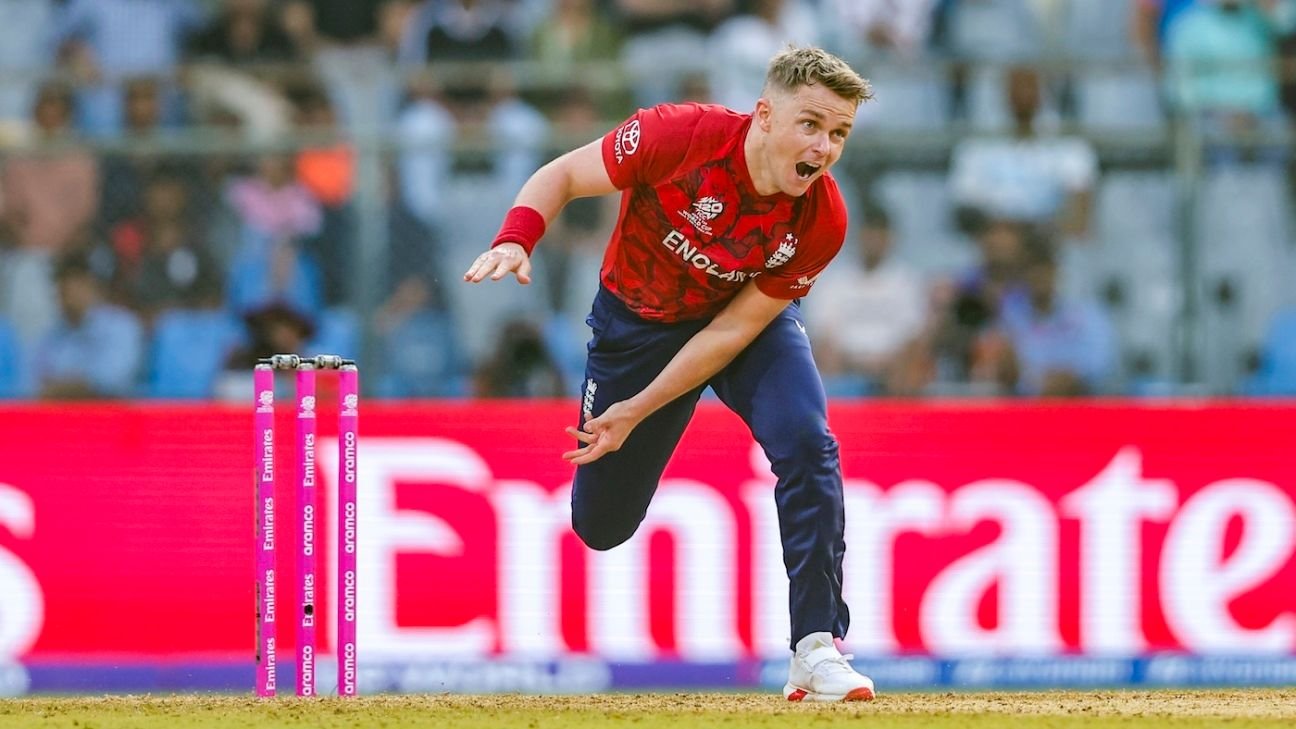
Yorkers. Slow yorkers. Slow bouncers. Wide yorkers. Cutters. Knuckleballs. Wobble-seam deliveries. These are some of the weapons fast bowlers have been using to counter the demolishing power of batters in T20 cricket. Add another to that list: the moonball, an ultra-slow delivery England left-arm medium-pacer Sam Curran bowls to befuddle batters. The average speed of the delivery, which hangs in the air, keeping the batter guessing, is around 47mph or 75kph. In this chat, which took place on the weekend, Curran expanded on the mechanics of the moonball, and how it came about.
Moonball, ultra-slow ball –
what do you call it?
To be fair, everyone’s started calling it the moonball.
It’s very different to what my usual slower balls are. I am just trying to be creative and catch the batsman off guard. It is something I worked on for a couple of years, but still not perfect.
What is the slowest you have bowled it?
Maybe 46 miles an hour – it came up [on the big screen] in the Hundred once. About 81kph.
And how fast was the ball before, roughly?
I don’t really remember. I guess my average speed’s probably below 130kph, so down to 80-odd, that was about a 50kph difference.
I started just trying to do it because I found sometimes the normal slower ball on some good wickets cannot actually be that effective. Weirdly, you watch spinners bowl, guys like Mitchell Santner, Adil Rashid – their slow, slow balls are really effective. Now my biggest trick needs to be bowling it at the right time.
Previously the variation between a regular ball and the slow ball was about 10 to 15kph for you, wasn’t it?
Probably around that.
No one’s really done it before. Obviously, someone like [Dwayne] Bravo mastered the dipper, but I wouldn’t say this ball I’ve been bowling is a dipper. It’s more of just a drastic change of pace to kind of catch guys almost… it’s so slow that they have to try and generate all the pace off the ball.
I haven’t used it hugely in India. In the last six months I bowled it a lot: starting with the Hundred, then the Big Bash as well, and ILT20. We’ll see how it fares in the World Cup.
When was the first time you tried it?
I remember starting [to bowl] it when I was first at Chennai [Super Kings], around 2021-22. I had kind of got injured and then you get time to mess around in the nets and work on things. And now I’m a bit more confident to do it off my full run-up.
I tried it twice last year in the IPL, but I didn’t feel massively confident with it. In the T20 Blast, for Surrey, that’s probably when I started trusting it in terms of [knowing] I can bowl it a lot more.
I’m probably starting to bowl it a bit less because guys are starting to become a bit aware of it. Also, sometimes you’ve got to pick the right battles because some guys pick slower balls better than others.
Harshal Patel, whose strength is slow balls, says he puts a lot more effort into the slower delivery. Is your arm speed as fast or faster than with regular deliveries when bowling it?
I wouldn’t say the arm speed’s faster.
The hardest bit is controlling length. You have to make sure your length is right, because if it’s too short, it’ll obviously get there slow and guys can rock back and pull it. It needs to be fractionally fuller, so guys almost have to reach for it, and it dips a little bit.
It’s probably made my other balls a bit more effective: my yorkers, my bouncer, because guys sometimes can be setting up for [the slower ball] and then I can get them with a quicker one.
What I probably noticed is guys that bowl real 145kph pace, their slow ball is 120. So that’s a 25kph difference. Whereas I feel sometimes guys who bowl a bit slower and their pace-on slow balls aren’t… I found mine wasn’t slow enough at times.
T20 bowling’s becoming a game of chess now. It’s becoming very tough. You see the [batters] swinging a lot in the powerplay.
Is your slower ball easier to bowl with new ball or old?
Probably outside the powerplay, I would say. But I don’t think the condition of the ball matters
Condition of the pitch?
Definitely. It can be more effective on certain surfaces, [against] certain batsmen.
Do you need to work on the trajectory?
I guess it’s more the pace. If it gets above the eyeline of the batsman, he probably thinks it’s… I chatted a little bit to guys like Adil Rashid – when they bowl real slow, it’s also the line you’ve got to bowl, and the angles to make [the batter] reach, make sure your field is set for it.
In India there’s different grounds, so there’ll be grounds that it’s more effective on, and in Sri Lanka it might be more effective at times.
It’s just nice that I’ve added something different. We play against the same guys so much and they start understanding your bowling. So I guess all the skills need to be there.
Do you practise bowling it in the nets?
I feel like it’s an instinctive ball. Sometimes when I’m running in to bowl, I just sometimes decide that it feels right. I practise it, yeah, probably not so much at the batsman; more in the side net, just trying to practise the length, the line, and visualise who I could bowl it to in the next match.
Do you hold the ball loose when you bowl it slower?
My grip’s pretty similar [to how it is for the regular delivery]. It’s just more the change of speed in the delivery and the arm speed fractionally. The hardest part is just controlling the length and line.
It worked in Sri Lanka recently when you got Pathum Nissanka out in the first ODI, didn’t it?
Yeah, it got him once and it has been hit a couple of times as well. So I’m not expecting it to be the perfect ball, but you just keep developing.
I’m a very competitive person, so I want to keep getting better. I feel quite adventurous about my bowling and my batting and just trying to keep adding because the game’s moving really fast. You’ve got to step out of the textbook at times because everything’s changing so much. Batsmen aren’t afraid to get out. You see guys trying to hit the first ball for six. So economy rates are naturally going to keep getting higher and higher. And it’s about keeping on taking wickets and not worrying too much about the economy in T20.
Would you say courage is something the bowler needs to bowl that slow? In the first match you played in the recent BBL, you went for 20 runs in your first over where you bowled a moonball.
You don’t look into it too much as a player, but as a bowler you know you are going to get hit, but it’s also about the courage to bounce back and trust that. Even the other week in Sri Lanka, I got hit quite expensively for the first couple of overs and then came back and got a hat-trick. The weird game of T20 – it’s so up and down, but it’s about staying level.
This World Cup will be interesting if batsmen still go as hard when the pressure’s on, if they lose a couple of wickets. So it’s the transition of, I guess, the game – you’ve got to read the situation. There’ll definitely be games this tournament where I don’t bowl the real slow ball. There’ll be games where I bowl it more than once. So it’s just that you’ve got to trust it and adapt to the opposition.
Against Sydney Thunder in the BBL last month you were on a hat-trick. You picked up wickets off the first two balls of your last over. The first was 109.1kph, and then came a 79.7kph delivery, followed by another one at about the same speed, and then a 128 kph length ball that hit Daniel Sams in the chest and jaw, though he was deep in his crease. He would later be assessed as concussed. So is the slower delivery now becoming a set-up ball, too?
I wouldn’t say a set-up. I just think maybe at times it can help me with the follow-up [delivery]. Maybe sometimes [batters] can be setting themselves up for the slow ball.
I think the word “set-up” is probably right [in that context]. The best T20 bowlers sometimes bowl two yorkers, slower ball, bouncer. We call it a sequence of deliveries. Sequencing helps with how you can reduce the chances of going for those 14-15-run overs and trying to go for eight or nine. Sometimes the bluff is used very well as well, where you can have square leg up and you can bowl a bouncer or a straight yorker. Having added the slower ball, the moonball, it’s obviously helped me. I still bowl my quick offcutter. I still bowl that from the back of the hand.
The more people talk about it, obviously people become aware, and I’m not hiding from the fact that there’ll be days where someone will hit it for six, and that’s fine. But at least I think it’s been a nice addition to my bowling and hopefully it can keep developing as well.
It’s just – ball after ball, you see guys change the field, bowl the same delivery. Batting’s developing hugely in terms of the power and execution. We sit here at Wankhede and you see the balls flying everywhere. As a bowler you’ve got to keep adding to your armoury, and sequencing is important. Tim Southee, who is our bowling coach now, he’s played a lot in India, so we are always chatting about how to sequence our deliveries.
And you’ve got to be brave as well as a bowler. You can’t stay still because the batsmen are just so powerful now.
Tell us about a wicket you have enjoyed taking with the moonball.
I don’t know who I got someone out in the Hundred with. It was very, very slow. And the ball hardly bounced and it rolled onto the stump. I can’t remember the exact person.
Once, I got Ashton Turner in the Hundred, maybe caught at cow corner.
It’s more just guys trying to generate so much pace off it. So I started having a bit of fun with it, and now I’m trying to use it as a real good weapon, because I’m confident to bowl it a bit more in an international game or an IPL. Fingers crossed it can go well.
Bravo is the bowling coach at CSK, your old IPL team, now. Have you spoken to him about this ball?
I haven’t actually, no. Maybe in the IPL or something we could have chats, but he was very unique. Our bowling actions are very different. He was more of like side-on and he went up [high arm] with it. His arm speed was always pretty good. He got the dip, but mine’s more just ultra-slow whereas his was more of a dipper, like guys like [Lasith] Malinga a little bit. All those guys who go up, like [Jasprit] Bumrah, who bowls the slower ball that drops. It’s a very good skill.

