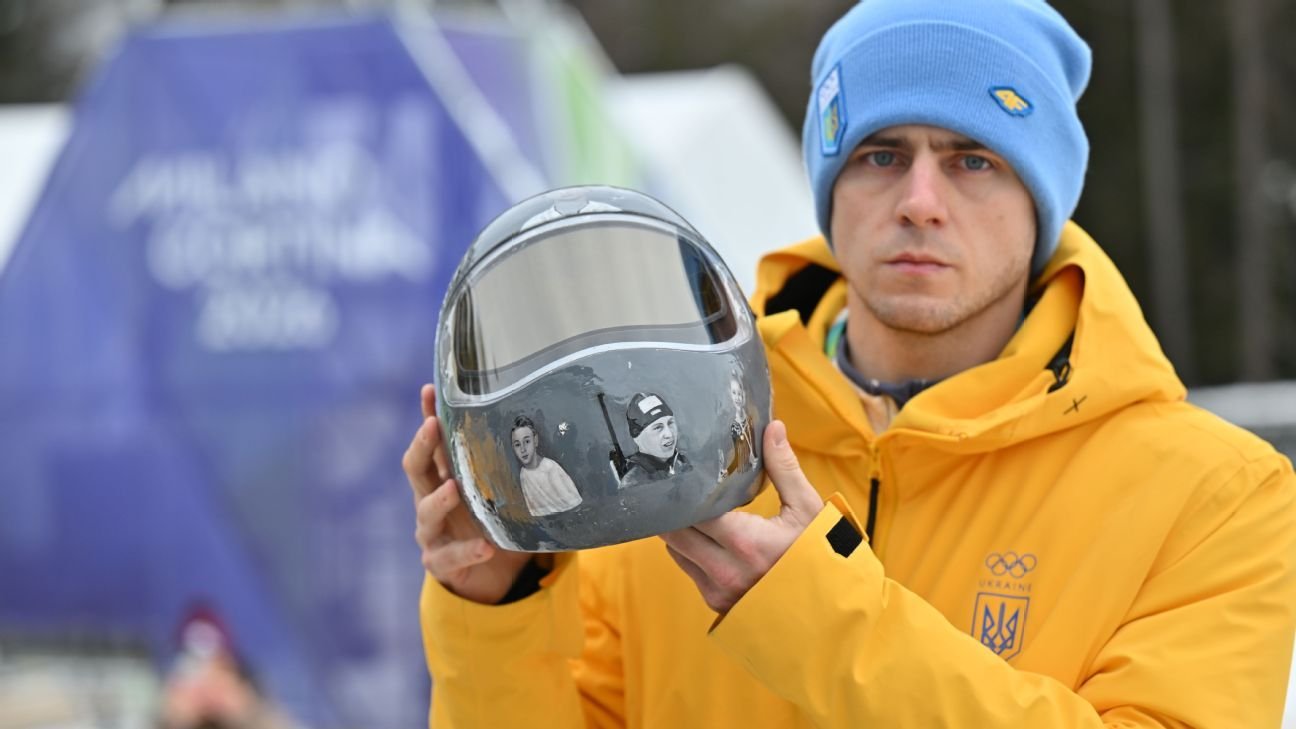
Ukrainian skeleton athlete Vladylsav Heraskevych has been disqualified from the Winter Olympics due to his helmet, which features pictures of people killed in the war with Russia.
The International Olympic Committee had ruled the helmet to be in contravention of regulations surrounding political statements in the field of play, but Heraskevych insisted he would not compromise on the issue.
Less than an hour before the event was to begin, the IOC announced he would not be permitted to compete.
In a post on X, the IOC said: “Skeleton pilot Vladylsav Heraskevych not allowed to participate at Milano Cortina 2026 after refusing to adhere to the IOC athlete expression guidelines.
“Having been given one final opportunity, skeleton pilot Vladylsav Heraskevych from Ukraine will not be able to start his race at the Milano Cortina 2026 Olympic Winter Games this morning.
“The decision followed his refusal to comply with the IOC’s Guidelines on Athlete Expression. It was taken by the jury of the International Bobsleigh and Skeleton Federation [IBSF] based on the fact that the helmet he intended to wear was not compliant with the rules.
“The International Olympic Committee (IOC) has therefore decided with regret to withdraw his accreditation for the Milano Cortina 2026 Games.”
The statement continued: “Despite multiple exchanges and in-person meetings between the IOC and Mr Heraskevych, the last one this morning with IOC President Kirsty Coventry, he did not consider any form of compromise.
“The IOC was very keen for Mr Heraskevych to compete. This is why the IOC sat down with him to look for the most respectful way to address his desire to remember his fellow athletes who have lost their lives following Russia’s invasion of Ukraine. The essence of this case is not about the message, it is about where he wanted to express it.”
Heraskevych said he felt “emptiness” after the ruling.
He said: “[It’s] hard to put into words. Emptiness, some kind of.
“As I understand, here we have channels who have some TV rights. I believe we had a final training run and I encourage you to put it on screen after races finished, after others get their moment, after the last sled, put my final training run on the screen. Just to honour athletes pictured on this helmet.
“I believe they deserve this moment. Certainly I do not get my moment at this Olympics, despite I would say pretty good results in the training runs. I really believe we could be among the medallists today and tomorrow, but we will not be able to race.”
Heraskevych was offered a compromise by the IOC of wearing a black armband but he felt strongly his helmet was within regulations.
He said: “I believe we didn’t violate any rules. In the press conference, it was told to me that I violated Rule 50 [of the Olympic Charter]. Here we have rule regarding expression, so it’s not Rule 50. I believe it’s Rule 40.
“I see big inconsistencies in decisions, in the wording, in the press conferences of the IOC, and I believe it’s the biggest problem that it’s inconsistent.
“I believe strictly in the ISBF [International Skeleton & Bobsleigh Federation), and the IOC understands I’m not violating any rules. Also what [is] painful is that it looks like discrimination because athletes were already expressing themselves.”
Heraskevych now plans to escalate his case to the Court of Arbitration for Sport, adding: “I believe we need to continue to fight for our rights.
“I told you from day one that I do not agree with what the IOC says to us, so probably we will prepare a CAS case and we will defend our rights in CAS.”
Heraskevych held face-to-face talks with IOC president Coventry on Thursday morning in a last-ditch bid to find a solution that would enable him to compete.
Coventry described an “emotional morning,” but stressed the IOC’s decision was not a political one, and cited the wishes of the IOC Athletes’ Commission in refusing to make an exception for Heraskevych.
Coventry said: “We’re not making a judgement on whether the message is political or not political, or has a statement or doesn’t make a statement. It’s any messaging, any form of messaging.
“That’s how the athletes back in 2020, 2021, came up with saying we should not allow any messaging on the field of play, on the podium and in the Olympic village.
“But they wanted other space — the mixed zone, talking to the press, press conferences, as soon as you come off the field of play, that’s there, he can do that. It’s just the field of play.”

