The Tight End position has become vital to a team’s success on offense in the NFL. No longer is it enough to be able to block well OR catch a pass over the middle. The Tight End needs to be able to protect his quarterback, open lanes for his running backs, and catch passes all over the field. NFL teams are searching for their Brock Bowers, Trey McBride, or Tyler Warren.
The 2026 Tight End Class
NBC Sports’ College Football and NFL Draft expert Eric Froton (@CFFroton) continues his breakdown of the top skill position draft-eligible players. Today, he releases his rankings and analysis of the top Tight Ends in the nation.
Advertisement
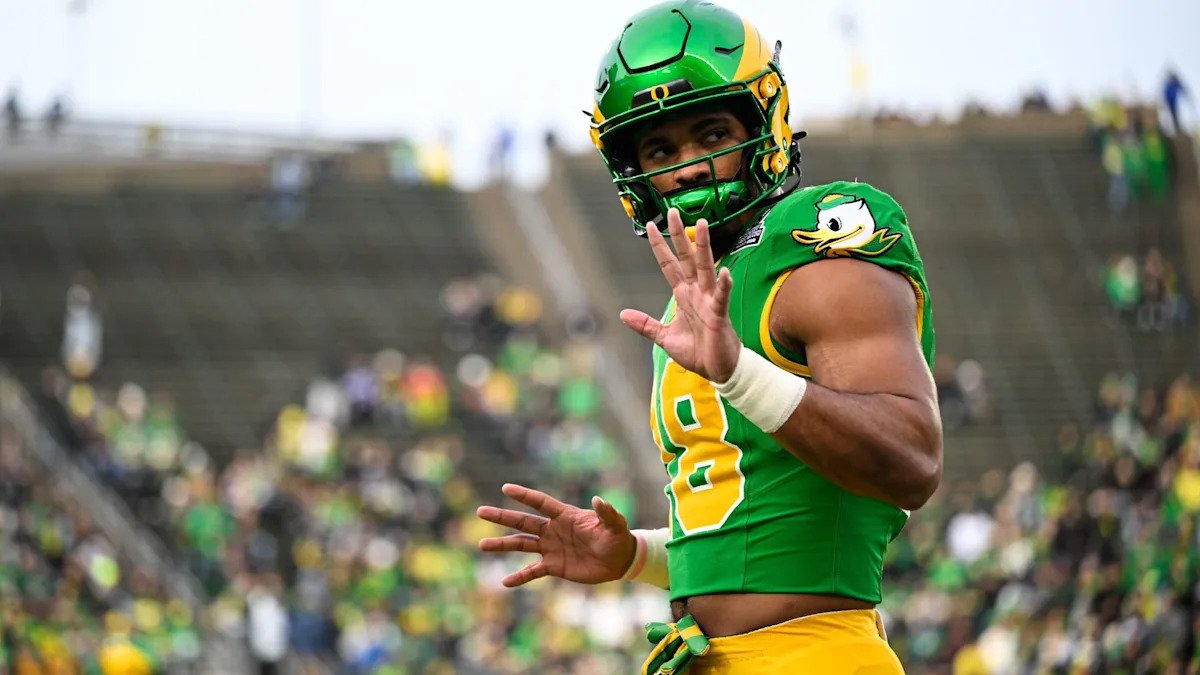
Tight End No. 1 – Kenyon Sadiq, Oregon
I was able to evaluate Kenyon Sadiq in person twice, against UCLA in his 2024 breakout after Ferguson got injured, and then in the OT “White Out Game” at Penn State. I can confirm that he is a rocked-up physical specimen who should test exceedingly well in Combine drills and has verifiable NFL athleticism. He’s a hyper-efficient YAC weapon, catching 25-of-27 passes (93%) for 307 yards with an 80.4 receiving grade in his 2024 breakout. That season showcased his calling card—balance, contact absorption, and violence after the catch, forcing 10 missed tackles and averaging a gaudy 10.1 YAC. Oregon expanded his role in 2025, and while Sadiq responded with 51 catches, 560 yards, and eight touchdowns, the added downfield volume exposed volatility in his hands and tracking (10.5% drop rate, uneven results on intermediate/deep targets). At his best, he’s a nightmare in space—stiff-arming defenders, hurdling DBs, snapping routes cleanly, and finishing plays through contact. Following a 28-yard TD reception vs. USC, where he secured a well-throw deep-shot between two defenders, he had just one reception in his final 25 targets that were thrown 7 or more yards downfield, as his PFF overall grade dropped to the 70th percentile. Jamari Johnson became the preferred downfield option, with Sadiq being used on screens, block & release, and short structured targets. Sadiq projects as an athletic, movement-based tight end whose NFL value hinges on leaning into his strengths as a screen, block-and-release, and underneath mismatch while he tightens up his ball tracking. Sadiq has tantalizing physical traits, but there is still an amount of projection involved in his evaluation. I can’t put him in the Bowers/Loveland/Warren class of recent elite TE prospects, but he’s got a massive ceiling nonetheless.
Tight End No. 2 – Eli Stowers, Vanderbilt
Vanderbilt Commodores TE Eli Stowers (6’4”, 235) is a former Texas A&M quarterback recruit who reinvented himself at New Mexico State, forged chemistry with Diego Pavia, and followed that connection to Vanderbilt, where he became one of the SEC’s most dynamic receiving tight ends. Stowers caught 62-of-85 passes (73%) for 769 yards and four touchdowns in 2025 with an exceptional 85.3 receiving grade with 2.55 Y/RR in 2025 (2.43 Y/RR/89.0 in 2024) while operating primarily as a big slot (71% career slot rate). He’s a certified zone-beater (3.08 Y/RR vs. zone) with a natural feel for spacing and rare body control to adjust to throws above or below his frame without breaking stride. After the catch, Stowers brings both suddenness and toughness, forcing 21 missed tackles on 112 Vanderbilt receptions (36% MTF rate) and consistently turning intermediate targets into chunk gains. An underwhelming 41.2% contested catch rate points to potential size limitations at 235 pounds, but SIS ranks Stowers as the #1 blocking TE in the class indicating three-down utility. When he’s winning with leverage rather than pure collision—climbing the ladder up the seam or extending through traffic—Stowers flashes legitimate NFL ball skills as a modern move tight end who can stress zones and punish defenses vertically. He should be a stable multi-year starting contributor.
Advertisement
Tight End No. 3 – Michael Trigg, Baylor
Michael Trigg (6’4”, 240) is the most vertically dangerous tight end in the 2026 class, hauling in 50-of-85 targets for 694 yards (13.9 YPC) and six touchdowns while leading all FBS tight ends with an eye-popping 11.3 aDOT. Trigg’s efficiency pops on a macro level—his 2.18 yards per route ranks 3rd nationally among FBS TEs and places him in rare air for the class. His ability to win against both man and zone coverage underscores a true mismatch profile. He displays elusiveness and physicality after the catch: his 17 missed tackles in 2025 lead the entire 2026 TE class, and his 36% career MTF rate reflects a player who punishes safeties and leaves linebackers grasping. The tape matches the numbers, as Trigg routinely stacks defenders downfield, draws DPI when he gets a step, and finishes acrobatically through contact, including dominant performances against Auburn, West Virginia, Kansas State, and Utah. Concerningly his drop rate spiked to 12.3% in 2025 after committing just one miscue in 2024 and his 4.5 YAC is modest considering his penchant for tackle-breaking. If Trigg stabilizes the hands and shows consistency, he profiles as a true seam-stretching NFL tight end who tilts coverage and has major offensive upside a a potential true TE1.
Tight End No. 4 – Max Klare, Ohio State
An athletic, natural receiver Max Klare’s (6’5/243) 2024 Purdue tape (85.6 receiving grade, 2.22 Y/RR) best captures his ceiling as a featured pass-game weapon capable of winning at all three levels. After transferring to Ohio State, the volume and efficiency dipped in 2025 (1.48 Y/RR, 66.5 grade), but Ryan Day’s willingness to deploy him in the slot (40%) and even out wide (13.4% = most in class) speaks to his one-on-one trustworthiness. He’s fluid for his size, finding soft spots in zone, adjusting seamlessly to off-target throws while securing the ball before turning upfield in one smooth motion. Klare’s flashes full-field utility to utilize advanced body control and hands, particularly when high pointing. While his usage dipped at OSU, and he arguably hasn’t consistently imposed himself after contact (16 MTF on 116 career catches), there is starter potential here. Klare can lineup all over the formation and flashes enough speed to stress linebackers and the agility to sidestep tacklers in space.
Advertisement
Tight End No. 5 – Dallen Bentley, Utah
A polished, chain-moving tight end who maximized his lone FBS season with 48 catches for 620 yards and six touchdowns, Dallen Bentley (6’4/262) paired an 83.1 receiving grade with pristine ball security (zero drops, 91.9 drop grade). Bentley wins with the smoothest hands in the class and an intuitive feel for zone coverage, subtly relocating when linebackers slide and routinely bailing out off-target throws with late, confident extensions outside his frame. He creates separation with savvy rather than speed, driving off his plant foot, selling in-breakers, and reverse-pivoting to uncover on rhythm throws while working primarily inline or from the slot. The limitations show up at the catch point in traffic—just a 26.7% contested catch rate—and he’s more of a fall-forward finisher than a true tackle-breaker despite a respectable 10 missed tackles on 48 receptions. As a 25-year-old JUCO transfer with a single year of FBS tape, Bentley profiles as an older but full-size TE in a class with lighter options, with a dependable track record that gives him a clear path to an NFL role.
Tight End No. 6 – Justin Joly, NC State
Justin Joly (6’3”, 263) is a throwback, power-slot tight end whose value is rooted in physicality, reliability, and winning in traffic rather than pure vertical stress. One of the most productive P4 TEs of the last three years, Joly has been remarkably consistent as a route runner (1.78 career Y/RR) while carving up zone coverage (2.29 Y/RR vs. zone LY). He committed just four drops on 96 catchable targets while converting an eye-popping 66% of his career contested targets. Joly piled up 46 missed tackles on 166 receptions (28% MTF rate), flashing rare contact balance for a 260-plus pounder. He’s primarily a short-to-intermediate mover due to his roundish frame but cashes in on his rare downfield opportunities at a high rate by catching 9-of-13 over the last two years. Joly’s 81.6 receiving grade in 2025 and 96 career first downs reflects how consistently he moves the chains from the slot and inline. Add in three years of 71st%+ pass protection grades, and Joly projects as a dependable NFL contributor who can play through contact, stabilize the middle of the field, and do the dirty work without needing volume.
Advertisement
Tight End No. 7 – Tanner Koziol, Houston
A massive, chain-moving target who served as Houston’s primary offensive catalyst, Tanner Koziol (6’7”, 250) secured 74-of-94 passes (79%) for 727 yards and six touchdowns with a sterling 87.3 receiving grade. His calling card is reliability in traffic, converting an elite 74% of his contested targets (20-of-27), posted an 88.7 drop grade, and routinely absorbed shots over the middle without flinching. Deployed primarily as a big slot (59% slot/wide rate), he wins with frame, reach, and timing rather than separation or speed, turning himself into an easy throwing window for quarterbacks. The limitations are clear at the next level: minimal YAC (3.9), just two missed tackles forced, and only 3 downfield targets, with 1 reception, despite receiving 94 targets on the year, pointing to a possession-oriented profile. Still, Koziol’s length, hands, and toughness give him a clear NFL pathway as a reliable TE2 who moves the chains and stabilizes the offense.
Tight End No. 8 – Jack Endries, Texas
Jack Endries (6’4/236) built his profile on elite efficiency, highlighted by a dominant 2024 at Cal where he linked up with close friend Fernando Mendoza for 56-of-61 passes (92%), 623 yards and an 85.4 receiving grade. After transferring to Texas, Endries accepted a tertiary role in a loaded offense, working inline on 65% of his snaps and predictably seeing his pass-game efficiency dip (1.07 Y/RR) despite solid per-target effectiveness catching 33-of-45 targets with a 65% inline rate that’s the highest in rate in my Top 10. He’s a quarterback-friendly target with strong hands and composure in traffic, converting 12-of-17 contested catches over the last two seasons while rarely putting the ball on the ground. Endries isn’t a home run hitter—just seven deep targets in two years—but he understands spacing, works the seams he’s given, and consistently finishes plays through contact. The resume points to a dependable, low-variance NFL tight end whose value comes from reliability, role discipline, and doing exactly what the offense asks, even when volume isn’t guaranteed.
Advertisement
Tight End No. 9 – Dae’Quan Wright, Ole Miss
Dae’Quan Wright (6’4/255) brings a modern, YAC-driven profile to the position, catching 39-of-56 passes for 635 yards (16.3 YPC) and five touchdowns while flashing explosive playmaking once the ball is secured. Wright is at his best against zone coverage (2.17 Y/RR), where his spatial awareness and burst show up, turning routine throws into chunk gains with an elite 10.1 yards after catch that separates him from most of the class. After transferring from Virginia Tech, his role at Ole Miss balanced slot, inline, and movement usage, leaning into his ability to accelerate through creases rather than win purely at the catch point. The limitations are clear in traffic—just 4-of-15 career-contested catches, suggesting he’s more creator than combatant. Wright projects as a space-oriented, scheme-leveraged tight end whose NFL value will come from motion, shallow crossers, and zone exploitation rather than traditional inline dominance.
Tight End No. 10 – Eli Raridon, Notre Dame
Eli Raridon (6’7/252) is a long-limbed seam stretcher who quietly delivered explosive efficiency, catching 32-of-44 passes (73%) for 482 yards at a robust 15.1 YPC despite not finding the end zone. Working primarily from the slot (48%), Raridon posted a strong 2.22 yards per route with an 8.1 aDOT, showing he can stress coverage vertically while still contributing after the catch (5.8 YAC, six missed tackles). The headline is his downfield dominance—an absurd 8-for-8 on targets of 20+ yards—underscoring rare stride length, ball tracking, and catch-point confidence for a tight end his size. He’s comfortable playing above the rim (4-of-6 contested), though the hands profile isn’t spotless with three drops (8.6%), suggesting concentration lapses rather than capability. Raridon profiles as a matchup-driven TE who can contribute on the blocking front and ceiling hinges on continued refinement and red-zone usage. His efficiency and deep success hint at a legitimate NFL prospect who could flourish in the right system with seasoning.
Advertisement
The Best of the Rest:
11 – Sam Roush, Stanford
12 – Seydou Traore, Mississippi State
13 – Josh Cuevas, Alabama
14 – Dan Villari, Syracuse
15 – Oscar Delp, Georgia
16 – Riley Nowakowski, Indiana
17 – Will Kacmarek, Ohio State
18 – Marlin Klein, Michigan
19 – Nate Boerkircher, Texas A&M
20 – John Michael Gyllenborg, Wyoming
Tomorrow, we’ll publish Froton’s breakdown of the top Running Backs.
Previous Breakdowns:
Wide Receivers 1-10
Wide Receivers 11-20
Enjoy the day and good luck as you prep for your team’s draft in 2026.

