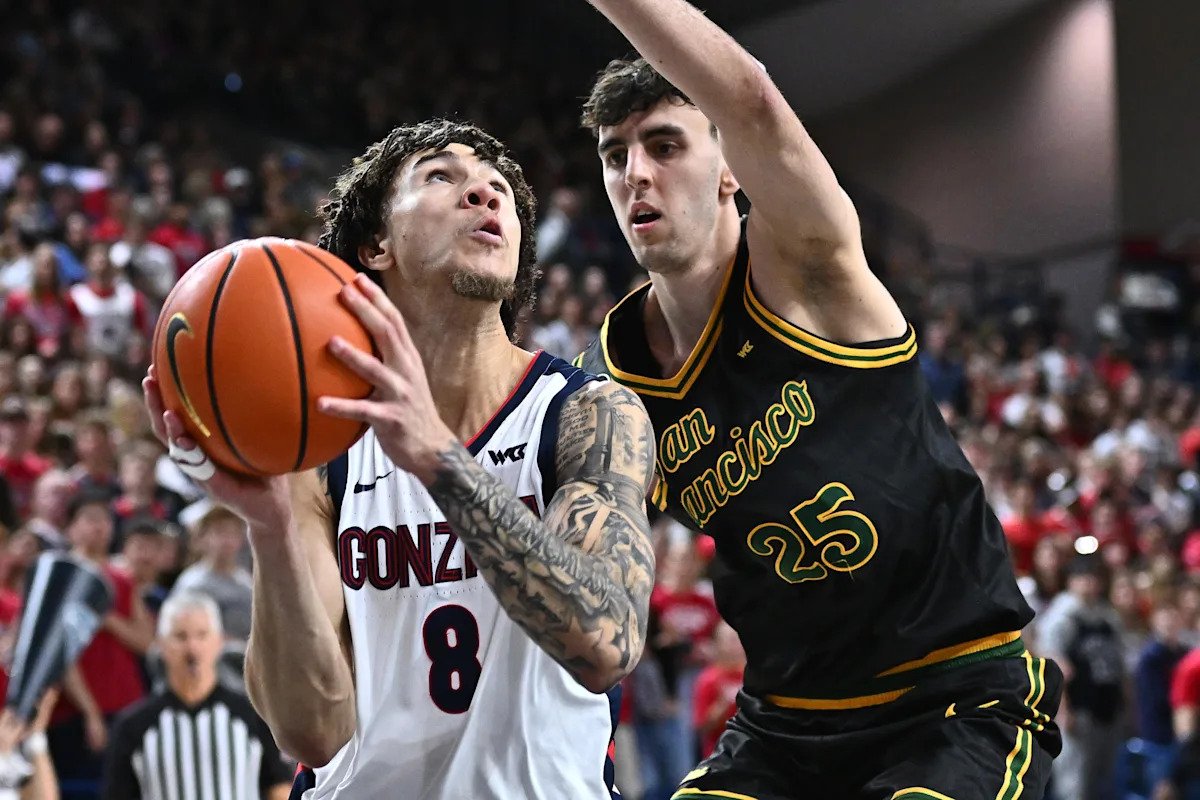
Gonzaga heads to San Francisco on Wednesday night for an 8:00 PM PST tip at Chase Center, with ESPN2 carrying the broadcast. The Zags now hold first place in the WCC and sit at No. 11 in the AP Poll after a narrow win over Santa Clara over the weekend.
San Francisco enters at 7-8 in WCC, 15-13 overall in the season. Since the last time these two teams met on January 24, USF has notched some quality wins over Pacific and San Diego but also some big losses to Santa Clara, LMU, Saint Mary’s, and Oregon State. Sitting at 118 in the NET, San Francisco’s win/loss numbers might look rough compared to Gonzaga’s, but if you watched the January showdown, you’l know that the Dons are more than capable of competing with the best in the conference.
Advertisement
Gonzaga beat the Dons 68-66 behind a stellar performance from Jalen Warley (19 points, 7-of-10 shooting, 5-of-7 from the line), but it reinforced something Zag fans have come to know about USF over the years: when things are humming for the Dons, they can be a very dangerous opponent.
Meet the Dons (again…)
San Francisco comes into Wednesday night off its best performance in weeks, a 92-79 win over San Diego. They punished the Toreros in transition, scoring 22 fast-break points, and consistently forced contact, finishing 27-for-35 at the free-throw line. That win snapped a three-game skid in which USF was blown out by LMU, Saint Mary’s, and Oregon State, struggling mightily to keep games competitive once things started to unravel.
Advertisement
Everything San Francisco does still runs through Ryan Beasley. The junior guard remains the engine of the offense, averaging just under 14 points per game while also leading the team at 3.8 assists. The efficiency numbers look ordinary, with Beasley shooting around 40% from the field and 31% from three, but that misses the point of how he scores. He lives in the gaps, using elite ballhandling to get downhill, pull up from soft spots in the defense, or draw contact when lanes close. He hung 30 points on LMU in a recent loss after torching them for 32 earlier in the month, and when his own shot stays quiet he shifts seamlessly into creator mode, finding teammates or forcing trips to the free-throw line.
Junior forward David Fuchs, a 6’9″ Austrian, provides the interior backbone, averaging 7.8 rebounds to go with consistent double-digit scoring, including a 21-point, 13-rebound night against San Diego while barely leaving the floor. Behind him, though, are two of the conference’s biggest post players in Saba Gigiberia and Guillermo Diaz Graham. On the perimeter, 6’6″ sophomore Tyrone Riley plays heavy minutes alongside Beasley, averaging 11.4 points per game and shooting 38 percent from three on the season, even as his recent six-game stretch includes a 3-for-19 run from deep built around interior scoring and craft.
More than any other dude on the roster, though, Gonzaga fans will likely remember freshman Legend Smiley, who burned the Zags in January by going 5-for-6 from three on his way to 18 points and enters this game hot again after a combined 7-for-13 showing from deep against Oregon State and San Diego. It’s USF’s guards that Gonzaga needs to key in on in order to make sure Wednesday’s matchup is a little less “exciting” than their last matchup.
Keys to the Game:
#1 – Create Offense from the Wings
The last time these two teams faced off, it was Jalen Warley who won the game for the Bulldogs, plain and simple. Warley is still playing through an apparently gnarly thigh bruise, however, so some of the minutes at the four-spot will be soaked up by Tyon Grant-Foster. Luckily, Tyon’s coming into this one hot, fresh off a 20-point, seven-rebound performance against Santa Clara. This is precisely what Gonzaga needs against USF: pressure from the perimeter that turns closeouts into downhill attacks, second-chance points off offensive rebounds, and a second option when defenses load up on Graham Ike inside.
The wings will be crucial on defense, also. San Francisco thrives when Ryan Beasley and Tyrone Riley get downhill, draw fouls, and trigger secondary breaks, as shown by their 22 fast-break points and 35 free-throw attempts against San Diego. Gonzaga’s advantage grows when transition defense stays intact, fouls stay measured, and possessions funnel into the half court. Shrinking driving lanes, closing out under control, and turning the game into a possession-by-possession grind favors Gonzaga’s depth and structure. If the Zags own the wings on both ends, the rest of the matchup follows.
Key #2: limit fouls
Besides the thigh bruise, Jalen Warley also continues to deal with a recent spell of foul trouble, an issue the Zags have limited room to absorb with Braden Huff unavailable. Warley leads the roster with 70 fouls on the season, which places real pressure on his decision-making as an interior defender. Gonzaga needs his activity without the reach-ins, lunges, and loose-ball gambles that invite whistles and force early substitutions.
Advertisement
That concern goes double for Graham Ike. With Huff sidelined, Ike has hovered around 35 minutes per night, and Mark Few has shown little interest in extending Ismaila Diagne’s role beyond short bursts unless circumstances demand it. If Ike or Warley picks up quick fouls, Gonzaga slides toward small-ball lineups that may struggle against San Francisco’s size, including Saba Gigiberia at 7’2″ and Guillermo Diaz Graham at 7’0″. The Zags lack the depth to match that length once whistles stack up. Staying vertical, defending without hands, and avoiding cheap fouls keeps Gonzaga’s preferred rotation intact.
Key #3: keep Adam Miller aggressive
Gonzaga finally saw the version of Adam Miller it has been waiting on against Santa Clara, and the most encouraging part had little to do with jump shooting. Miller went 2-for-4 from deep, but most of his damage came attacking the rim and living at the free-throw line, where he finished 7-for-8. He scored 21 points in 27 minutes, played under control, and paired that production with just one turnover and one foul, a clean, efficient night that reflected a player learning how to impact games without relying too heavily on the long ball.
That version of Miller changes Gonzaga’s offense, and the confidence piece matters here. There remains room to believe Miller can shoot his way out of a season-long three-point slump, and Gonzaga becomes a different team if a reliable perimeter scorer emerges alongside its interior anchor. Keeping Miller assertive keeps pressure on San Francisco’s guards and prevents the offense from narrowing late.
Advertisement
Final thoughts
Gonzaga holds a clear edge heading into Chase Center, especially with Graham Ike back in the lineup, but the first meeting serves as a reminder that San Francisco can turn games into a grind. Wednesday still demands clean execution, particularly in keeping the Dons out of the lane and off the free-throw line while finding ways to score and rebound against a long, physical interior.
This late in the season, it doesn’t look like the 25-26 Zags are ever going to turn into a great three-point shooting team, and that remains fine if the offense stays grounded in what works. Ike on the block sets the tone, and everything else flows from there based on matchups and feel. Take care of the details, avoid foul trouble, and the Zags put themselves in position to handle business before a quick turnaround back home against Pacific on February 22.

