If you’ve played this grand game of fantasy baseball for any length of time, surely you’re feeling calm, informed and assured of your ability to win your league’s title. That confidence is a key ingredient in any fantasy baseball toolbox.
But while the force is with you, young Skywalker, a Jedi yet you are not.
There are a few more nuances to this game that you’ll need to know in order to accelerate to the level of perennial championship contender. We all know that’s the goal in fantasy baseball — to win championships, right?
Here are nine strategies with which you’ll need to familiarize yourself, angles that will make you a more competitive player. Additionally, while experienced fantasy managers might already be familiar with a few or all of these, a refresher is never a bad idea.
1. Use skill-indicator numbers, not “back of the baseball card” stats
Rotisserie baseball rose to prominence during the peak of the bubble gum card industry, and also at a time where television broadcasts introduced players with their “AVG-HR-RBI” numbers for hitters and “W-L-ERA” for pitchers.
It was a time when Pete Vukovich could win a Cy Young Award on the strength of his 18 wins and ace status for the eventual American League champion Milwaukee Brewers (and not, contrary to popular 1980s movies, because when he sneezed he looked like a party favor). Vukovich would earn the award despite having nearly five fewer WAR (Wins Above Replacement) than Dave Stieb.
Regardless of where you stand on the debate of what’s relevant to postseason hardware voting, or even which statistics most belong in fantasy baseball, future analysis — the very foundation from which you build your team — has little to do with those basic, surface-level numbers, and much more to do with underlying, advanced skills indicators. Use batting average, wins and ERA to express how a player did — estimating the worth of his past. However, use expected batting average, Barrel rate and FIP (Fielding Independent Pitching score) to evaluate who he is.
Here are a few examples of the benefits of “looking beneath the hood” or examining a player’s underlying metrics, in addition to his raw fantasy stats:
-
Gavin Williams: A top-25 starting pitcher in fantasy points during a breakthrough 2025, he had the widest differential both between his ERA and Statcast expected ERA (4.30 xERA, minus-1.24 differential) and between his ERA and FIP (4.39 FIP, minus-1.33). Williams’ future might be bright, but without a tangible improvement to his raw stuff, he’ll be a candidate to regress.
-
Dylan Cease: No ERA-qualified pitcher last season had a wider differential between his ERA and expected ERA (4.55 vs. 3.46, for a 1.09 gap), and he had the fourth-widest gap between ERA and FIP (4.55-3.56, 1.00). The Toronto Blue Jays surely noticed before committing $210 million to him over the next seven seasons, figuring the pendulum would swing back in the positive direction in 2026.
-
Brandon Pfaadt: He won 13 games and had a winning record despite posting a 5.25 ERA, something no other ERA-qualified pitcher could claim in 2024 or 2025. Pfaadt will be hard-pressed to repeat the success, as he received an average 5.55 runs of support, fourth most in the league, while PECOTA projects his Arizona Diamondbacks to average 0.4 fewer runs per game in 2026.
-
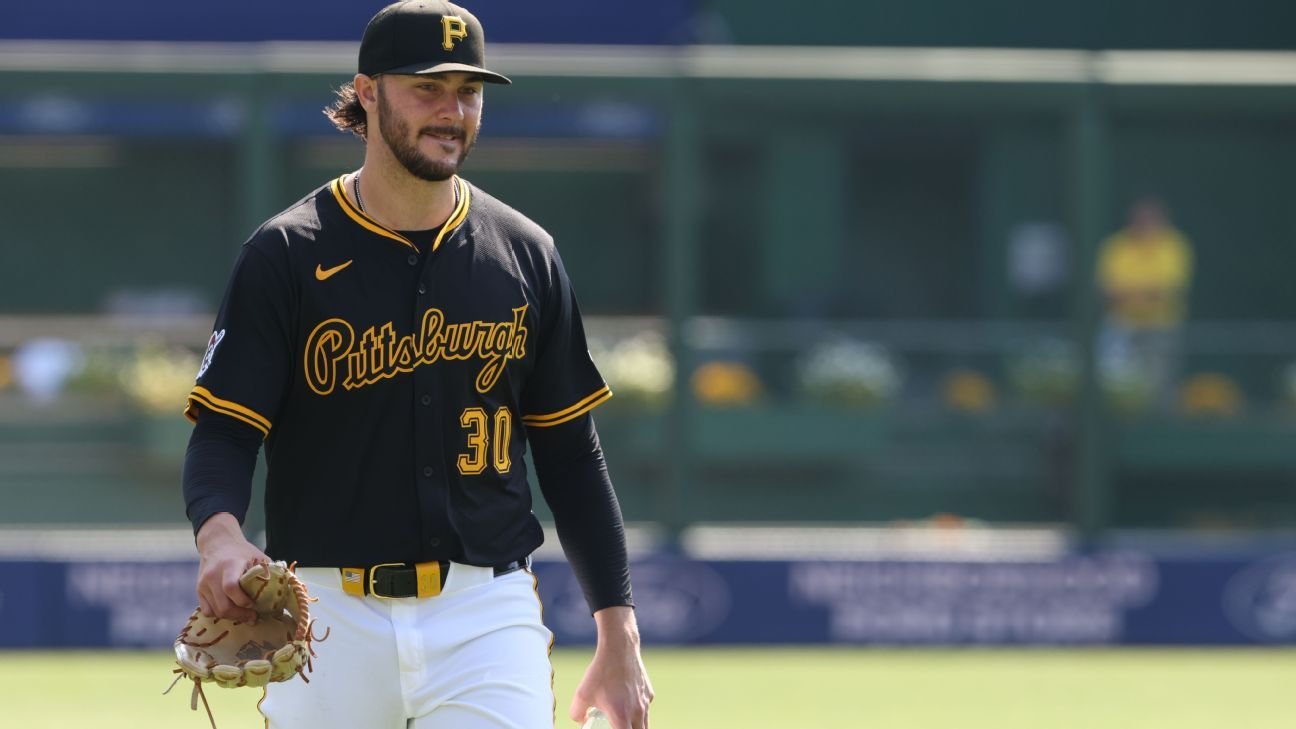
Paul Skenes: He posted a 1.97 ERA, 0.95 WHIP and 216 strikeouts, yet won only 10 games last season, joining Jacob deGrom (2018) as the only pitchers in history to win fewer than 16 times with at least as good numbers in all three categories. (Fortunately, the Cy Young voters didn’t dock Skenes for the poor win total.) Skenes’ 3.38 average runs of support were third fewest among qualifiers, but PECOTA forecasts his Pittsburgh Pirates to average 0.70 more runs per game in 2026.
-
James Wood: A league-leading 21.2% of his fly balls cleared the fence, the highest rate by a batting title-eligible hitter in a full season since Christian Yelich in 2018 (21.6%). Wood, who hit nearly half his batted balls on the ground, will need to correct that if he’s to blossom into a fantasy superstar. As is, he cooled significantly over his final 70 games of 2025, batting just .210/.291/.369 with a 39.4% strikeout rate.
-
Salvador Perez: His .236 batting average was his worst in a single year since 2018, and the second worst in any season. That said, Statcast estimated that Perez “should have hit” .269 based upon his contact quality, marking the third consecutive season that he has managed at least a .260 xBA. His 33-point gap, the widest in that direction among eligible hitters, should narrow substantially in 2026.
2. Buy low and sell high on the trade market
As with the stock market, the perceived values of baseball players on the fantasy trade market can vary based upon numerous factors, such as their recent performance, health, role and supporting cast — and the perception doesn’t always match the player’s true worth.
Identifying these players, whether under-appreciated or overrated, can be a critical ingredient to a fantasy team’s success. It’s not merely about making the right trade. It can also be about making the right trade at the right time.
To “buy low” means to trade for a player at a low — and preferably the lowest — point on his valuation curve, while to “sell high” means to trade away a player at his highest point, when interest in trading for him has reached its apex. Success with this trading strategy does not require the two to be done in tandem, and in fact, insisting it to be so is one of the most common missteps fantasy managers make.
Buying low and selling high is most applicable at around the 25% mark of the season, or within range of the first two weeks of May, when seasonal statistics still represent a precariously small sample size and fantasy managers are most likely to be frustrated with their teams’ slow starts and seeking a change. That said, it’s a strategy that can be utilized any time of year, especially if you’re adept at checking a player’s recent game logs or splits.
To execute the strategy, seek players who have either vastly exceeded or underperformed expectations, and consider underlying metrics such as the ones discussed in tip No. 1. Be prepared to take chances, since attempting to buy low requires taking a leap of faith that the player will eventually improve.
-
Cristopher Sanchez would have served an outstanding example of a pitcher to buy low via trade in the early stages of last season. A buzzworthy spring training performer thanks to his increased sinker velocity, the left-hander had a forearm injury scare after being removed from an April 22 start and, through the season’s first month, he had a mere 3.45 ERA. Fantasy managers who recognized his swift recovery from the ailment at that point, and recalled his electric stuff from during Grapefruit League play, might have traded for him in time to reap the rewards of his 2.18 ERA and starting pitcher-leading 360 fantasy points across his final 20 starts.
-
Conversely, through the first 40 games of his season, Jacob Wilson appeared to be on the fast track to an AL Rookie of the Year award, batting .362 with five home runs. A quick glance under the hood, however, would have revealed him to be one of only six players with top-30 numbers in terms of BABIP (batting average on balls in play) and HR/FB percentage, indicators of a hitter’s good fortunes on batted balls. Wilson, who would have been an ideal sell-high candidate at the time, hit .285/.339/.411 over his final 85 games — a valuable stat line, but one much more representative of his skill set as an “empty batting average” type.
3. Stream starting pitchers
“Streaming” a player means to roster him for only one day (or one week, if your league locks lineups weekly), only to release him the following day (or scoring period) for a similar, matchups-oriented replacement. It’s a particularly popular strategy in fantasy baseball formats such as ESPN’s standard, where daily transactions afford managers the luxury of filling in lineup gaps caused by days off, a pitchers off-turn in the rotation or day-to-day injuries.
The goal is to dominate counting number categories — HR, RBI, runs scored, wins, saves and strikeouts, most commonly — in a rotisserie league, or to maximize a team’s point-scoring potential by constantly having an active player at all lineup spots. Barring your league limiting the number of pitcher starts or hitter games played in a given week or season — always check your league’s rules to understand the extent to which you can stream players — your success will depend upon how attentive you are to having high-quality, healthy players with good matchups constantly active.
Nowhere does a streaming strategy benefit a fantasy manager more than on the pitching side. Pitching statistics tend to be more volatile than hitting statistics, and starting pitchers work significantly less often than hitters. Since starting pitchers typically work only once (or possibly twice, if slotted on Monday/Tuesday and Saturday/Sunday) per week, streaming starting pitchers can help you squeeze more starts out of your lineup, maximizing your chances at getting fantasy points (or wins or strikeouts if in a roto league). If your league caps your starts for the week (or season), streaming relief pitchers can be another way to maximize your pitching staff’s daily output.
In weekly leagues, particularly those that use points, streaming two-start pitchers — those who work at the beginning and end of the week — can be a similarly advantageous strategy.
To identify the best streaming candidates, exploit matchups against the weakest-hitting offenses, as well as pitching assignments in pitching-friendly ballparks.
Using PECOTA projections, here are the 10 teams projected to score the fewest runs in 2026:
Using Statcast’s Park Factors Leaderboard and its three-year outlook (I always recommend a minimum of three years of ballpark data), here are the 10 most pitcher-friendly venues (using single-year data for those only in use in 2025, and the most recent three years in the venue otherwise):
4. Volume is king, especially in points leagues
Tied to the previous recommendation to stream, volume is king in fantasy baseball. You want as many opportunities to accumulate statistics from your players as possible.
Besides manipulating your lineup daily (or weekly), there are several other ways to do this. The first is to draft or acquire hitters from the most productive offenses. Simply put, the more runs a team scores, the more runs and RBI it will spread up and down the lineup, and the more times it will turn the lineup over and give your hitters another opportunity to bat. Of the 12 hitters who scored at least 100 runs last season, nine played for teams that ranked among the top 10 in runs per game, while 11 of the 16 hitters who drove in at least 100 runs played for top-10 scoring offenses.
Another way is to draft or acquire hitters who bat higher in the lineup. This tends to be an overlooked facet of fantasy baseball analysis. As to the previous point about turning the lineup over, the higher a hitter bats in the lineup, the more at-bats he’s likely to get in any given game. A single at-bat might not seem like much, but over the course of the season, those collective at-bats can amount to a noticeable volume advantage.
Notice that the difference in plate appearances between each of the nine lineup spots is roughly 18 for each successive slot we move down. The difference between the No. 2 and 7 slots, meanwhile, is 86. Also consider the team strength context, as the difference between the best team’s No. 2 and worst team’s No. 7 slots was 128 PAs. This is why Brendan Donovan‘s trade to the Mariners was such a boon to his fantasy value, as he went from leading off for one of the weakest offenses in the game to one of the best. He could gain as many as 30 PAs in the process.
The final way is to rely on hitters who have the largest number of games (if in a league with weekly transactions) or the most favorable matchups in a given scoring period, whether daily or weekly. Fantasy managers are typically quick to start hitters scheduled to play games at Colorado’s Coors Field, MLB’s most hitter-friendly ballpark, and they’re always on the lookout for seven- or eight-game weekly schedules.
As with the pitchers above, here’s the list of the 10 teams PECOTA projects to allow the most runs in 2026, for exploiting hitters’ matchups:
Again using Statcast’s Park Factors Leaderboard, here are the 10 most hitter-friendly venues:
-
1. Coors Field (Rockies)
-
2. Sutter Health Park (Athletics)
-
3. Fenway Park (Boston Red Sox)
-
4. Great American Ball Park (Reds)
-
5. Chase Field (Diamondbacks)
-
6. Target Field (Twins)
-
7. Angel Stadium (Angels)
-
8. Nationals Park (Nationals)
-
9. Truist Park (Atlanta Braves)
-
10. Kauffman Stadium (Kansas City Royals)
5. Shun the statistics, but don’t sleep through spring training
Baseball fans love statistics and often crave them. To have a new set of statistics available, before the end of February, tantalizes us, persuades us to put a level of faith into them that’s not remotely deserved.
Here is the harsh truth about spring straining statistics: They’re practically worthless — numbers drawn off a minuscule, roughly-30-day sample size. And, unlike stats from the regular season, a good chunk of them are accrued against career backups, washed-up veterans and players ticketed to spend the majority of 2026 (if not their entire careers) in Class-A ball.
Additionally, Cactus League games in Arizona are played at 1,000-plus-foot elevations, often in humidity, amping up hitting numbers, while Grapefruit League games in Florida are played at sea level, often in larger ballparks that favor pitchers. Veteran players who are guaranteed Opening Day roster spots, as well, rarely play full games. They tend not to see the amount of at-bats or innings you’d expect from them in, say, June.
Nowhere is the absurdity of spring statistics more apparent than in the saves category. Teams almost never use their true closers in the role, being that teams rarely have their regular hitters in the lineup in the game by the eighth inning, meaning pitchers like Mason Miller, Edwin Diaz and Cade Smith will probably get their reps in the fourth, fifth or sixth innings in March. To that point, 60 relievers managed a multi-save spring in at least one of the last three years, but that group totaled only 57 saves during those respective regular seasons (26 of them by Carlos Estevez alone in 2024).
That’s not to say that you should “zone out” entirely during spring training — not by a long shot. There are relevant, statistical tales to be told in March, and fantasy managers merely need to find them. Always consider the context behind the numbers, which is where Baseball Reference’s “strength of competition” number can be a handy resource. The higher the number, the more relevant the output.
-
Less proven and/or younger players typically have managers to persuade or roles to claim during spring training. Gavin Sheets‘ .315/.373/.704 hitting line and six homers across 59 plate appearances last spring earned him, in large part, the strong side of the Padres’ DH platoon, making him a viable dart throw in NL-only and deeper mixed leagues and a season-long bargain accordingly.
-
Another factor to consider is whether a player’s strikeout or walk rates has noticeably shifted from previous seasons. Clay Holmes‘ addition of a kick-change to his repertoire last year fueled a five-start spring training during which he posted a 0.93 ERA and a 31.9% strikeout rate, giving confidence that he could be a successful rotation option for fantasy purposes. Though he did slow down over the course of the year — something common for a reliever being stretched out into a starting role — he posted a 2.97 ERA across his first 16 starts and ultimately finished 49th among starting pitchers in fantasy points for the year.
6. Bargain shop for saves, but tread carefully in the marketplace
I hesitate to use the word don’t when it comes to investing in saves, being that ironclad strategies lead to inflexibility at the draft table, a major hindrance to a successful fantasy baseball game plan. “Don’t pay for saves” is a commonly cited strategy for filling the category and, while it has a good deal of merit, it also can lead to some dangerous pitfalls.
In defense of the strategy, 44% of MLB’s total saves last season came from pitchers who were unquestionably not drafted in ESPN leagues (specifically selected outside the top 300 on average, as well as picked in fewer than 5% of all drafts). This group included Emilio Pagan, who finished tied for fifth in the majors in saves (32) and sixth in fantasy points among relief pitchers, and fellow top-20 fantasy relievers Will Vest and Dennis Santana. Daniel Palencia also saved 22 games despite being entirely undrafted.
This represented a stark increase in the percentage of saves that were accrued by the widely available portion of the draft pool, underscoring the importance of flexibility with your draft-day strategy. In 2024, a substantially greater percentage went to the draftable pool — only 31% went to those who went undrafted — illustrating the annual volatility of the saves market. Some years, closers (on the whole) are more apt to maintain their roles. Other years, change is the name of the game.
The fact that, typically, a minimum of one-third of the league’s saves are right out there for the taking diminishes the need to sink a hearty chunk of your draft-day resources into closers. At the same time, widespread reliance by a league “going the cheap route” to fill the saves category can lead to positional bargains. It can also lead to massive mark-ups for closer candidates on the FAB (free agent budget) and/or waiver front in-season. There might not be a greater way to waste your acquisition resources than by constantly throwing them at pitchers with even a remote chance at sniffing saves.
The depth of your league also weighs in this decision, as AL- and NL-only leagues deplete the player pool significantly more than even 15-team mixed leagues do. The more likely that your league will roster pitchers with a remote chance at saving games upfront, the greater the importance to address the category at the draft table.
7. Beware the rookie hype
Everyone wants to be the fantasy manager who first discovers the next big thing. Especially in recent years, rookies have made waves on the fantasy baseball front, from Corbin Carroll‘s first-ever 25/50 (25 home runs and 50 stolen bases) season by a rookie in 2023, to Skenes’ 1.96 ERA in 2024 that was lowest by any rookie with at least 20 starts during the live ball era, to Nick Kurtz becoming only the sixth rookie in history with at least 30 homers and 1.000 OPS last year.
Those performances, as well as lesser yet still hearty rookie contributions from Gunnar Henderson and Elly De La Cruz (2023), Jackson Merrill and Jackson Chourio (2024) and Drake Baldwin and Roman Anthony (2025), illustrate the potential present within each year’s rookie class. There’s no doubt that rookies and younger players have greater odds of success than at any other time so far this century.
That said, understand the inherent randomness involved with evaluating each year’s rookie class. Entering 2024, Jackson Holliday and Yoshinobu Yamamoto were prohibitive favorites for their leagues’ respective Rookie of the Year Awards, and Holliday was Kiley McDaniel’s top-ranked prospect. Entering last season, Dylan Crews and Jasson Dominguez were among the — and, at times, the — favorites to win the hardware, while Roki Sasaki topped McDaniel’s annual prospect list. Every one of these players finished significantly shy of his preseason expectations.
Tuck that away as you estimate the worth of the 2026 freshman class, which is headlined by Kevin McGonigle, 2025 postseason standout Trey Yesavage, JJ Wetherholt and McDaniel’s No. 1 overall prospect, Konnor Griffin. Any and all could put forth award-caliber statistics and be every bit worth their draft-day price tags, but the difficulty every player faces adapting to the game’s highest level of competition makes each a riskier pick than similarly ranked, more experienced players.
8. Resist recency bias
Fantasy managers on the whole, in all sports, tend to chase yesterday’s statistics. When a hitter clocks three home runs on a given night, or a pitcher throws a no-hitter, he often becomes the hottest commodity in our game the following morning.
Even more experienced fantasy managers, who aren’t often fooled by such one-night outbursts, can be fooled by lengthier, albeit still-small sample sizes of hot and cold spells. Familiarize yourself with that phrase, “small sample size,” which refers to data points that reside within a range of statistical variance — this could mean a day’s results, or a week’s, or even as many as 40 days. There is a reason baseball is played over a 162-game schedule, and it’s that the lengthier road does an excellent job of smoothing out the statistical noise, separating the truly great from the not-so-much.
Lenyn Sosa‘s 2025, which placed him 15th among second baseman on the Player Rater (and 20th in fantasy points), was greatly influenced by an eight-week stretch between June and August during which he hit 13 of his 22 home runs and drove in 37 of his 75 runs for the season. Due largely to his free-swinging nature, however, he hit only .236/.263/.386 with five home runs over his final 32 games, demonstrating the level of regression to which a player with his skill set is subject.
This is especially true during the season’s early weeks, where hot starts can cause us to make foolish decisions on players’ full-year prospects. Cedric Mullins, generally a final-round pick candidate in standard ESPN drafts (No. 220 ADP, drafted in 42% of leagues) who averaged .244/.311/.407 rates, 16 homers and 28 steals the prior three years (2022-24), got off to a scorching, .295/.433/.590 start with six homers and five steals over his first 23 games, giving the look of a major bounce-back candidate. Due to his mediocre contact-quality metrics (and ultimately his trade away from beneficial Camden Yards), Mullins hit only .199/.266/.347 with 11 homers and 17 steals in 110 games thereafter, even losing his starting job.
This recency bias can also adhere to entire seasons, in certain circumstances, such as the player who had the out-of-nowhere big year, or the former superstar coming off an unexpectedly miserable campaign. Before assuming that the most-recent season defines the player’s future expectation, seek out the why he performed in the way he did. Might his prior, lengthier track record be the wiser measure of his skill?
Among the better examples of this single-year bias:
-
Yordan Alvarez: Injuries ruined his 2025 campaign, limiting him to only 48 games and resulting in a career-worst .797 OPS. Yes, Alvarez’s injury history warrants concern, as he averaged 132 games the prior three years, but that’s still a substantially larger number than last season’s, and his contact quality metrics were as excellent as always. Alvarez should be due for a rebound.
-
Geraldo Perdomo: He managed an outstanding, top-15-overall caliber 2025, but his level of power output was almost entirely out of character with his prior history. Perdomo remains a plenty draft-worthy player, but he’s among the top candidates to regress in the home run department.
-
Adley Rutschman: Yes, he faces a challenge to his playing time from top prospect Samuel Basallo, and his 2025 was as disappointing as they come. That said, everything that made Rutschman’s points-league fantasy game potentially great in the past is still present in his skill set. Plus. he’s still a prime-age 28.
9. Have patience through streaks, where warranted
Pardon the cliché, but fantasy baseball is a 180-plus-day (this year, it’s 185) marathon, not a sprint. As mentioned with the recency bias point above, statistics tend to even out over the course of the full season, making patience a true virtue in our game.
Learn to recognize the difference between hot and cold streaks and a definitive change in a player’s skill set, approach or role. Certain subsets of players are more subject to extreme streaks than others, and making rash moves with them at the wrong times can cost you on the fantasy baseball trade market.
For example, sluggers who hit a lot of home runs at the expense of many strikeouts — typically called “three true outcomes” players because of the high likelihood that the outcomes of their plate appearances will be either a home run, strikeout or walk — tend to be the streakiest such players.
-
Kyle Schwarber is a notorious such example, his 48.9% career rate of his PAs ending in a home run, strikeout or walk second-highest among active players (Aaron Judge‘s 51.1% leads). Schwarber is renowned for having epic Junes, his .248 batting average, .557 slugging percentage, .911 OPS and 11.1 at-bats per home run average in that month his best in any of the season’s six months. Meanwhile, his .437 slugging percentage, .769 OPS and 16.3 at-bat per home run average in April are his worst in any single month. If he gets off to a sluggish start yet again in 2026, recognize that his past history demands patience through it.
Schwarber, or other such sluggers as De La Cruz, Eugenio Suarez or Matt Olson, also tend to be poor fits to the aforementioned buy-low, sell-high trade strategy. Their track records are lengthy enough that their fantasy managers are well aware of their penchant for streakiness, making it difficult to “buy in” at low points on their performance curves, and it’s especially dangerous to trade for any of them at their high points, knowing that a dip could be coming at some point. These are players much better to lock into your team for the long haul, allowing their skill sets to even out over time.

