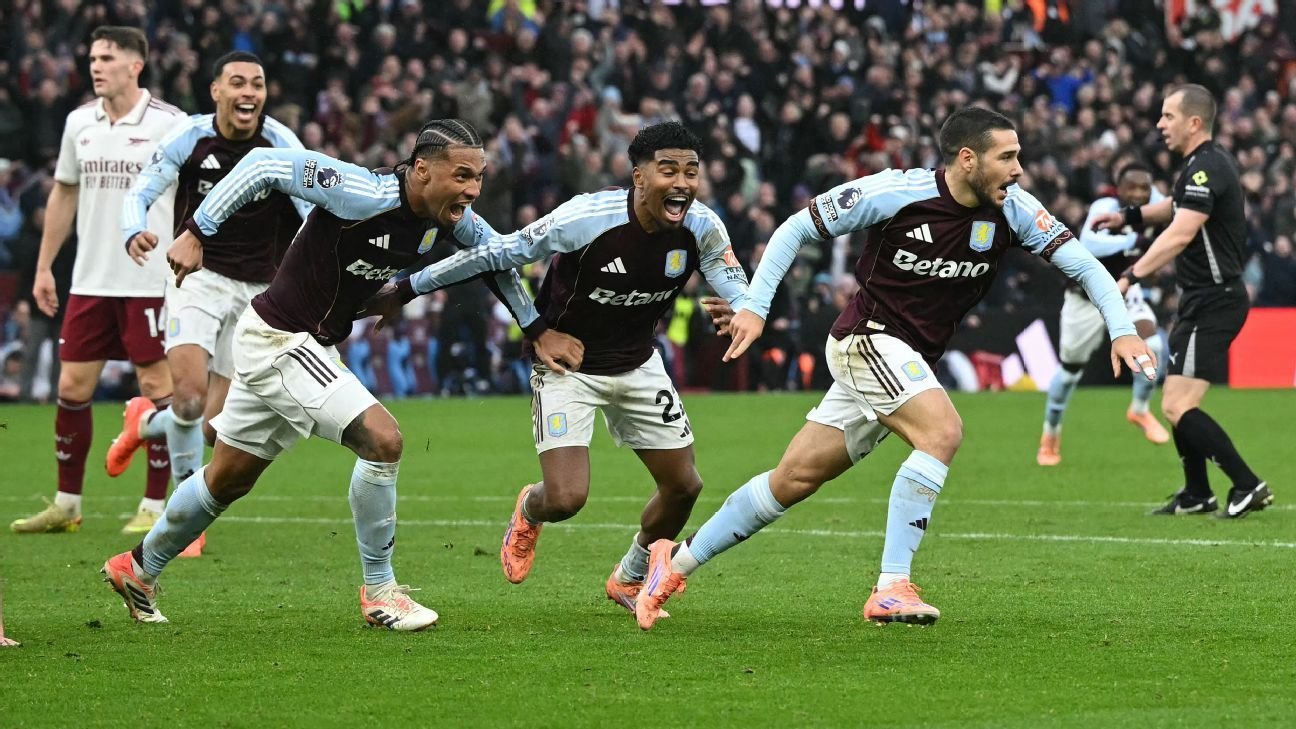
The phrase “Premier League big six” might be flawed — you need look only at Tottenham Hotspur and, to an extent, Manchester United‘s position in the table over the past 12 months to understand why — but it does exist for a reason.
Between 2016 and 2022, six clubs — Arsenal, Chelsea, Liverpool, Manchester City, United and Spurs — occupied the top six positions in the table four times in those six years. In the three seasons since, at least four have secured a spot there, with United (15th) and Spurs (17th) struggling last season in particular.
The domination has placed a glass ceiling over what most other clubs in the division can realistically achieve, and though some occasionally smash it, they often sink straight back down.
One of the reasons for that is obvious: Trying to compete consistently with rivals whose financial capacity far outstrips your own is borderline impossible. But there’s also a curious tactical element to this, as clubs are often forced to make a treacherous transition that mostly ends in tears.
Many clubs complete Step 1 (leap up into the top seven) but fall flat from there. In the past couple of years, Aston Villa and Newcastle United have clearly breached the top order but, as we’ll come to, even their cases feel slightly different.
So, why has it proved so incredibly difficult to break up the Premier League’s hegemony?
How to punch above your weight: Forget possession, just counterattack
Most clubs that rise to the point of threatening the “big six” do so by perfecting a counterattacking strategy. They hit a sweet spot in terms of defensive solidity and carry a clear threat on the break, often picking up a couple of wins against top sides along the way to raise some eyebrows. It sees them leap up the table into about … seventh place.
A simple metric such as average possession share clearly highlights the typical approach taken. In the past 10 years, Leicester City, Burnley, Wolverhampton Wanderers, West Ham United, Aston Villa and Nottingham Forest have all pushed up into seventh or above by playing “reactive” football.
That’s not to say they all played the exact same way. Leicester played almost exclusively counterattacking football, leaning on striker Jamie Vardy‘s pace, en route to their fairy-tale title win in 2015-16; Burnley were brutally defensive in 2017-18, scoring just 36 goals but conceding only 39; while both Villa and Forest have mastered the art of scoring an early first goal and managing the game from there.
None of those teams took a heavily possession-based approach to the pitch — although there are two examples of that working. Brendan Rodgers’ Leicester were very proactive in 2020-21, while Brighton & Hove Albion feasted on the ball in 2022-23, racking up the league’s third-highest average figures.
Playing reactively isn’t the only way to punch above your weight, but there’s a clear pattern of it being the most likely method of achieving it.
This term, it’s Brentford pushing to break up the top six. Their average possession? 46.5%, the 14th-highest mark in the league.
To pull this off, you need a manager who excels in organizing a team defensively (such as Claudio Ranieri, Nuno Espírito Santo or Sean Dyche), speedy counterattacking forwards (like Vardy, or West Ham United‘s Jarrod Bowen and Adama Traoré) and the freshness a fixture list without European football brings.
But the hard part is only just beginning.
1:55
Hislop: Aston Villa’s inconsistency could cost them UCL place
Shaka Hislop raises concerns over Aston Villa’s squad depth following their 1-0 defeat to Brentford.
The bad news: Opponents adjust to you
If you make enough waves and fly consistently high in the Premier League table, opponents will adjust tactically to you. This has happened to all of these teams in the past 10 years except one: Leicester City, in 2015-16, who ran the same counter-attacking setup for 38 straight weeks and for reasons unknown, no one seemed interested in specifically setting a game plan for them. (To be fair, it was a very strange season; City were learning Pep Guardiola’s style in his first season, Liverpool finished eighth and Chelsea finished 10th.)
But all the others were suddenly confronted by a newfound respect from their opponents, which took the form of a tactical compromise: They let them have possession. If you’re coming from a template of not having the ball, this makes life really difficult.
Players are quickly asked very different questions. Attackers such as Bowen go from sprinting into open space to working in much tighter spots; defenders go from guarding their box to playing much higher up the pitch; and midfielders are asked to be progressive and creative against the low blocks they were forming themselves not so long ago.
Put simply, it’s a massive culture shock.
There’s another complicating factor to address here, too: The extra strain that European games add to a squad. Finishing seventh or above will qualify you for continental competition, resulting in anywhere between six and 15 extra matches being added to your schedule. If you’ve punched above your weight to finish in those spots, you’ve probably got a lean squad, relied on 14-15 players to get there, and now face the need to change up your XI or add heavily in the transfer market to cope with the increased physical demands.
The Leicester team that won the title in 2015-16 finished 12th the following season; Burnley’s seventh-place heroes in 2017-18 slipped down to 15th the next year. In 2022-23, West Ham (rightly) poured all their energy into winning the UEFA Conference League and finished with just 40 points in the Premier League table, six points above the drop zone.
And most recently there’s the case of Forest. Despite bulking up the squad and spending £180 million over the summer window, they’ve been embroiled in a relegation scrap all season, currently sit 17th and have just appointed their fourth manager of the campaign.
This combination of a stretched schedule and opponents forcing you to alter your playing style from “reactive” to “proactive” is a deadly cocktail. More often than not, clubs sink straight back down the table.
So how do you make it stick?
The key is to make what has become an extremely difficult tactical transition that most clubs get completely wrong: One way or another, you very quickly have to become comfortable as a possession-based team that can play out from the back without making mistakes and break down deeper defenses. It’s fraught with difficulty and peril.
The only team to successfully make this jump and stay there is Aston Villa. They finished seventh in 2022-23 and qualified for the Conference League in the process, then finished fourth the following season while juggling a continental campaign.
In 2024-25 they reached the Champions League quarterfinals and finished sixth in the league, missing out on the UCL once again only on goal difference. At the time of writing, they’re third in the league — and have been since early December — and qualified for the Europa League knockout phase with seven wins from eight.
In a Premier League table that begins in 2023-24 (and spans the past 102 games), they’re fourth — eight points above Chelsea, 37 points above Manchester United and 51 points above Spurs. It’s safe to say they have embedded themselves among the elite. But how?
Manager Unai Emery joined halfway through the 2022-23 season and initially deployed relatively cautious tactics, focused on taking an early lead and then managing the flow of the game. But in his first summer transfer window, he signed ball-playing center back Pau Torres for £31.5 million, who was the catalyst for the team to embrace a possession philosophy.
Many of Villa’s existing players, who had either underperformed or been misused under the previous management, scaled up easily to Emery’s demands of a different style. The fact that Emiliano Martínez, a World Cup-winning goalkeeper with Argentina who is excellent with the ball at his feet, was already present no doubt made the transition easier than it should have been.
From 2022-23 to 2023-24, Villa’s average possession jumped from 49.1% to 52.8%. They racked up 13 league games with 60% possession or more, winning six, drawing four and losing just two.
No one would bat an eye if Villa won a Premier League game comfortably with the lion’s share of the ball these days, but just over three years ago they were 17th in the table and looking over their shoulders.
0:51
Pep Guardiola: Man City are 7th in the Premier League net spend table
Manchester City manager Pep Guardiola has hit back at claims that his side only win trophies due to the amount of money they spend in the transfer market.
Who got it wrong, and why?
Even Villa’s success story drops a few hints as to why this transition is so difficult.
They were already in a strong position with their squad, evidenced by the fact that eight of the players Emery inherited played a role in a 3-2 win over Paris Saint-Germain in the Champions League knockouts two years later. They just needed the right coach to nurture them and transition them to a new style. So that makes them a bit of an outlier.
Newcastle United have also (mostly) successfully vaulted into the modern top six but did so by employing a possession-based manager, Eddie Howe, when they were bottom of the league in November 2021. Ordinarily, this was no time to make such a switch — they had zero wins from 12 games — but the club had just been purchased by Saudi Arabia’s Public Investment Fund and spent £85 million on new signings in the January transfer window, including star midfielder Bruno Guimarães.
In the majority of other cases, there are more issues at play.
The first problem is that a squad built to defend and counterattack is unlikely to be able to transform into a ball-dominant attacking force overnight. You’re going to need new players. But if you give them to a tactically reactive manager, is he going to get the best from them?
So, change the manager? Well, that’s difficult. They’ve highly likely just enjoyed a very successful season and carry a lot of goodwill with the fans. They’ll say they’ve earned the chance to make that next step with the club … but the odds are, it won’t work.
Nottingham Forest represent an extremely intriguing case here. They spent £180 million last summer after leaping to seventh from 17th and in doing so, signed some players — most notably Douglas Luiz on loan — who clearly did not fit the manager Nuno’s style. Those who believed it was foreshadowing something were quickly proved right, as just four games into the season, Nuno was replaced by Ange Postecoglou — a manager who coaches a possession style.
The problem here was that the timing was terrible. With European games clogging the midweek schedule, where was Postecoglou going to find the time to get on the training pitch and instill his ideas, which were vastly different from Nuno’s? He wasn’t. And he lasted just eight games before being replaced by Dyche … a tactically reactive manager.
Forest’s toils showcase how incredibly difficult the transition into the top six is. They clearly anticipated the issue and did their best to get ahead of it — perhaps even to the point of recruiting players with the manager they’d lined up to take over in mind — and still fell flat on their faces.

