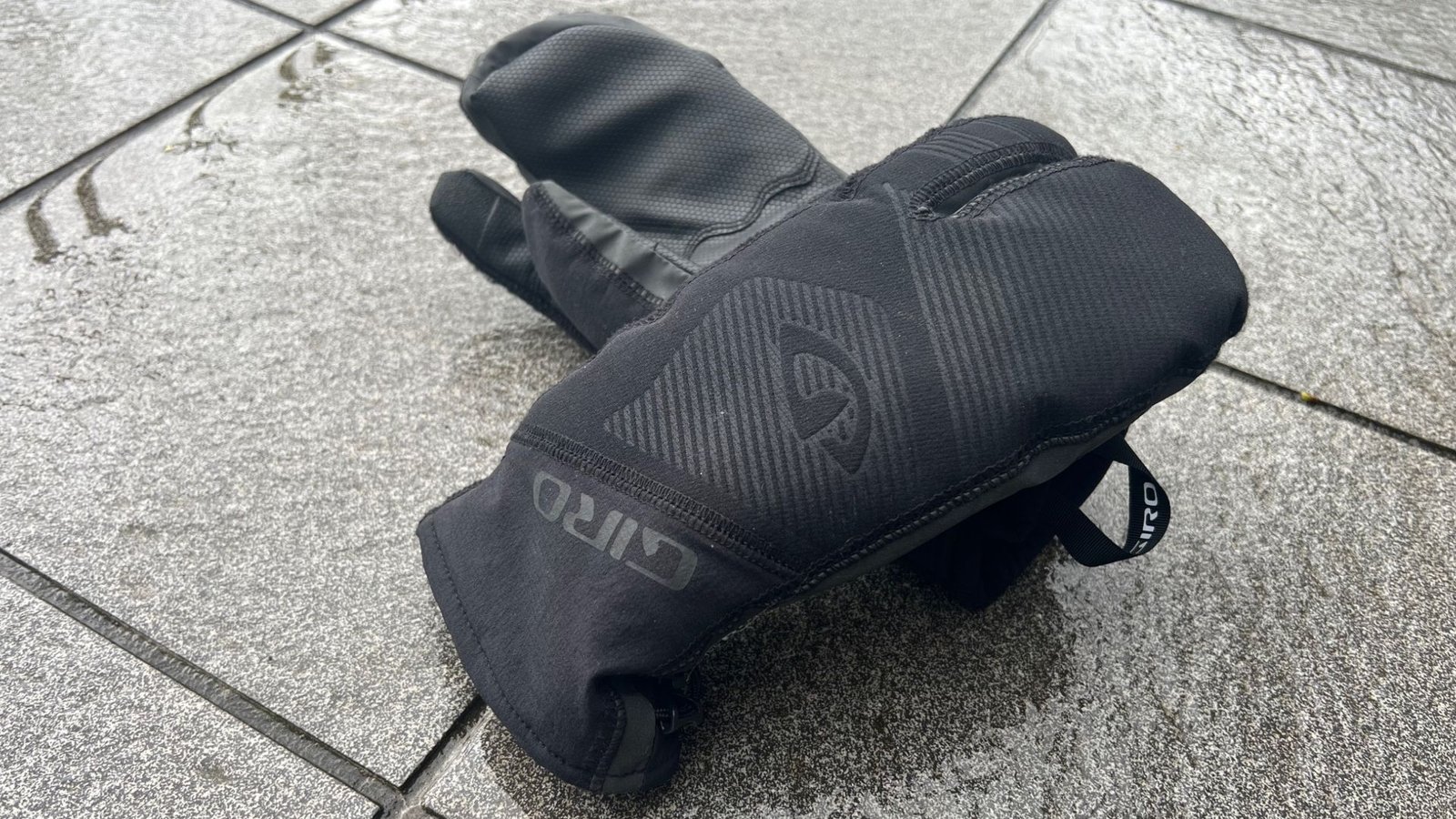
It’s been five years since we last reviewed the Giro 100 Proof winter cycling gloves, and eight years since the mitten-come-pincer entered production in its current form. At the time, it was considered a pair of the best winter cycling gloves.
To put that into perspective, Anna van der Breggen was dominating the podium (often on the top step), and the Brits cleaned up at the men’s Grand Tours with Chris Froome (Giro), Geraint Thomas (Tour de France), and Simon Yates (Vuelta).
The Giro 100 Proof winter gloves use Direct Dry Solutions in their construction
(Image credit: Hannah Bussey)
Construction
Ok, so I may have been over-egging the ‘first time’ bit – because the design of the Giro 100 Proof winter gloves hasn’t remained entirely static over the past decade. As I mentioned about five years ago, they actually had an update on the key ingredients, but since then, it’s largely remained unchanged.
The padding on the back of the gloves uses a Polartec Power Dry insulated core, still with the same 80% post-consumer recycled fibre content, although I’m seeking more information on this.
Back to the matter at hand…
Wrapped in a Direct Dry waterproof membrane, Giro states that it “uses a one‐piece patented construction process that creates a waterproof breathable barrier. This impenetrable layer is heat-bonded directly to the outer fabric, leaving no seams, no gaps, and no way for water to enter.”
This is in comparison to what Giro calls traditional waterproof technology; here when water gets in, it can stay inside, collecting between the inner and outer layers, making them heavy and wet, eventually leaving your hands in cold puddles of water.
The palm of the gloves remains made from a durable AX Suede Echo Diamond synthetic fabric. It claims to be designed expressly for gloves, offers significantly greater durability, while remaining thin and comfortable. There’s also Touchscreen Technology on the index and pointer fingertips for compatibility with smart screens, both phones and your GPS head units.

The palm of the Giro 100 Proof winter gloves
(Image credit: Hannah Bussey)
The ride
Hands are one of the trickier body parts to protect on a bike, where the rule of ‘dressing for the second mile’ gets thrown out the window, because if you start a ride with your hands too cold, they are unlikely to ever warm up.
For me, it’s even more crucial to begin with warm hands. I suffer from Raynaud’s disease, and my hands lose their ability to function, making winter riding quite dangerous.
My solution has mainly been the SealSkin Upwell electric heated gloves, which have been revolutionary at times but frustratingly unreliable. Often, the battery suddenly depletes (since they can be accidentally turned on), leaving me with gloves that don’t keep my hands warm enough.
On days when it has been extremely cold, the 100 Proof gloves have still allowed me to get out on the bike (off-road, as tarmac is way too sketchy with ice).
At times, I’ve even had to check that it was really that cold, as my hands remained warm enough to function, wrapped in the fleecy inner of the mittens. If it hadn’t been for spotting other riders fully wrapped up and the fact that I had no signal to my frozen feet, I might not have fully realised just how cold it truly was.
In fact, they’re so great at keeping my hands warm that I become acutely aware of how cold the rest of my body is, wishing Giro would hurry up and make some socks just as effective. On days when I’ve had to ride in freezing, sleety rain, the 100 Proof gloves have been my lifeline and the only way I’ve managed to finish the ride.
While keeping hands warm is essential, it is equally important to ride safely, maintaining enough dexterity for brake modulation and gear shifting.
Small sizes often pose the biggest challenge, but Giro has been clever with its sizing, downsizing not only the glove but also its protective layers to ensure each hand isn’t overwhelmed by padding, allowing me to feel fully in control of the bike once I’ve adapted to one-finger braking and the shifting with the hand now ‘mittened’.
In these temperatures there’s also still the issue of my constantly running nose. Which, after a while, became sore from the nose wipe on the gloves, which weren’t quite big enough. I would love to see any amendment to the design tackle this issue, and freezing temperatures and rhinorrhea go hand in hand.

The fleecy nose wipe is long, but just needs to be a bit wider for ultimate softness
(Image credit: Giro 100 Proof winter gloves)
Value and conclusion
The advantage of the 100 Proof gloves is that they provide constant warmth, but anything above freezing, even for the coldest hands, makes these gloves too effective at retaining heat.
However, in deep winter, when you need gear capable of supporting you in Arctic-like conditions, they excel. That said, if I were to calculate their value as I usually do on a cost-per-wear basis, I would find it hard to justify the expense.
Nonetheless, they are likely the only thing that will help you survive a bitterly cold winter ride, and anyone who has experienced the excruciating sensation of reactive hyperemia (when your hands start to warm up) will find their only question about purchasing is who to hand the money to.

