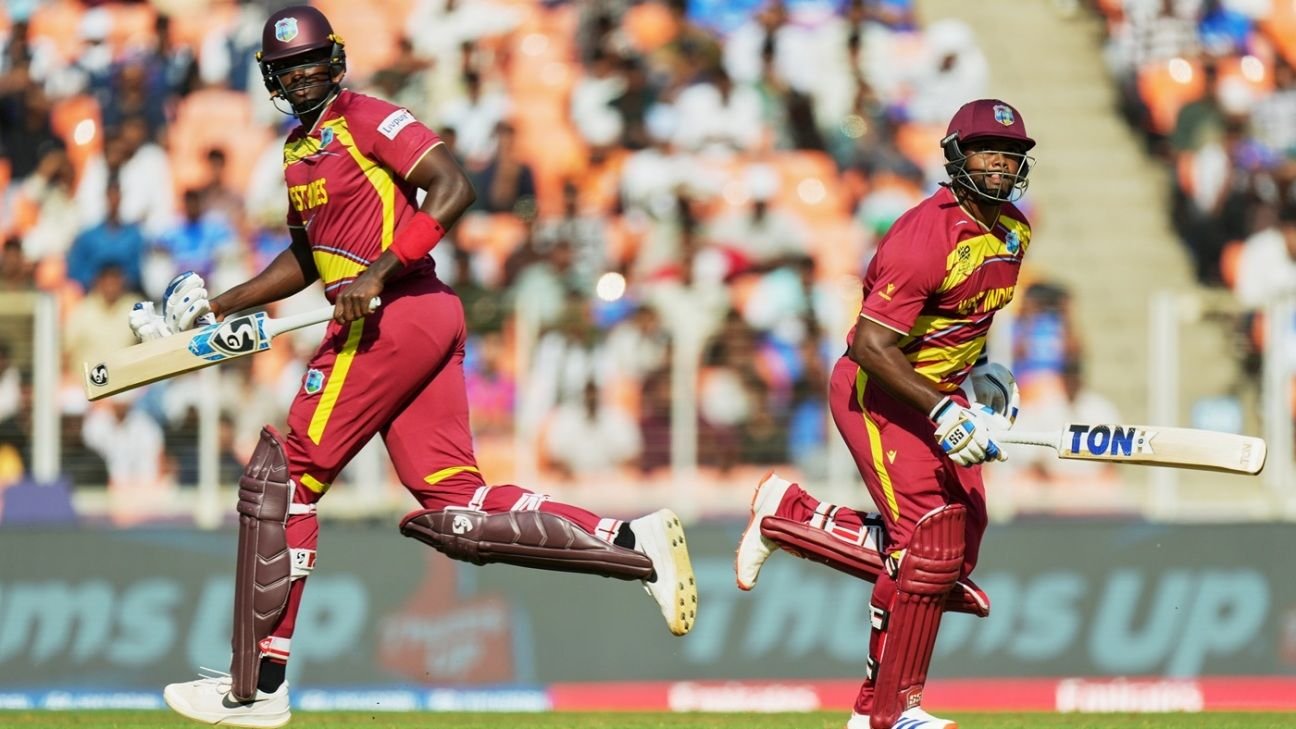
A hip-high short ball from Corbin Bosch, an effortless shovel-pull from Romario Shepherd, a landmark moment in the history of the T20 World Cup. This six, in the 16th over of Thursday afternoon’s Super Eight game in Ahmedabad, was the 63rd of West Indies‘ tournament.
This six took West Indies past their own previous record, from 2024, for the most sixes hit by any team at a T20 World Cup.
West Indies feature four times in the top 11 six-hitting campaigns of all time: this one (66, with at least one match to go), 2024 (62), and their title-winning runs in 2012 (49) and 2016 (43).
This, of course, will be to no one’s surprise. West Indies haven’t just produced some of the greatest six-hitters of the T20 era; they’ve shown the world how to turn it into a science at both individual and team level.
The last time they won the T20 World Cup, in 2016, was probably when the wider world cottoned on to the calculation that went into West Indies’ team construction and style of play. Their captain Daren Sammy was one of five seam-bowling allrounders in their squad, and usually one of four in their XI. He was renowned for his six-hitting but was probably the least accomplished six-hitter of the four, and his bowling – at that stage of his career – was almost redundant. He batted three times in six matches in that tournament, facing just 13 balls, and bowled a grand total of three overs.
He played an important role, however, simply by being in the line-up, and being one of many possible players who could do a job – six-hitting being a key part of it – if required. The man whose six-hitting won West Indies the final, Carlos Brathwaite, was another player in the same mould. He bowled 18 overs in six games, but he was primarily in the team for his batting, which he did not do all that much of: 28 balls over three innings (two not-outs).
One of those innings, of course, was that unbeaten 34 off 10 balls, with one four and four sixes. Limited opportunity, maximum impact.
Ten years on, Sammy is West Indies’ head coach, and his team is built along similar lines. They hit a lot of sixes. They bat incredibly deep, with allrounders – three bowling seam, one bowling spin – lined up from Nos. 6 to 9. And the six-hitting and the depth go hand-in-hand. One could exist without the other, but it often wouldn’t, because of the inherent risk of dismissal that comes with launching the ball in the air. The depth helps even the odds, so to speak.
On Thursday, against South Africa, West Indies experienced both sides of the probabilistic coin in one of the most unusual T20 innings you’ll see. They hit 15 fours and 11 sixes, scoring 126 runs in boundaries. It was the 35th T20I innings, and 163rd in all T20s, to include exactly 126 boundary runs. Their 176 for 8 was the lowest total of all those innings.
The innings included a T20I record eighth-wicket stand of 89 between Shepherd and Jason Holder, which rescued West Indies from the depths of 83 for 7.
Conventional wisdom would have it that West Indies batted poorly during their top-order collapse, and that their eighth-wicket pair showed up the batters above them with their approach and execution.
Control data, however, would suggest that 83 for 7 and an eighth-wicket stand of 89 were consequences of probability as well as skill. West Indies lost their first seven wickets to just 17 false shots, over the first 62 balls of their innings. They played 18 false shots in their last 58 balls and lost no wickets (the one they did lose was to a run-out).
Over the course of their innings, West Indies’ luck evened out somewhat, and they ended up with an overall ratio of five false shots per wicket, which isn’t too dissimilar to the tournament ratio of roughly 4.7.
West Indies had somewhat evened the odds, and they had given themselves the chance of doing so by constructing their line-up in that 2016 way, stacking it with accomplished six-hitters all the way down to No. 9 (even their tailenders, Gudakesh Motie and Shamar Joseph, can hit a long ball).
Even so, their total on the day proved far from enough, as South Africa romped home with 23 balls to spare. In his post-match press conference, West Indies captain Shai Hope felt his team had fallen a long way short of a competitive total.
How short? “I felt as though maybe 40, 50, even 60 runs short, given how the pitch was playing.”
That probably explained why West Indies’ batters went as hard as they did, and as early as they did, even as they kept losing wickets in the powerplay. It was only until they were four down, with Rovman Powell and Sherfane Rutherford at the crease, that they retrenched – and only briefly, with Rutherford fifth out trying to follow one pulled six with another.
And West Indies may have looked to aim even higher than some other teams might have, because there’s a flip side to their extreme batting depth: their bowling. In this game they had one genuine fast bowler, Joseph, who is quick and a constant threat in Test cricket but is limited in white-ball skill and variety. Their other seamers were all medium-fast operators who were as much in the side for their batting as their bowling. They had left out the artful left-arm spinner Akeal Hosein for match-up reasons, and the offspinner they picked in his place, Roston Chase, is a batting allrounder.
Contrast that with South Africa’s bowling options, particularly their fast bowlers who turned the bounce available in this red-soil pitch into a wicket-taking ally (helped, of course, by probability falling in their favour). They had height, pace, variations, and a variety of angles with the left-armer Marco Jansen in their mix.
But West Indies line up the way they do because they, like everyone else, are making the best of the options available to them. Jayden Seales could theoretically improve their bowling at the cost of one of their seam-bowling allrounders, but would he make up for the loss of runs that would come with it? Unlike 2012 and 2016, West Indies do not have point-of-difference bowlers of the class of Sunil Narine or Samuel Badree, and their allrounders don’t quite possess the end-overs nous of Dwayne Bravo and Andre Russell.
For all that, though, Thursday’s defeat was just one match, against a South Africa side that isn’t just one of the favourites to win this tournament but the only remaining unbeaten team, a team coming off a massive win over India, the No. 1-ranked T20I side. And for all the limitations it exposed in West Indies’ line-up, Thursday’s match also showed how dangerous they can be, against anyone, if the odds fall a little more in their favour. They are stacked with six-hitting ability, enough to worry any opposition.
India are next, on Sunday, at Eden Gardens. West Indies like that ground. They have pleasant memories of it.
Stats inputs from Shiva Jayaraman

