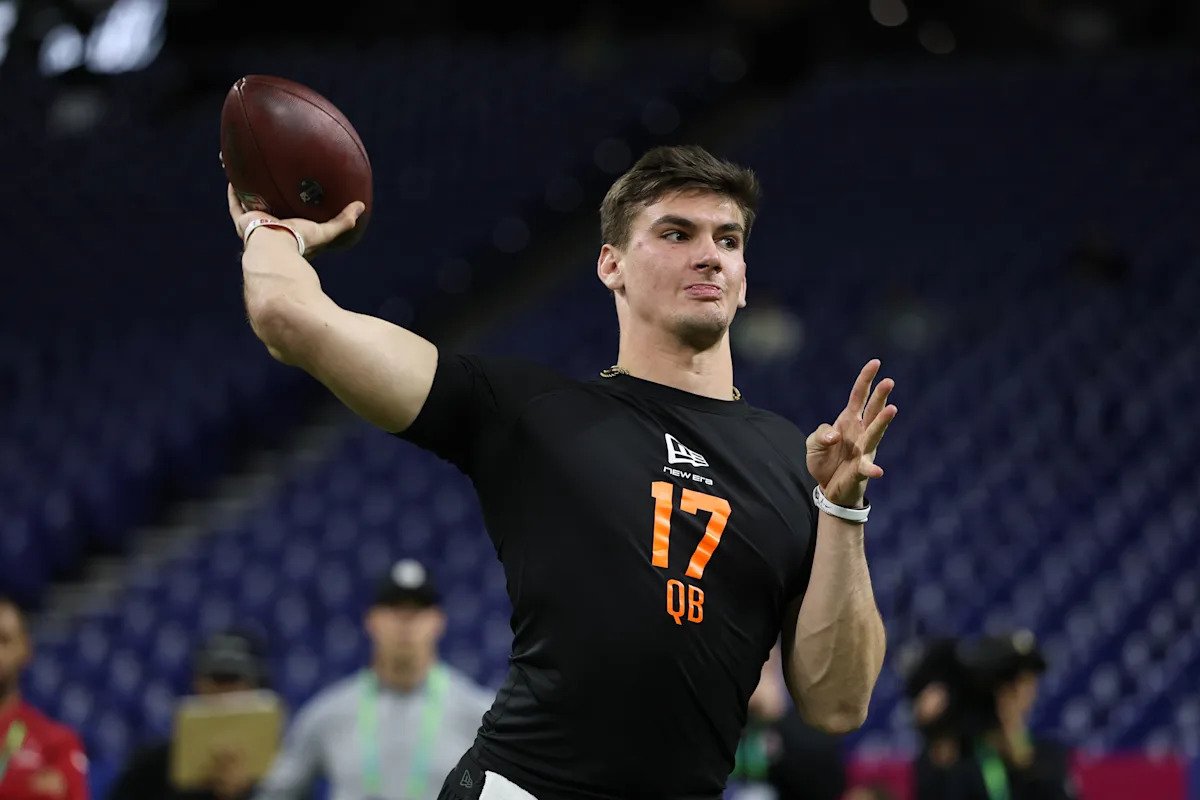
INDIANAPOLIS — Coming into the NFL’s scouting combine, the quarterback spot was best summed up as Indiana’s Fernando Mendoza and then a lot of guys in need of development. After Saturday’s QB throwing session — which Mendoza skipped — that analysis held firm … but with some added intrigue.
The arm of Drew Allar? Didn’t disappoint, particularly on deep throws. The accuracy and mechanical efficiency of Ty Simpson? Evident. The athleticism of’ Taylen Green? Beyond absurd. The overall thumbnail of the entire quarterback class? Probably unchanged in terms of potential to start in the NFL quickly.
Advertisement
That was the biggest takeaway from Saturday’s throwing sessions, which were suggestive of what we’ve been hearing from talent evaluators for a while: You can find some tools or traits to like, but when you get beyond Mendoza, the 2026 NFL Draft is filled with a litany of backup quarterbacks and a precious few who might develop into starters.
A brief thumbnail on five who stood out throwing against air:
Alabama’s Ty Simpson — You can see why he’s firmly entrenched as the No. 2 quarterback in the class, albeit far behind Mendoza. He was smooth and relatively mistake-free Saturday, with easy mechanics and accuracy with all the throws that he was tasked with. It’s not hard to see where the Brock Purdy comparisons are coming from, with both his size and how he looks throwing.
When you get past his frame, which is passable by NFL standards, it comes down to his lack of starts and the back end of his season fading in 2025. He didn’t hurt himself at the combine. If anything he solidified his status as the next QB after Mendoza.
Alabama QB Ty Simpson likely solidified his status as the No. 2 QB in this draft with his workout on Saturday. (Photo by Stacy Revere/Getty Images)
(Stacy Revere via Getty Images)
Penn State’s Drew Allar — He’s got the arm and the frame and absolutely looks like the prototype big, strong QB that NFL teams are looking for. He threw some really nice deep balls that didn’t look like they took much effort. He also had nice zip on intermediate routes. But you can also see the reliance on his arm, one of the things evaluators feel needs work. His mechanics, consistency and overall touch will end up being the factors that get teams under the hood with him for however long it takes to mold him. Overall, if you’re taking just the size, raw tools and nice deep tosses, it wouldn’t be a surprise to see him being the third QB to come off the board when it’s all said and done. Even with Allar’s very uneven college career, NFL teams always seem to gravitate toward raw skill, especially when it comes with prototypical size.
Advertisement
LSU’s Garrett Nussmeier — He was over his skis to start his session, with some shaky accuracy. But he got into a groove and really hit everything in rhythm once he got going. He looked healthy and confident throwing the football as Saturday’s workout went on. I still think some teams are going to ding him on his size, with the likelihood that he’s never going to become a 215-pound guy who can handle the wear and tear. It’s hard to know what he can be without really having a healthy season at LSU in 2025. It’ll be a projection for someone, but at the very least it looks like Nussmeier can go through the rest of the process and his workouts without worrying about the oblique issue that derailed him.
Miami’s Carson Beck — He went through his workout with the pro-Indiana Hoosiers crowd booing basically every rep. Interestingly, you could see the other quarterbacks in his group rallying behind him with encouragement and cheers. Some teams might see the reaction of his position group as a positive for Beck. His critics have questioned him as a leader at times, so seeing the other QBs get behind him is a plus. Even in a one-off situation. Beck also had a nice throwing session, displaying the arm strength and size that once had him projected as a possible top pick in the draft when he was excelling at Georgia. Like Allar, he can make throws all over the field without needing to load up. The size and effortless tools were there. And having a good performance in front of a weirdly hostile crowd — which really never happens at a combine — was a plus.
Clemson’s Cade Klubnik — He was very accurate and confident with all his throws. His arm isn’t big, but you could see how he has velocity on the short to intermediate throws. He looks like another good, efficient and polished passer. I thought he and Nussmeier stacked up well together once Nussmeier got going. It was surprising to see Klubnik pass on the 40-yard dash, given that he has the athletic profile to showcase a bit.
Arkansas’ Taylen Green — As a pure athlete, he’s wiping the floor with every other quarterback here. His 4.36 40-yard dash, 43.5-inch vertical and 11-foot-2 broad jump gave us a wild set of numbers. Especially when Green stands 6-foot-6 and checks in at 227 pounds. He also showed a really nice arm in the passing drills. But like most griping about quarterbacks who are extremely tall, he definitely has a bit of a long delivery. And he was off-target on several throws. He looks raw as a passer. I’m not sure what that will mean for him as an NFL QB project, but there’s no doubt he has an abundance of athleticism.
Advertisement
Some other odds and ends from milling around the combine on Saturday:
Is a hefty payday ahead for RB Kenneth Walker III thanks in part to a soft RB draft class?
While it’s hard to label a Super Bowl MVP landing a lucrative deal in free agency a shocker, there has been some definitive buzz in the agent and executive ranks that Seattle Seahawks running back Kenneth Walker III will end up getting a deal that puts him in the top three or four highest-paid at his position, with an annual average value that could reach $13 to $14 million per season. That’s a number solidly north of the $9 to $10 million window that some were predicting prior to the Seahawks’ Super Bowl-winning run, and still north of the $12 million average that some agents were slotting him at heading into the combine. Why the change? There are two main reasons.
Advertisement
First, New York Jets general manager Darren Mougey was very suggestive that the team will use the franchise tag on Breece Hall if they can’t get a deal done by the tag deadline of Tuesday at 4 p.m. ET. That was at least a surprise, taking the best running back aside from Walker out of the free-agent pool.
The second development was the running back class being generally soft in this draft and disappointing with a lot of players at the position sitting out portions of workouts at the combine. While there were certainly some combine bright spots, Walker is coming out of the combine as a winner, now being far and away the best free-agent option at his position and still having several years of prime left ahead of him.
Arkansas’ Mike Washington Jr. makes strong play for RB2 of this draft
Speaking of bright spots in this running back class, Arkansas’ Mike Washington Jr. is the quintessential “made himself some money” guy coming out of the combine. Some of the talent evaluators I spoke with heading into the workouts classified the running backs as having Notre Dame’s Jeremiyah Love in Tier 1, then Love’s backup, Jadarian Price, in Tier 2, then a drop-off to a Tier 3 that had a few players mixed in depending on scheme and the type of running back a team preferred.
Advertisement
There’s a chance Washington may have scooted himself up into that second tier with Price, blowing the doors off in workouts with a 4.33 40-yard dash, a 39-inch vertical and a 10-foot-8 broad jump — with a 6-foot-1, 223 pound build. And it wasn’t just a workout warrior moment, either. Washington had good production as a fifth-year senior at Arkansas and worked his way up through the transfer portal, spending three years at Buffalo before transferring to New Mexico State in 2024 and then to the Razorbacks in 2025. He has also shown he can catch the football out of the backfield. Don’t be surprised if he ends up pushing Price for the No. 2 back in the class, especially after Price checked in at a more “third-downish” 203 pounds.

Ohio State wide receiver Carnell Tate (37) runs the 40-yard dash at the NFL football scouting combine in Indianapolis, Saturday, Feb. 28, 2026. (AP Photo/Michael Conroy)
(ASSOCIATED PRESS)
Yes, Carnell Tate’s 40 time raises a flag, but …
Carnell Tate running 4.53 in the 40-yard dash wasn’t a stunner. Maybe mildly disappointing, but several evaluators went into Saturday believing he’d likely land somewhere in the 4.45 to 4.5 range based on Tate’s game tape and the practice data they’d gotten out of Ohio State.
Advertisement
Two things to consider with Tate: evaluators have always been more enamored with his ability to get himself open with his polished route-running; and he showed top-end ability to aggressively attack the football when it came his way.
I’d expect Tate will end up running the 40 again at Ohio State’s pro day and likely slot closer to the 4.45 to 4.5 range that was expected at the combine. All of that said, the one rub here with Tate now is that for his frame (just over 6-foot-2 and 192 pounds) there aren’t a great deal of good comps in the NFL who ran in the low 4.5 range. If Tate can get into the 4.45 to 4.5 range at the Buckeyes’ pro day, that puts him more into the realm of a George Pickens in terms of size-to-speed ratio.
Bottom line: the 4.53 is not everything. But it’s also not nothing. Especially when Tate entered the combine expecting to be a top-10 pick. Frankly, he probably should have done the pass-catching drills to leave the combine on a brighter note, but he didn’t.
Reasons to believe Browns are looking to move back in draft
One of the teams that I think may end up getting targeted for trade-up scenarios is the Cleveland Browns, who hold the sixth and 24th overall selections in the first round. The Browns are more likely than ever to end up with Deshaun Watson as their starting QB in 2026, and I think there’s a longer view in play. Watson’s deal expires after next season and Shedeur Sanders still has a significant amount of development needed to be cemented as a starter. I think if the Browns have a chance to move back in this draft — especially from that 24th pick — and get a 2027 first-round pick as part of the return, there will be an appetite to make that move and create the flexibility to dip into what is expected to be a quarterback-rich 2027 first round.
Advertisement
The ultimate goal would be options. If Watson doesn’t provide any attraction to be re-signed as a starter and Sanders doesn’t appear to be in the plans as a long-term starter, having a second first-round pick available to maneuver in the 2027 quarterback class will be more attractive than the players on the board in April’s first round. The caveat, of course, is that we don’t know who will be available at No. 24 and whether there will be an inclination to trade up into the 24th pick while sacrificing a very valuable 2027 first-round pick.
Prospects declining drills at combine continues to confound teams
I said it two years ago when I wrote a piece about the combine entering an “opt-out” era, but I think it’s becoming even more prominent. It’s getting to the point of players being advised to do only whatever they do well and skip everything else. I understand this in terms of the jobs of agents. But we’re seeing some agility drills, like the 3-cone with running backs, basically getting eliminated from some positional workouts. It’s not ideal for NFL teams to see the trend continue to deepen and you wonder if there’s some kind of breaking point where teams strip players off their boards who completely refuse to do certain drills.
There has been some grousing for the past few years from some in the personnel ranks about rescinding combine invites when players won’t commit to certain drills, but that will never happen because teams still value the medical checks and interviews over getting every workout measurable.

