Winning the opening race of a new Formula 1 rules era has long been viewed as a sign of things to come.
You’ll likely remember Brawn and it’s mighty, double-diffuser aided, advantage at the start of 2009, or Mercedes’ Nico Rosberg and Lewis Hamilton fighting only themselves in the opening 2014 races after a major engine regulation change.
But ahead of the dawn of what is arguably F1’s biggest-ever rules shake-up with all-new cars and engines, just how important — and foreshadowing — will the Australian Grand Prix be? And will whoever we see at the top step of the podium in Melbourne on Sunday, also be lifting the Drivers’ World Championship trophy come December?
– Bold predictions for F1 in 2026: Ferrari will end its title drought
– Australian Grand Prix 2026: Race start time, how to watch, full schedule
Why winning in Australia isn’t everything
With help from ESPN Global Research, we’ve looked at nine other previous major regulation changes, since 1961.
In those nine seasons, only four drivers who won the first race of a new era went on to claim the title that year, and on just three occasions did the eventual constructors’ champions also win the opening race.
And the winning driver and team of the season-opener going on to claim both championships? That has happened only twice.
Back in 1961, for one of the most revolutionary regulation changes with a regulated engine and maximum car weight introduced, Stirling Moss won the opening race of the season for Lotus Climax, but he would finish the season third in the standings and Lotus second. Phil Hill and Ferrari came on top.
Then, when flat-bottomed F1 cars were debuted in 1983 after the first — but not the last — ‘ground effect’ era, Nelson Piquet won the opening race, and indeed the title. But his team, Brabham, were only third in the constructors’ standings, with Ferrari eventual winners of that crown.
A ban on turbo engines in 1989 saw more of the same unpredictablity. That year, it was Nigel Mansell who won the season-opener for Ferrari — but he would only claim victory once more that year. He finished fourth in the standings while Ferrari were third as Alain Prost and McLaren reigned supreme.
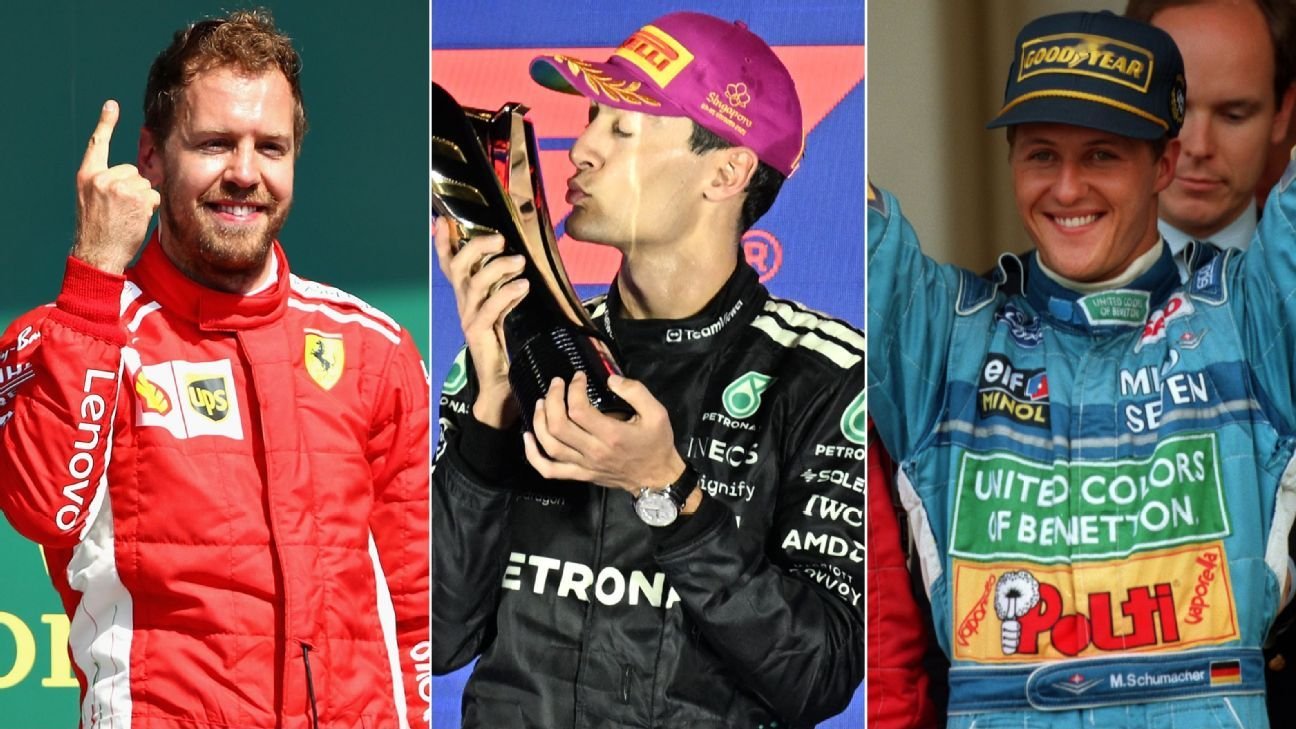
Order was restored a touch for the following regulation overhauls, with Michael Schumacher (1994), Mika Hakkinen (1998) and Jenson Button (2009) winning the opening race and indeed the drivers’ titles — though in Schumacher and Benetton’s case it was Williams which in fact won the constructors’ championship that year.
More recent seasons underline the uncertainty, however. Mercedes may have walked away with the championship in 2014 but the first winning driver of that season — Rosberg — was beaten to the title, while in 2017 Sebastian Vettel and Ferrari’s good start wasn’t matched by silverware, with Hamilton and the Silver Arrows again on top.
The most recent major rule change came in 2022 with another ‘ground effect’ era — aimed at improving racing by reducing ‘dirty air’ — and Charles Leclerc won the opener in Bahrain.
But the drivers and constructors’ champions, by quite some distance? Max Verstappen, and Red Bull.
Who’s the favourite this weekend?
For months, the consensus in the paddock was that Mercedes was the heavy favourite — based on its power unit — and while the team has been playing down expectations, a bit of gamesmanship might be at play.
Mercedes have had a quiet confidence all preseason and despite not showing all its pace, frequently lit up the timing screens in Bahrain.
If that is indeed the case, then look out for George Russell, the defacto team leader who is desperate to follow Lando Norris in claiming a maiden world championship.
Behind them? Ferrari seem to be leading that pack — although there are still so many unknowns with these cars, and indeed how they’ll fare at a unique Albert Park street circuit in Melbourne.
But as ever with F1, you can never count out Red Bull’s Max Verstappen, or indeed world champions McLaren and star drivers Norris and Oscar Piastri.

