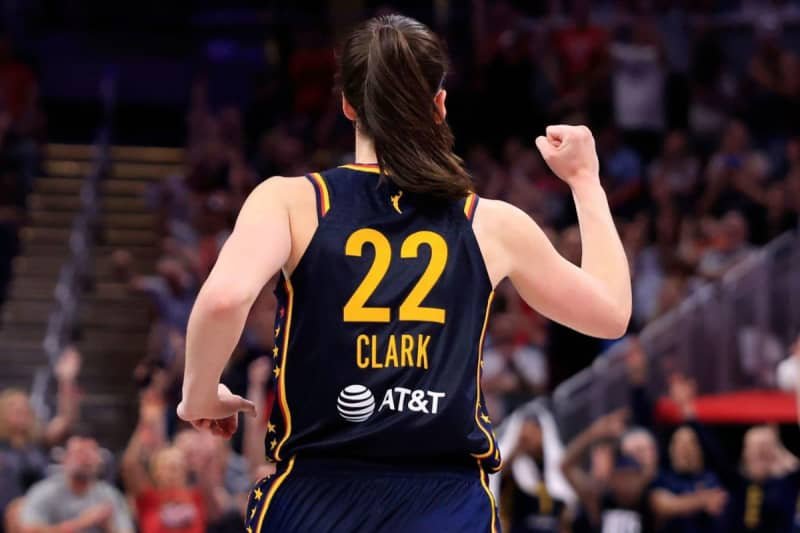
A single player can open the door. But sustaining an entire industry? That takes something bigger. If you’ve been following the WNBA, you must already be familiar with the “Caitlin Clark Effect” narrative. It has been credited as the driving force behind women’s basketball’s modern boom. However, can the league’s growth last without her?
That’s where Susie Piotrkowski stepped in last week at a Front Office Sports event. As ESPN’s VP of women’s sports programming and espnW, Piotrkowski argued that while the Indiana Fever star may have brought fans in, the product itself is what’s making them stay.
Advertisement
“I say this in quite literally the most positive way possible: Caitlin’s a gateway drug for some people to women’s sports,” she said. “If that brought you in, I’m going to keep you here.”
“Nobody wants the finger wagged at them, especially if you’ve been in sports for 20-plus years, and you’ve worked at ESPN, and you’ve built other parts of our business. It’s my job to build the bridge to get you to understand that this is the best business opportunity. I’m not going to make you feel silly if you don’t get it, or you still think, ‘Oh, so is that rating because of the Caitlin Clark effect?’” Piotrkowski further added.
Her point wasn’t to downplay Clark’s influence on the league or the sport as a whole. If anything, it was to acknowledge it and then expand the conversation.
Advertisement
“Well, she’s been out of college basketball for a long time,” Piotrkowski said. “I’m going to tell you why it is more than that. And that’s okay if you’ve come by way of her; now I’m going to tell you why it’s necessary for you to stay here.”
When Clark was playing in college, she helped push the 2024 NCAA Women’s Final Four past the men’s tournament in television viewership. Her arrival in the WNBA turned the Indiana Fever into appointment viewing. And nearly every major ratings spike over the last two seasons has carried her fingerprints.
However, when she was sidelined early from the 2025 campaign due to soft-tissue injuries, the WNBA still posted a 3% year-over-year increase in average viewership, drawing 969,000 viewers.
Network-by-network numbers:
Advertisement
-
ESPN/ABC (25 games): 1.3 million viewers, up 6%
-
CBS (9 games): 1.27 million viewers, up 16%
-
Ion (30 windows): 627,000 viewers, down 6%
For a league that struggled to draw a million viewers for its Finals just two years ago, those figures signal something closer to a new baseline than a fleeting spike.
Still, none of this erases Clark’s impact.
The four most-watched games of the 2025 season all featured her, including the Fever’s opener against the Chicago Sky, which drew 2.7 million viewers. Ion’s most-watched game of the year also included Clark, and her lone appearance on CBS produced that network’s top number of the season at 2.2 million. So without a doubt, she remains the league’s single biggest ratings magnet.
But in the end, it’s the sport that’s making the fans stay. And that growth is now forcing structural change.
Advertisement
New CBA Proposal Fast-Tracks Max Deals for Rookie Standouts like Caitlin Clark
It has been more than 16 months since the players and the WNBA have been at the negotiation table to figure out a new CBA. The players demand a better salary structure as the league continues to grow.
But with the 2026 season approaching, the WNBA and the WNBPA must agree on a new collective bargaining agreement by March 10 to avoid disrupting the May 8 tipoff. And the league’s latest proposal reflects just how dramatically the economics have shifted.
Sep 18, 2025; College Park, Georgia, USA; Indiana Fever guard Caitlin Clark (22) shown on the court against the Atlanta Dream during the first half during game three of round one for the 2025 WNBA Playoffs at Gateway Center Arena at College Park. Mandatory Credit: Dale Zanine-Imagn Images
According to ESPN’s Alexa Philippou, All-WNBA First and Second Team players still on rookie deals would become eligible to sign a max contract in their fourth season, a significant change from previous structures.
Advertisement
For a breakout star like Caitlin Clark, who earned All-WNBA First Team honors as a rookie, that clause would fast-track her path to a max deal. But the proposal isn’t designed for one player. It’s built for a league trying to recalibrate its financial model around sustained demand.
The numbers underline that shift. The salary cap would jump from $1.5 million to $5.75 million in year one of the deal, eventually reaching $8.5 million. Maximum salaries would increase from $249,000 to $1.3 million, while average pay would more than quadruple.
If the league’s rise was once framed around one player, this phase will be defined by how it rewards the players driving it. The new CBA isn’t just about Caitlin Clark. It’s about whether the WNBA believes its own momentum is here to stay.

