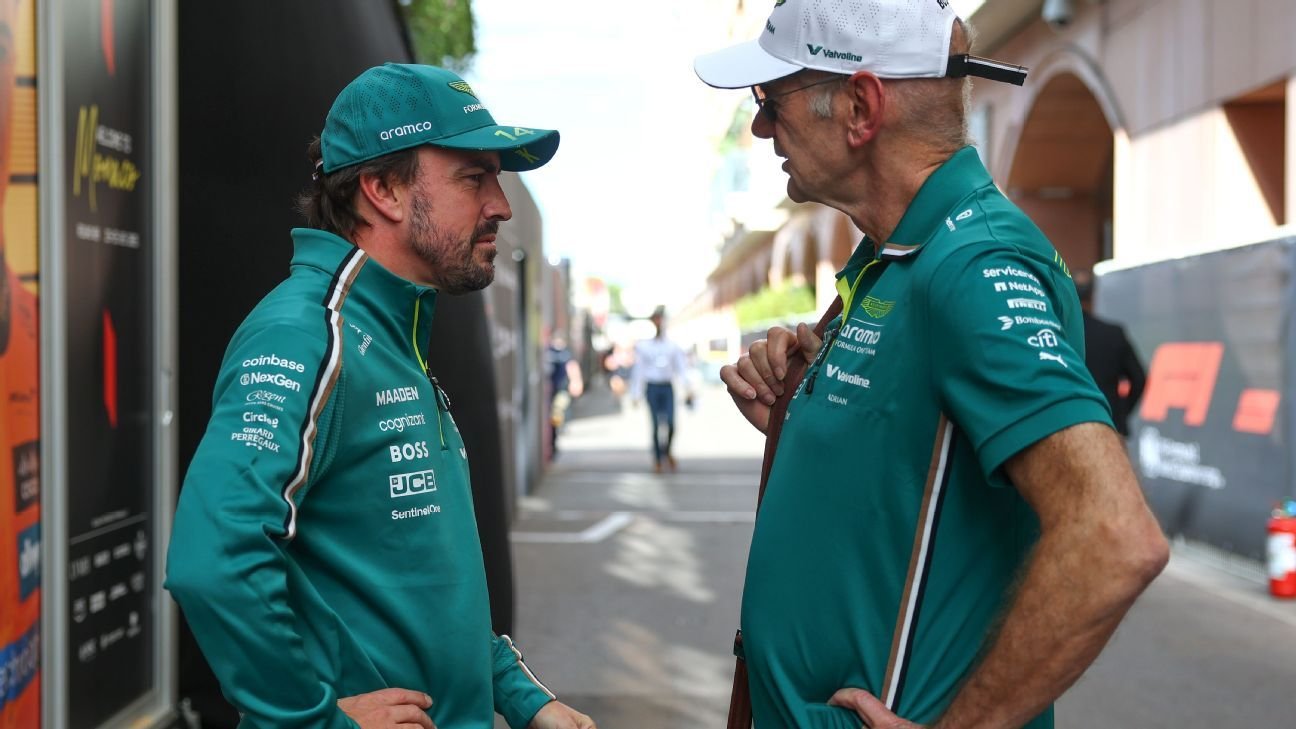
Aston Martin was supposed to be starting a glorious new era in 2026, but it heads to the Australian Grand Prix set to battle upstart newbies Cadillac to avoid starting last. It’s a baffling situation for the team star driver Fernando Alonso himself dubbed “the team of the future.”
The car running the famous tinge of British racing green was maybe the most eagerly anticipated of the off-season, given the hype and expectation that has led to this point. Billionaire owner Lawrence Stroll has long targeted F1’s new rules change as the moment he turned the team sporting the famous British racing marquee into title chasing juggernaught. He’s thrown money at every level of the team — a state-of-the-art new factory opposite the Silverstone circuit, a new windtunnel, big-name signings like design legend Adrian Newey and an exclusive engine deal with Honda.
But alarm bells were ringing — and ringing loudly — the moment preseason track action started. The team arrived late to F1’s private ‘Shakedown’ event in Barcelona, before spending the two weeks in Bahrain accumulating low mileage and setting dismally slow times. Stroll spent much of the Bahrain tests angrily stomping up and down the paddock as the extent of the problems with Honda’s engine became apparent. Going into the opening race, lenient analysts had Aston Martin 10th out of 11. ESPN had them 11th, behind Cadillac.
There’s been no sugarcoating it. Aston Martin, by its own private admissions are in deep trouble, and there might not be a quick fix, even if F1’s new rules have been written to help manufacturers in trouble catch up down the line. Newey has promised progress will come over the next few months, but a growing feeling in the Formula 1 paddock is the team will be in a hole for a long time.
– Bold predictions for F1 in 2026: Ferrari will end its title drought
– Australian Grand Prix 2026: Race start time, how to watch, full schedule
– Does winning first race of F1’s new era guarantee title?
– The craziest F1 start ever? Why Melbourne might see chaos from the off
How has this happened?
Anyone with a good memory will be having dejavu about the headline item here. Honda has arrived to a new regulation cycle significant steps behind its manufacturer rivals, with an underpowered, unreliable and overweight engine. The same happened in 2015 when it paired with McLaren, a situation which barely improved over three miserable, painful seasons. Ironically, as looks set to be the case this year, star driver Alonso was one of the two drivers who had to bare the brunt of those problems.
This time around problems were numerous. Honda’s engine was heavy from the beginning, and Aston Martin has struggled integrating it into Newey’s new chassis. Assessing its true performance levels has been complicated by this and other issues — some Spanish media reports suggested it vibrated so much during Bahrain testing that the car could not be run anywhere close to full power, even though full power seems to be significantly down on the likes of Mercedes, Ferrari and Red Bull anyway. Worst of all, the engine did not appear to be reliable, and that’s where the fact it’s not being run at full beans is even more concerning — the upper limits of an engine’s performance capacity is often where the bigger reliability issues lie. All in all, Honda’s engine seems fundamentally flawed in every area.
The fact this has happened to Honda again is baffling. Some have pointed to the decision the Japanese manufacturer made at the end of 2021 to quit the sport, which saw it put a freeze on anything beyond the existing engine which helped Red Bull and Max Verstappen win titles at the start of this decade. The company did a U-Turn in early 2023, thanks in large part to the existing set of regulations which they had played a part in formulating. Some have argued the 18 months or so Honda had committed to an F1 exit as a reason for the current situation, as its engine programme was effectively frozen internally at that point.
The obvious counter argument comes in from Honda’s former partner, Red Bull, who have built their own engine from scratch — starting in late 2022 after a proposed partnership with Porsche fell apart in the closing stages — and appear to be coming into the new season in a competitive position few expected them to be in this early. New manufacturer Audi has also entered the new season in decent shape with the first ever F1 engine the company has built. The excuse of the time Honda spent thinking they would not be racing beyond 2026 is a difficult one to give much credence to. Former team boss Andy Cowell, shuffled back to a Honda-facing role after Newey’s arrival, has spent much of the winter at the company’s Sakura facility and it is clear there’s a great deal of cage-rattling going on from Lawrence Stroll already. It was telling that on the final day of testing, it was Honda who put out a press release saying the team’s running would be limited — usually that kind of press release would come from Aston Martin.
F1’s rules have a mechanism which could allow Honda catch up — dubbed ADOU, or Additional Development and Upgrade Opportunities — given to any engine which produces over three percent less power than the highest-performing manufacturer by midseason. Honda already seems a shoe-in to trigger that mark, but that in itself is no guarantee it will be able to catch up, even if afforded more resources and leeway to work on the problem. It has to fix the existing issues first, and those seem significant, all while its rivals are understanding more and more about the complicated new power units with every passing week.
Is everything on Honda?
While Honda are a clearly the largest part of the issue, blame cannot be solely laid at their doorstep. The problems the team are facing have laid bare some deeper issues which could have been predicted to anyone who has been paying attention to Stroll’s big-money dream team of talent and resources. One of these was the idea that bringing Newey in was going to be a magic bullet in terms of performance.
The design of his first Aston Martin F1 car turned heads in Barcelona, although it is difficult to separate actual technical fact from the aura the Englishman carries with him as the sport’s most successful car-builder ever. One notable viral video in the hours after Aston Martin’s car had first emerged from the garage at Barcelona likened the car to the Mona Lisa and the Sistine Chapel in its unprecedented beauty, thanks to a slightly different take on the assembly of the rear wing compared to its rivals. Such comparisons seem to have been incredibly premature, with the car seemingly also behind schedule due to the late arrival of Aston Martin’s wind tunnel and Newey himself, who only started in April last year after a period of gardening leave which followed his Red Bull exit.
Then there’s what Newey’s presence at the team represents something more widespread. His signing was seen by most as the key missing piece of the puzzle. Finally, everyone rejoiced at the time, Newey, who has built winners wherever he has worked, could design a car for Alonso, who he had never crossed paths with before. A tantalising combination, no doubt. But Newey’s signing did something else.
Each time Stroll has made a new big-money engineering signing, its had the remarkable effect of undermining the last one he made. Stroll signed ex-McLaren CEO Martin Whitmarsh to a significant leadership position in 2021, but the arrival of former Mercedes engine guru Andy Cowell marked the end of Whitmarsh’s stint with the team. Former Red Bull technical whizz Dan Fallows was an early big name, but Newey’s arrival undercut him in a major way. Cowell’s position was also significantly undermined by Newey’s signing and ESPN understands Cowell is set to leave the team for good later this year.
That’s just the tip of the iceberg. The chopping and changing of names in key leadership positions represents major overhaul at every level — ESPN understands Aston Martin onboarded 250 new hires in 2025 alone, and the team has grown from around 400 in its days as Force India to somewhere north of 1100 in its current form. That rapid growth might have been easier to manage if there had been stability and clarity at the top, but Stroll’s impatient, trigger-happy approach to hiring has led to a vacuum of leadership at the top of the company. That’s never a good thing for any company. In a time of crisis like the one Aston Martin is currently facing, it becomes even more obvious.
Newey’s role as a leader of men and women might also be under question as well. You only have to watch one interview with him to see his skills are not in the the charisma field. While the role of the F1 team boss has changed in recent years and lent more towards people of an engineering background, like McLaren’s Andrea Stella or Red Bull’s Laurent Mekies, you still usually need a strong character at the top to act as a mouthpiece. Newey’s former Red Bull boss Christian Horner was a great example of this — in times good or bad, he would front up to the media when he ran that team.
By contrast, over the two weeks in Bahrain, Newey refused to speak to the media, while Stroll also barely speaks publicly. The uninspiring Mike Krack — another man undermined by the arrival of other talent which shuffled him out of the former role of team boss — and team representative and former race driver Pedro de la Rosa were left to face the media and explain the team’s problems. Rudderless teams with unclear lines of leadership are often exposed in moments like this and the fact Newey and Stroll both declined to be the ones taking accountability spoke volumes about what the internals of the team must look like.
What happens to Alonso now?
The elephant in the room is what happens to one of Stroll’s original big-money signings, Alonso, who will be 45 later this year. Stroll’s son Lance appears to have a contract for as long as he wants one to drive the car, but the future of Alonso, who’s deal is up at the end of this season, was always going to be a major talking point and one closely linked to how the car performed this year. Alonso has not won a title since 2006 or a race since 2013 and he returned to F1 in 2021 with the memorable tagline ‘El Plan’ — his chase of that elusive third world championship. It didn’t work with Alpine, but he moved over to Aston Martin, lured by Stroll’s ambitious vision to completely rewrite the competitive order under this set of rules.
After all the hype and the waiting, Alonso looks set for another bitterly miserable year. He’s widely regarded to be the most complete talent of the modern era but looks set to also be remembered as one of the most unfulfilled talents the sport has ever seen — the fact that’s the case when he has two world titles to his name should highlight just how good most in F1 think he is. Alonso infamously embarrassed Honda about its “GP2 engine” at its home race in Japan during the dark days at McLaren and its almost impossible to imagine he will be any nicer about things this time around.
One saving grace for Alonso in terms of staying in Formula 1 might be that the line of people wanting to talk to Stroll must have diminished significantly over the past few weeks. Even if Aston had arrived in this new era of F1 just slightly off the pace but with a strong foundation and a clear path for progress, they would have been a tantalising prospect for any driver looking for somewhere to move after this season.
Reports last year in Italy said Charles Leclerc had talked to Aston Martin as a potential jump-off point should Ferrari falter coming into this regulation cycle. It’s hard to see that option looking appealing anymore. Joining Aston Martin now would be like getting a lifeboat to the Titanic after it hit the iceberg. You can also assume Stroll’s long-standing and well-known ambition to sign Verstappen from Red Bull is dead in the water now. Verstappen already seems to dislike the new rules — it’s hard to imagine you could convince the Dutchman to drive both a car he doesn’t enjoy and one that is seconds off the pace.
Whether Alonso even wants to stay beyond 2026 remains to be seen, and his mood will become clearer over the opening weeks of the season. Usually, that would be a key concern for everyone at Aston Martin. But the scale of the issues are so deep, even how Alonso feels seems like an afterthought as we head to the Australian Grand Prix.

