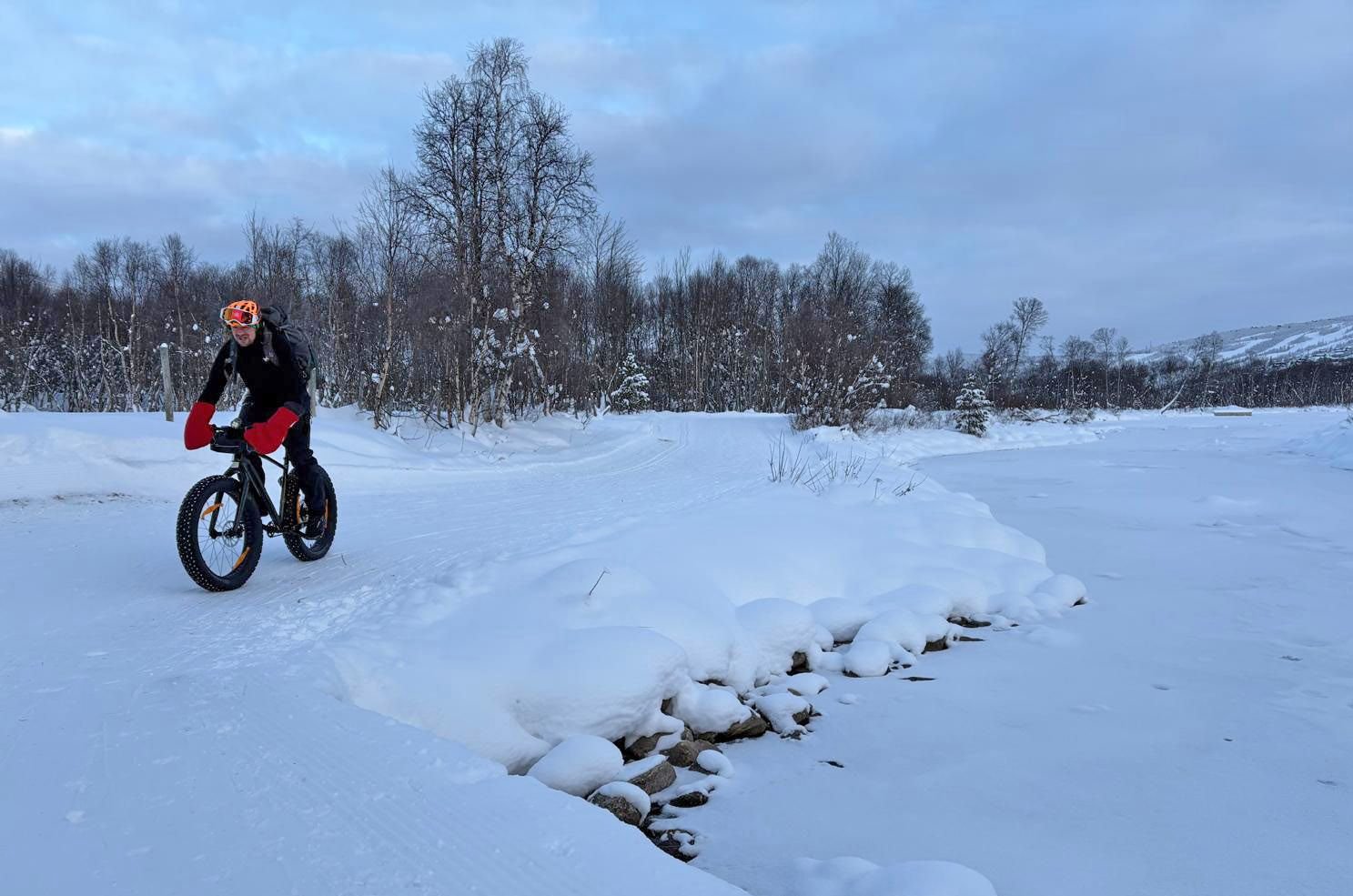
I realised I’d bitten off a little more than I could chew at the two kilometre mark. I’d been riding for just shy of an hour and although my brain had already begun to misfire I still had a grasp of rudimentary arithmetic: At this rate completing the 150km Fat Viking event in Geilo, Norway would take about three days.
That’s three long days in icy cold conditions – and we’re not talking about a bit of frost on the car windscreen here, we’re talking about the kind that takes your fingers off.
It was -22 degrees in Geilo when we – myself and fellow Going Long Adventure podcast presenters Dan Baines, Ian To and James Benson-King – alighted from a four-hour train journey from Oslo. The Fat Viking was a ride we’d been planning for several months and kitting ourselves out for the occasion started with the new and interesting experience of acquiring a fat bike. Not even the best gravel bikes, with the biggest tyres would be up to this task.
Fat bikes are not, as the name suggests, a bicycle that’s succumbed to one too many pork scratchings, instead they earn their title from their tyres – 4 inches wide at the rim, and up to 6.5 inches wide at the outer reaches of the gnarly rubber – designed for snow and sand. Unsurprisingly, UK availability was limited. “We don’t sell them anymore.” or “Try our US branch” was the standard response we got.
Riding through the snow is slow going
(Image credit: Steve Shrubsall)
Two of our number, then, – myself and Dan – were resigned to hiring a pair of Giant Yukon hire bikes from the event HQ in Geilo. This wasn’t ideal. The bikes themselves are fine, but picking them up on arrival leaves little time for fettling or familiarity; we’d roll out cold and hope for the best. Ian and James, meanwhile, are both seasoned fat bikers and travelled with their own machines.
Once sourcing a bike was ticked off it was time to concentrate on the small matter of not freezing to death. That I’m writing these words now not only pays testament to my superlative organisational skills (ahem), but also the comprehensive mandatory kit list that the event organisers had written in bold at the bottom of the race entry email. The list started with a curious entry: Pogies. Who or what are they? Didn’t they sing Fairy Tale of New York?
“No, they’re handwarmers that fit onto your handlebars, “ Ian told me. “Your hands will actually drop off without them.”
I’m rather attached to my hands, so the Pogies were duly added to the shopping basket along with other items including a Thermos flask and (“at least three”) chemical handwarmers. They had to be as there was a mandatory gear check before the start.

As if riding in deep snow wasn’t hard enough, we ended up riding in the dark.
(Image credit: Steve Shrubsall)
Back to the two kilometre mark and I was towards the back of a 40-strong group of starters. Snow fell in silent flurries while a slowly rising sun began to shed a little more light on the situation. Winter in central Norway isn’t gifted with a huge amount of daylight; the shortest day plays out through a four hour window from 10am to 2pm.
We were afforded a slightly more indulgent six hours today, and at 9am an ethereal landscape unfurled before me. I allowed myself a few moments of tranquil repose. The noise in my head had been deafening from the outset. Would I complete this race? Would I even make it to the first checkpoint at the 50km mark?
But now, clambering unceremoniously from the Giant Yukon, my thermally insulated Lake cycling boots scrunching into six inches of loose snow, I took a deep appreciative breath of cold mountain air and drank in the surroundings.
Unfortunately my surroundings would be the only thing I’d be drinking over the next several hours. Reaching for the hose of my hydration bladder, I noticed that it had frozen solid. I suppose this was to be expected at -20 degrees, but that didn’t change the fact I still had 148km of riding ahead of me and my only liquid was now solid ice.
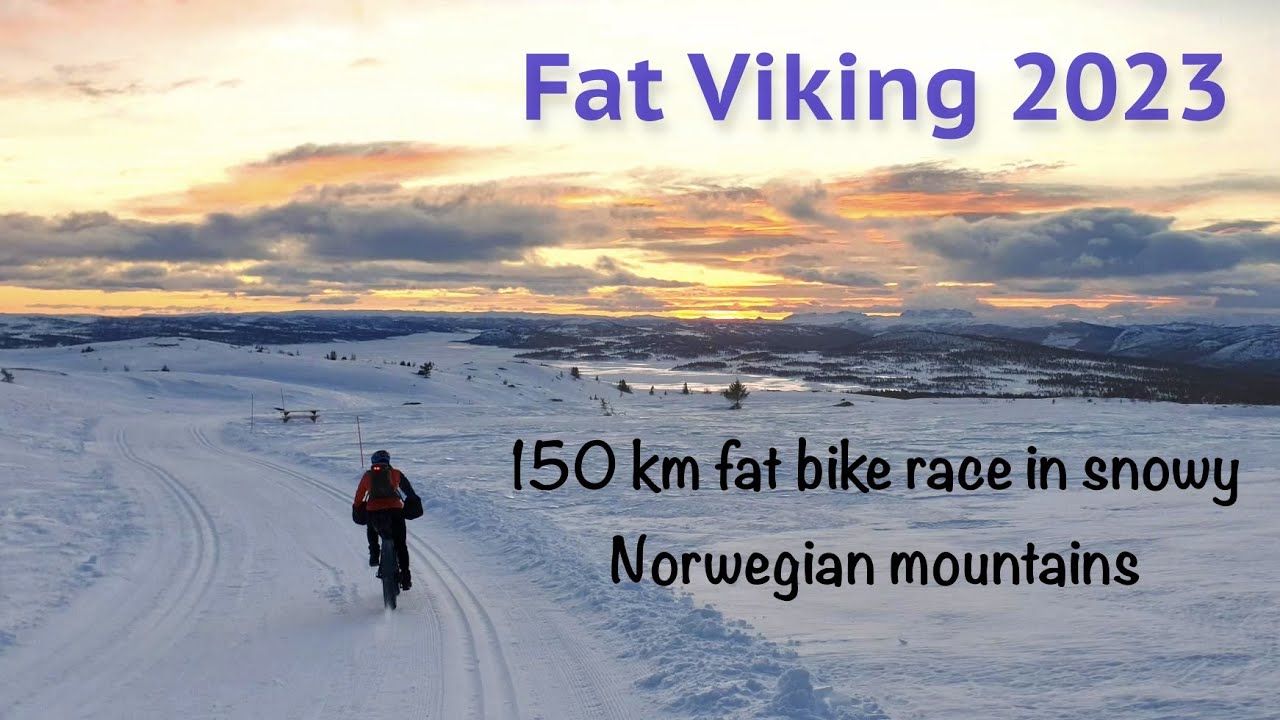
The voices soon started. Just a whisper at first, but planting the seed of doubt. “You are useless .” They told me. “You will fail – again.”
At the five kilometre mark the whispers morphed into a muted roar. Muted because my head buried under three feet of snow.
I’d suffered the first of several dozen spontaneous meet and greets with the Norwegian tundra. Every time I stumbled on a semblance of pedalling rhythm, six inches of rubber met with three feet of snow. I went straight over the bars and each time would spend the next 10 minutes emptying snow out of my helmet.
The 25km mark signalled my new halfway point. It had taken me four and a half long and arduous hours to reach this milestone. There had been little riding, lots of walking and even more falling over. I was inside the strict cut off time for the 50km event, but the chances are I wouldn’t make the others. And there was no bargaining with the organisers on this front. 150km was not going to happen. The voices had won. A line from Radiohead’s Creep played on a loop in my head: “I don’t belong here.”
But then something strange happened. I overtook someone. Then I overtook someone else. Before long I’d moved up five places. Granted, several of my rivals vying for last place were also in the process of extracting their heads from snowdrifts, but it was an empowering revelation. I was not uniquely useless. We were all ensnared in our own private battles with the snow, taking it in turns to topple off our bicycles.

(Image credit: Steve Shrubsall)
Maybe I do belong here. Or maybe none of us belong here. Maybe I’ve accidentally entered the hardest bike race on the planet.
At the 35km mark I decided that this was indeed the hardest race on the planet. I’d been riding for six hours. That’s an elapsed time of around 5km per hour. That’s a brisk walk, and no matter how you dress it up, it’s incredibly slow.
Other than the woeful statistics displayed on my Strava feed, it’s difficult to convey just how psychologically punishing this experience was. From a physical point of view, despite the fact I’m writing this two weeks later and I’m still regaining feeling in my feet, it was fairly standard endurance fare. But the concentration required to sustain any kind of momentum was a bit like an online IQ test – the parcours had to be analysed, interpreted and actioned every pedal stroke.
None of our number finished. Myself and Ian bailed at the 50km mark, Dan boldly attempted the 100km option but came unstuck with a navigation error, and James got picked up by a skidoo at 90km. We’re listed in the results of the 50km race with NA next to our names. Kenneth Asmussen of Denmark won in a time of eight hours 29 minutes while the 150km event was won by Italian Filippo Barazzuol in a quite remarkable time of 14 hours 32 minutes.
Of the eleven Brits who entered only one, Stuart Barlow, completed the distance he set out to ride. Everyone else is listed as NA or DNF. Officially, only one rider completed the 100km event, the other ten finishers had all started the 150km route so were listed as NA.
On paper then a comprehensive failure on my part. A woeful way to start 2026.
But somewhere between the second and the 50th kilometre a moral began to emerge. When you choose to ride in off-grid locations the landscape doesn’t care about you. Not a jot. It doesn’t care if you’re cold, hot, hungry or just plain pissed off. It’s just there. It’s been there forever and won’t make concessions for ill-prepared cyclists.
The Fat Viking was a totally humbling experience – and although I didn’t manage to beat the Artic, at least I managed to give it a headbutt or two.

