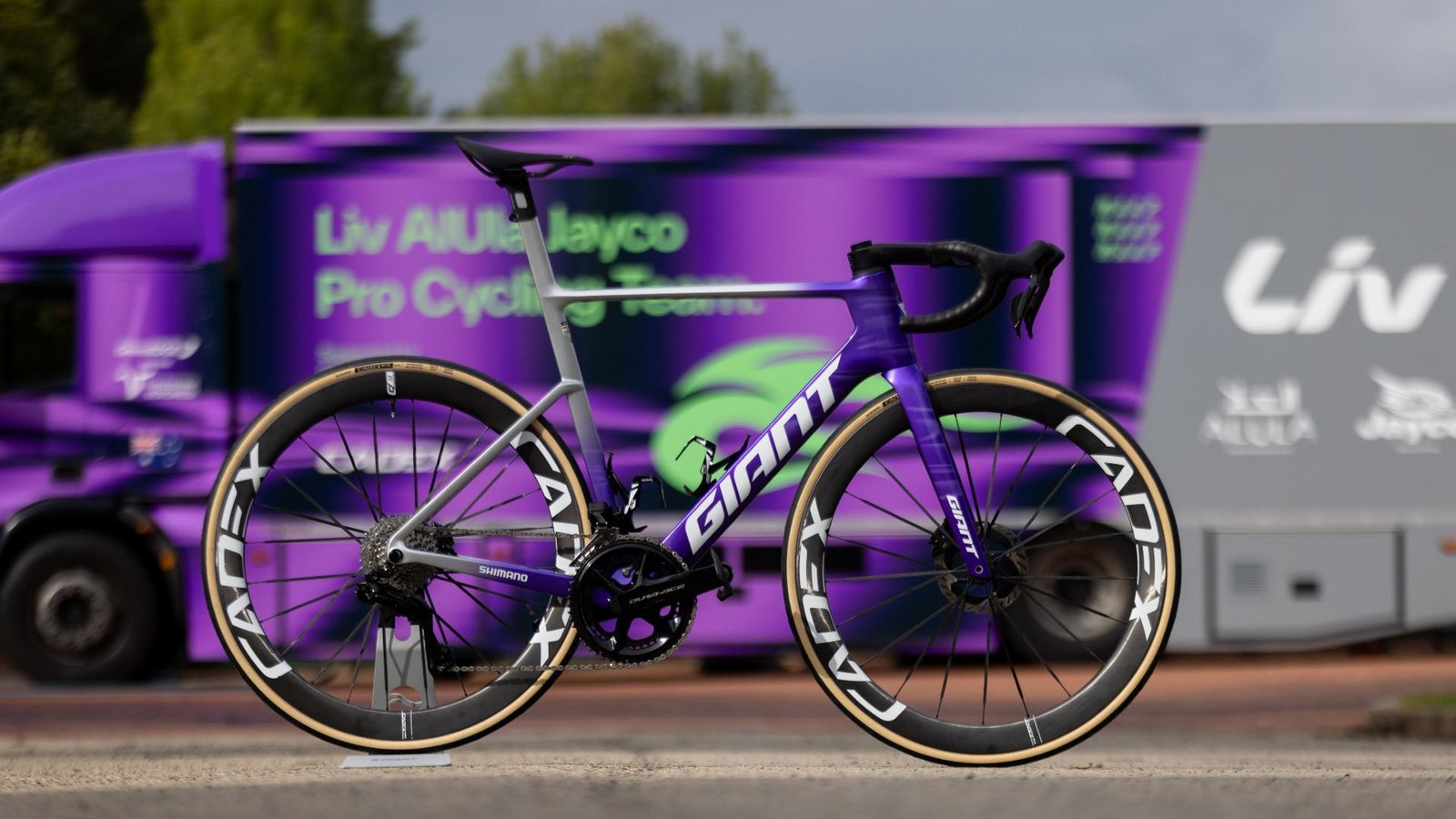
Since its inception the Propel has been winning bike races. The first generation, released in 2013, was resplendent in yellow a year later, piloted by Marcel Kittel to a Stage 1 victory at that year’s Tour de France. The last iteration was equally successful, winning two stages of le tour in 2023.
In this new version, which outwardly hasn’t changed much, like some similar launches recently, we’re having to reassess the category. The assumption has always been aero-bikes are just heavier. Not anymore. The 56cm model we got a peek at tipped the scales at 6.5kg, with cages and mounts installed.
(Image credit: Giant)
This is partly down to the way this bike has been conceived. Its development driven by what Giant likes to call its “total speed system”. Essentially, it means the bike has been developed to be a sum of its parts, rather than measuring the efficiency of elements in isolation; here, rider, frameset, cockpit, wheels and tyres are created as one drag-reducing unit, aided by a new wind-tunnel mannequin and plenty of real-world feedback from Team Jayco AlUla, who’ll be racing the Propel Advanced SL model throughout this season.

(Image credit: Giant)
As you might expect from a revised modern race bike, Giant claims that the latest Propel is lighter, stiffer and faster than ever before. The Advanced SL frame is said to be 45g lighter than the outgoing model, but when viewed as whole, taking into account the new integrated Contact SLR Aero cockpit, Cadex Max 50 wheels and the Cadex Aero tyres, the top-tier SL 0 becomes more than 350 grams lighter. Regarding the frame Giant has implemented new technologies, including one-piece molding and cold-blade cutting to help reduce weight. On the range-topping SL, continuous fiber technology has been used, which means fewer pieces and junctions.

(Image credit: Giant)
To improve aerodynamics the new Propel features airfoil sections that use truncated ellipse tubing, which are said to be more efficient than teardrop shaped tubes. The tube shapes are developed and proven through CFD modelling and extensive testing in the wind tunnel, and there are even aero bottle cages, specific to the seat tube and down tube.

(Image credit: Giant)
Like many race bikes, the front end has been slimmed down to reduce drag. The headtube is tapered and works in conjunction with the new Contact SLR and SL Aero cockpit. All models support fully or semi-integrated cable routing, with the SLR 0 featuring a ‘Cable Access Window’, to allow for easier adjustment.

(Image credit: Giant)
And it’s not just the cabling that helps the setup to be more efficient. The bars are shaped with a narrow top and flat back with the aim of cutting through the wind, while the geometry is designed to help narrow the rider’s frontal area. In terms of numbers, you’re getting a 72mm reach with narrower hood spacing and a compact 125mm drop. The flare at the drops varies from 4.8 — 7.3° depending on the width options, which start at 360mm and go as wide as 440mm. Stem length options start at 80mm and extend to 140mm.
The ‘entry level’ Propel Advanced bikes feature a two-piece cockpit with the Contact Aero SL Aero bars in play. These are an alloy bar that, shape-wise, bear a close resemblance to those of the one-piece carbon version used on the more expensive builds. The drop and reach numbers are the same, as is the 7.3° of flare. Width options are more limited however, with just 400mm or 420mm available.

(Image credit: Giant)
Similarly the wheels are part of the aerodynamic synergy. The SLR 0 and SLR 1 50 wheelsets feature 50mm deep hookless rims designed to be efficient across a range of yaw angles. There are carbon aero spokes, too, which help reduce weight and add some torsional rigidity; the claimed weight for SLR 0 set is 1,410g, with valves and rim tape. Like many new road wheels, the internal rim width has widened and at 22.4mm is a better fit for today’s wider tyres.
And talking of tyres, the wheels have been created in unison with the Cadex Aero and Gavia Course tyres. Both see a lightweight casing matched to a compound created to lower rolling resistance. The tread pattern is said to reduce air drag, as does the interface between tyre and rim; Giant says in the case of the Cadex Aero tyre, almost six watts are saved when paired with the SLR 0 50 wheels.

(Image credit: Giant)
Today’s racing is aggressive from the off, with explosive bursts peppering each and every race. In recognition of these stinging attacks Giant has married the drop in weight with an increase in torsional and pedalling stiffness – by a claimed 3.4% and 2.4% respectively. Combined they improve the SL ‘s stiffness-to-weight ratio by almost 6%.

(Image credit: Giant)
However, during a race, it’s important to be able to not only create speed quickly but to be able to hold and sustain it for long periods. And being comfortable is a significant contributor to this. The new Propel features an integrated seatpost that’s said to be 25% more compliant compared to the outgoing model. The fork and cockpit are almost 13% more compliant, and created to better absorb road chatter. Add in clearance for 32mm wide tyres and some svelte seat stays and you have, Giant says, a smoother and more efficient ride that keeps the rider fresher, for longer.

(Image credit: Giant)
As for the frame’s geometry the numbers are as you might expect for a WorldTour-ready race bike. A size M has a stack height of 546mm and a reach of 388mm. The chainstay’s are 405mm long, while the wheelbase is 980mm. Seat and head tube angles are 73.5 and 73 degrees respectively. So nothing out of the ordinary for a bike created to be fast, responsive and agile.
Range and pricing
The Propel Advanced is offered in three models and in numerous builds. The Advanced SL 0 is the most expensive option and comes in two builds: Shimano Dura-Ace and SRAM Red AXS. In the UK these are priced £9,999 and £10,499 respectively. Only the SRAM model is available in the US, priced at $13,500. The Advanced SL can also be bought as a frame only option, for £3,799 / $5,300.

(Image credit: Giant)
The Advanced Pro, with a frame built using a ‘high-performance grade’ carbon, rather than the ‘professional grade’ used on the SL, is also offered with a range of Shimano and SRAM groupsets, with prices starting at £4,599 in the UK, In the US only a single model is available, with SRAM, and costs $7,800. The Advanced Pro is also offered as a frame only, for £2,199 / $3,200.
Finally, the entry-level Advanced is offered across three models: 0, 1 and 2. Prices start at £2,599 / $3,500.
CW Says

(Image credit: Future (Richard Butcher))
Giant just dropped a new Propel. That’s big news, except, like many of this year’s WorldTour bike launches, the ‘new bike’ is almost an exercise in spotting the difference. It’s not all bad though, as we’re told the real work is happening inside the frames.
While that doesn’t make for exciting launches, we’re clearly reaching a zenith in carbon fibre bike production, where the previously awkward bedfellows, stiffness and compliance, now lay side-by-side, wrapped up in each other in ways that once seemed whimsical.
The aero bike, once assumed to be horrid to ride and heavier, is now compliant while able to hold magical speed; and recently we’re seeing weights nudge ever lower – bringing them into direct strategic conflict with their climbing cousins.
If aero bikes are necessary, it’s not at all clear if those at the top of the sport agree on that point yet – with big manufacturers like Cannondale betting on one bike to rule them all, going against the grain. They’ve emphatically moved to say, “we’re not going to play the quiver game anymore,” removing the SystemSix completely, taking its own aero-specific road bike platform off the table, and relegating it to the annals of WorldTour history.
Yet here, Giant is thoroughly reworking its aero platform. What’s interesting about that is the conundrum it creates for brands that stick with a two-bike solution. To illustrate my point, Giant proudly sent me a phone picture of the scales whilst they were building up our test bike. With pedals, an out-front mount, and two cages, it came in at 6.5kg in a size 56.
With Jonas leaving the R5 in the truck all last season, and Tadej snubbing the V5RS in favour of Y1RS, where on earth does this launch leave Giant’s TCR?

