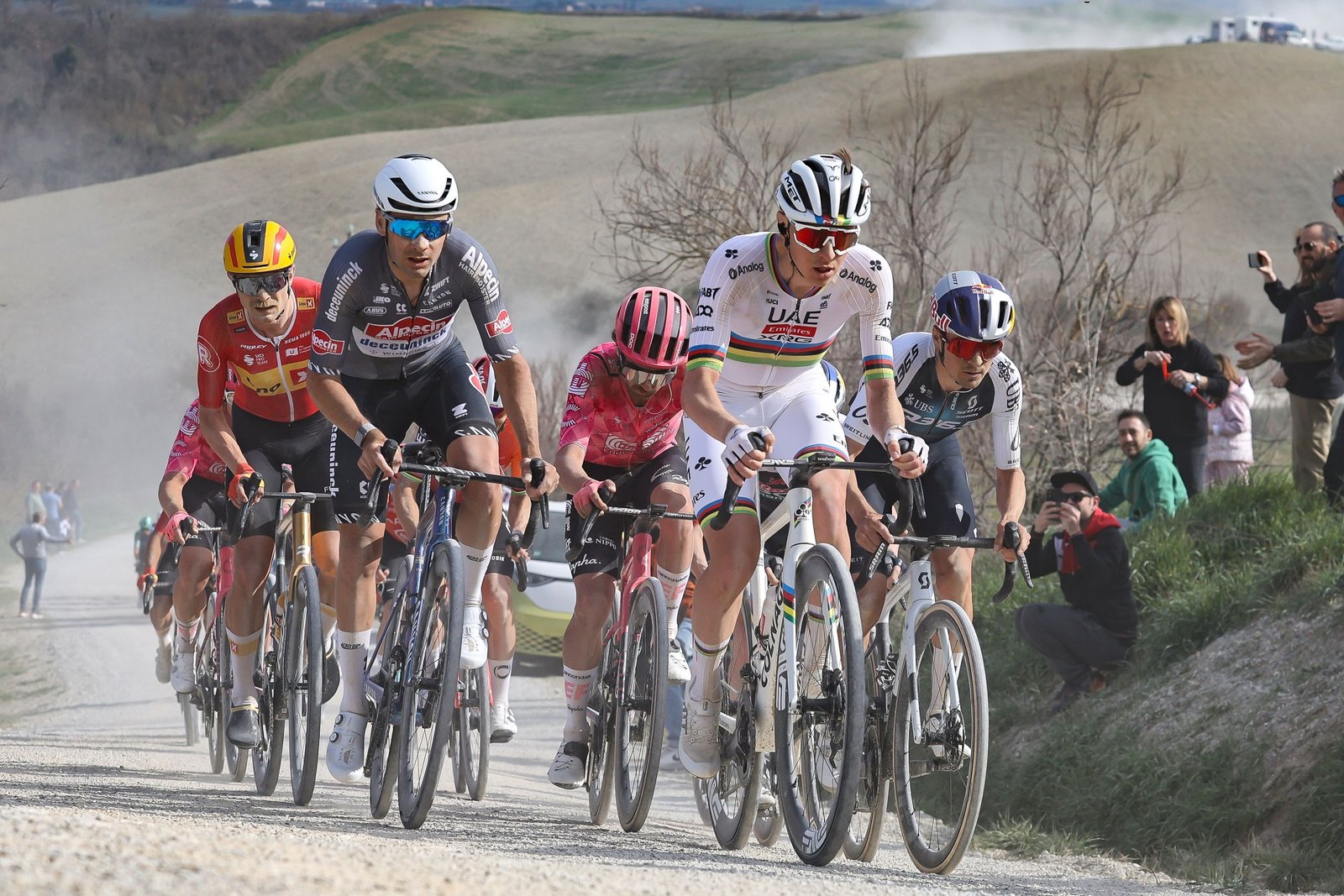
Plumes of white dust will fill the scented air around Tuscanys roads this weekend as the men’s and women’s pelotons take on Strade Bianche. But while it looks so much like a gravel race, why don’t the riders use gravel bikes?
Some 80km of the race is run on sections of road made of limestone gravel and chalky white clay. These rough farm roads that give the event its name look remarkably similar to the courses used in modern UCI Gravel race events.
And with multiple gravel and tarmac climbs throughtou the race, including the famous final climb into Siena’s Piazza del Campo, bikes that are lightweight become essential.
Fundamentally, that’s why most teams stick with their aero road frames. Teams riding Specialized bikes tend to stick with the S-Works Tarmac SL8 rather than the more endurance-focused Specialized Roubaix, although that bike has made the occasional appearance.
The Factor Ostro VAM gravel bike has been ridden at Strade, but the bike is arguably so similar to the road-going version, but with more tyre clearance, that it would make little difference. It’s likely it was the marketing team who wanted to see it prove itself in a high-profile race.
Whilst we don’t see many gravel bikes, we have seen plenty of gravel tech creeping in, especially in with tyres. And over the last five years, the bikes have adapted, with wider clearances for bigger volume tyres run at lower pressures. 25mm tyres crept up to 28mm, and I suspect we’ll see plenty of 30mm and 32mm options.
(Image credit: SWpix.com/Thomas Maheux)
Gravel bikes are getting faster
Of course, we now have gravel race bikes. Bikes like the Cervelo Áspero-5 have many of the features of bikes like the S5, and whilst they are indeed fast — I’ve been riding an Áspero-5 on all surfaces all year and think it’s an absolute rocket ship of an all-road bike.
It has bags of clearance and could offer more handling stability over the rougher sections, but it’s still not nearly as fast on tarmac as an S5. The aerodynamic penalty would soon add up on the very fastest sections.
Then there’s climbing weight, and stiffness. Even the lightest gravel bikes are slightly heavier than the dedicated road race frames. The geometry is designed for control, rather than an aero position and quicker handling. In a race that regularly sees decisive attacks on short, vicious gradients, that difference is important.
And then there’s the marketing to consider sponsors invest a packet in their flagship road bikes. Victory at a classic sells bikes.
All that said, the lines are still blurring. As gravel continues to grow under the UCI umbrella, race gravel bikes are getting lighter and faster, perhaps inching closer to the performance of road machines.
If weather, or a change in the route – where perhaps more off-road sections were added – the balance could shift. Riders might stick their necks out and gamble on a gravel platform, where the extra traction and control might help as the race hots up, in less ideal conditions.
For now, with tyres and clearance on road bikes edging ever upwards, the hybrid solutions seem fit for purpose, despite carrying a little more gravel, cyclocross, or even classics DNA than perhaps ever before.
The bikes you see riding flat out, emerging from the dust this weekend might be road bikes, but they’re far more adaptable, capable, comfortable, and downright fast than anyone could have imagined just twenty years ago, let alone before.
Explore More

