Just before he set a new North American attendance record for a single MMA event, Scott Coker had a problem with his cage. This was 20 years ago today — his first MMA event, the one that launched the Strikeforce brand and made him a somebody in the wild world of professional fighting — and it’s still the part he remembers best, mostly because it was the part that stressed him out the most.
The first problem with the cage was that there was no cage. Coker had ordered one, of course. He knew a guy who said he knew a guy in Tennessee, and that guy — or some other guy he knew — could get them a cage from a professional wrestling company down there. But it didn’t arrive on time and still needed to be loaded on a truck and driven more or less non-stop to San Jose, California — a task that was completed just in time by a young fighter named Donald “Cowboy” Cerrone.
Advertisement
But when the cage arrived and they went to put it together inside San Jose’s HP Pavilion, Coker and his associates discovered there was another problem.
“The cage got there seriously overnight, between midnight and the next morning,” Coker told Uncrowned. “We go to put it together and we realize, ‘Oh my God, this thing is shaking. Like, it is really shaking.’”
Coker turned to Bob Cook — better known in MMA circles as “Crazy Bob,” then one of the main coaches and prime movers at San Jose’s American Kickboxing Academy — and asked if he had any ideas. Turned out he did.
“He was like, ‘Let’s just get some zip ties,” Coker said. “So we did. We put like 2,000 zip ties on that cage to hold it together.”
Advertisement
According to Cook, it wasn’t just zip ties. “We used duct tape and rope and everything else we could think of,” Cook said. “That cage was just a disaster and the whole time we were so nervous about it falling apart.”
It didn’t, though. The cage held together in front of 18,265 people — a number Coker can still quote from memory — and Strikeforce began its existence on March 10, 2006 as an MMA promotion with a record-breaking event. It was also the first fully-sanctioned MMA event in the state of California, which had previously hosted multiple events at Native American casinos.
About a year earlier, the UFC had set a new high-water mark for itself with 14,562 fans in attendance to see the rematch between Chuck Liddell and Randy Couture at UFC 52 in Las Vegas. Coker didn’t think he’d beat that, but he thought maybe if he did everything right, maximizing his connections in the Bay Area martial arts community and putting together the right card for this place and time, he could maybe get 10,000 people in the door.
Advertisement
When he started to think he might be wrong was when AKA coach and founder Javier Mendez called and asked about tickets.
“He said he wanted to buy some for his friends and he didn’t want to bother me when I was so busy, so he went to Ticketmaster and they were all sold out,” Coker said. “I was like, ‘No, that can’t be right.’ So I checked — and sure enough, we were sold out.”
In case you’re wondering, this is the kind of thing that basically never happens. A new fight promotion does not take shape in the combat sports ether and then sell out an NHL arena with its very first show. It certainly does not set new attendance records with its first attempt.
And yet Strikeforce did.
Advertisement
With no TV deal and no existing fan awareness of the brand or the product, it kicked in the doors of MMA with a wildly successful first event.
March 10, 2006: Future UFC Hall of Famer Clay Guida (left) prepares to deliver a blow to Josh Thomson at Strikeforce’s debut show. Guida beat Thomson via unanimous decision to win the inaugural Strikeforce lightweight title.
(John Medina via Getty Images)
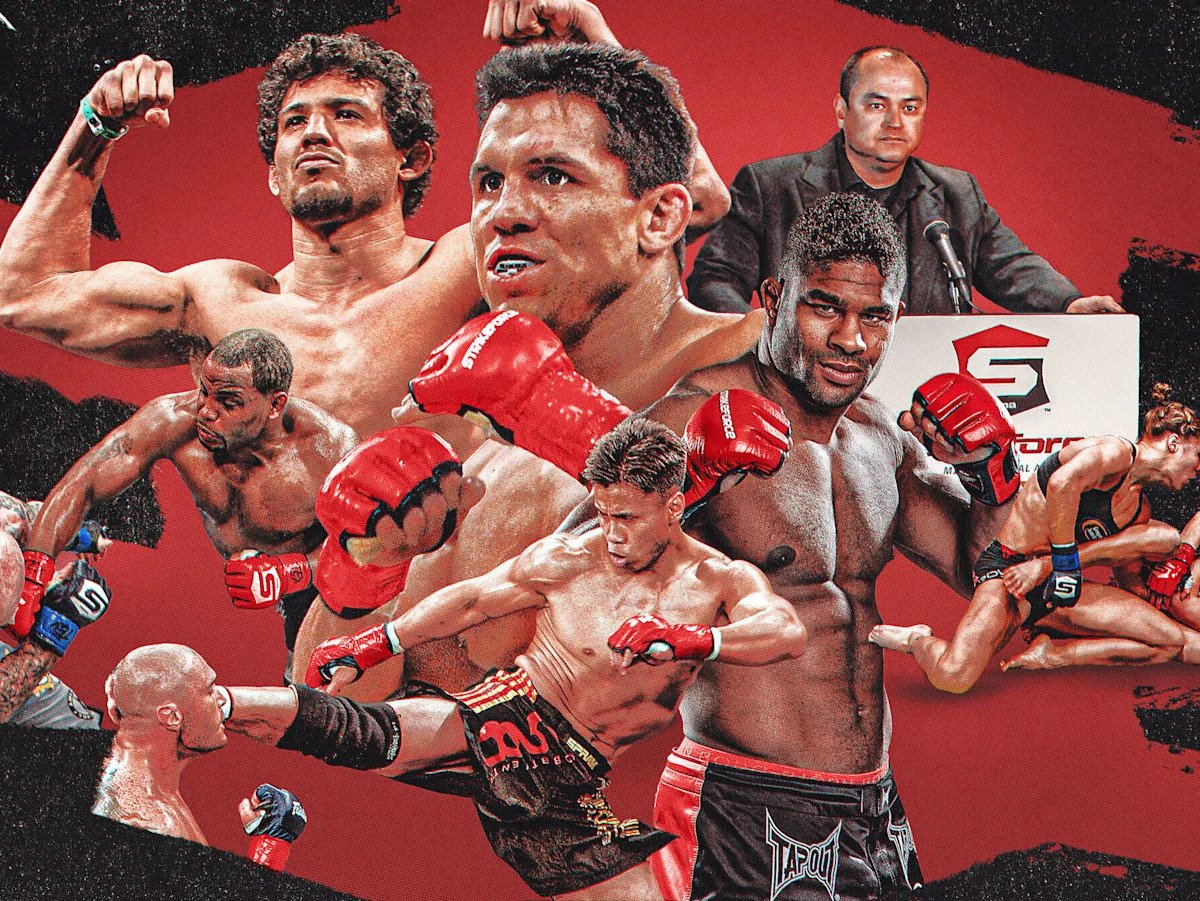
Strikeforce would eventually go on to become one of the world’s most important MMA organizations. What started as a regional power became a genuine nationwide competitor to the UFC, so much so that the UFC’s parent company bought it in 2011, just five years after that first event. UFC later absorbed the jewels of the Strikeforce roster, which included future superstars and UFC headliners like Ronda Rousey, Daniel Cormier, Nick Diaz, Miesha Tate, Alistair Overeem and Dan Henderson, among many others.
It all started that first night in San Jose, when Coker put together a card that perfectly captured a mood and a moment in the sport of MMA.
Advertisement
The big key was the main event. Frank Shamrock, the former UFC champ who hadn’t fought in three years, would return to the cage to take on Cesar Gracie, who owned and operated the Northern California gym that became most notable for producing fighters like the Diaz brothers.
While Shamrock brought MMA titles and a fighting pedigree to the headliner, Gracie mostly brought a name. Officially, he remains 0-1 as a professional in 2026. There were rumors of gym fights and other informal no-holds-barred competitions, but he was primarily a jiu-jitsu coach whose last name matched up perfectly with Strikeforce’s hopes to cash in on memories of the Shamrock-Gracie feud.
[Mendez] went to Ticketmaster and they were all sold out. I was like, ‘No, that can’t be right.’ So I checked — and sure enough, we were sold out.
That rivalry began in 1993, with Royce Gracie’s submission win over Ken Shamrock at UFC 1, but it continued in the media and in various proxy battles for years afterward. With both of them being prominent figures in the Northern California martial arts scene, Shamrock thought it made perfect sense as a pairing to get Strikeforce some immediate attention.
“I really respect Cesar for taking it,” Shamrock said. “He never should have fought me. That was silly. But I had ideas about how we could sell it, how we could promote it, and to Cesar’s credit he listened to me and he got in there and did it.”
Advertisement
Greg Savage, a longtime MMA media member who covered the event for Sherdog.com, remembered officials from the California State Athletic Commission reaching out in an effort to verify Gracie’s credentials before agreeing to sanction the bout.
“That was the big thing leading up to it, is [Gracie] had no real experience, so they kind of made up a bunch of stuff to help get him licensed in California,” Savage said. “They had a call with family in Brazil, from what I remember them talking about, asking about his credentials because there were no sanctioned fights, no tape, nothing. I honestly don’t know what his record really was before, if there was any.”
The main event itself didn’t last long. Just 21 seconds, with all of the offense coming from Shamrock, who dropped Gracie with a right hand behind the ear and then finished him with punches on the mat. It was still long enough for Shamrock to injure his hand in the process, he said, but he declined a ride to the hospital in the immediate aftermath.
Advertisement
“My buddy Phil had negotiated something like a $50,000 appearance [fee] for me at this club,” Shamrock said. “So the medics wanted to take me to the hospital and I was like, ‘No, I’ve got to do this thing.’ So me and Phil took a limo to the club, did my appearance, then took a limo to the hospital.”
The undercard that night was a reflection of how strong the Bay Area MMA scene had become, and also a look at where things were headed. Nate Diaz won a first-round TKO victory. So did Cung Le, who was already something of a local sensation due to his decorated kickboxing career. Future Strikeforce champion Gilbert Melendez also picked up a win on the undercard, while Clay Guida became the first Strikeforce lightweight champ with a decision win over Josh Thomson.
Strikeforce would go on to hold three more events that year, featuring a diverse crop of fighters ranging from Vitor Belfort and Alistair Overeem to Paul Buentello and David “Tank” Abbott. Somewhere in there, future UFC heavyweight champion Cain Velasquez made his pro debut, while future MMA sensation Gina Carano became the first woman to win a Strikeforce bout.
As Strikeforce grew and became more of a national promotion, San Jose remained its stronghold. Fights at the HP Pavilion (later renamed SAP Center at San Jose, but commonly known as “The Shark Tank,” due to its status as the home of the San Jose Sharks hockey franchise) were their own kind of special. During a fight week in San Jose, media members could grab a seat at Original Joe’s, an Italian restaurant with old-fashioned red leather booths and waiters in tuxedos, and watch as fighters, managers and all manner of industry insiders came and went.
March 10, 2006: In his MMA debut, Cung Le (right) knocks out Mike Altman with a first-round kick at Strikeforce’s first-ever show.
(John Medina via Getty Images)
Rich Chou, who became Coker’s right-hand man as a Strikeforce matchmaker, still recalls the magic around those events that somehow never quite repeated itself even when the two reunited at Bellator years later.
Advertisement
“Strikeforce was homegrown, it was Scott’s baby,” Chou said. “Maybe that’s what made it special. It had that organic, authentic, natural connection, building from the ground up.
“I’m proud of what we did at Bellator, and I think we were relevant and had a good run, but that same magic was never there, if I’m being honest.”
The timing of the 2011 sale to the UFC’s parent company was particularly painful, Chou said. Strikeforce had signed former PRIDE FC champ Fedor Emelianenko, a fighter who’d long been UFC CEO Dana White’s own personal white whale. It put Emelianenko in a star-studded heavyweight grand prix along with fighters like Overeem and Josh Barnett, with Cormier eventually winning it all after beginning the tournament as an alternate.
“We were on a little bit of a hot streak at the time,” Chou said. “The UFC was moving to a new media partner, which was going to maybe open some things up for us. I think they thought the timing was right and they made their move to buy us. That put a stop to our run, but it also validated what we’d been doing in a way. They wouldn’t have wanted to buy us if we weren’t doing something right.”
Strikeforce was homegrown, it was Scott’s baby. Maybe that’s what made it special. I’m proud of what we did at Bellator, and I think we were relevant and had a good run, but that same magic was never there.
Part of what created that opportunity for the UFC was a desire on the part of Coker’s partners at San Jose Sports & Entertainment Enterprises to sell and refocus on their primary business as the owners of the Sharks. Coker was reluctant to take the money and let the UFC have his baby, as Savage recalled.
Advertisement
“He was calling everyone in MMA who had two nickels to rub together, trying to get them to invest and help him hold onto it,” Savage said.
In the end, the UFC’s offer was too enticing, and the brand was sold. That outcome still stings in some ways for Coker, who admitted he’s battled his own share of what-ifs in the years since.
“I think Lorenzo [Fertitta] and Dana didn’t want to have a competitor around, so that’s when they came knocking on the door,” Coker said. “I still feel that, at the time, we had a much better heavyweight division than they did. That’s why that tournament was so special for us, so I was sad it ended there. But the whole thing was a magical moment in my life, and something I’ll never forget.”
It was also something he never envisioned on that first night in March 2006. Looking back, Coker said, the real kicker is that he couldn’t even truly enjoy what a success that first show was, or how it launched his career as an MMA promoter with one historic sellout.
Advertisement
“I should have been celebrating,” Coker said. “But honestly, I was too stressed out. Every time someone hit that cage, I was sure it was going to collapse.”

