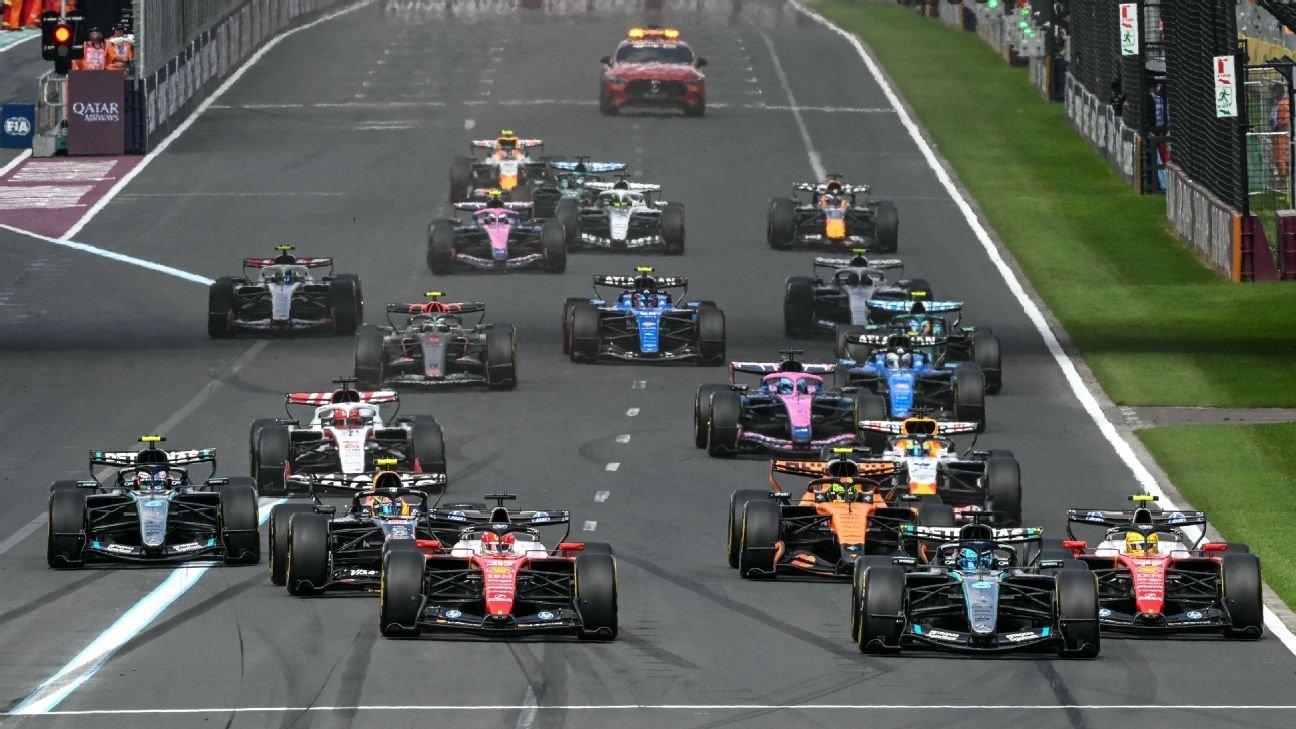
SHANGHAI, China — Formula 1 drivers are growing increasingly worried a big crash at the start of a race is a matter of when, not if, unless the governing FIA makes rule changes.
New rules this year have placed a huge emphasis on energy management and battery power deployment due to a 50-50 engine split between combustion and electrical power.
This has created controversy in a few areas, one of which centres around the way races start.
Australia’s start was chaotic, with different cars having wildly different launches off the line, which has become one of the standout early features.
In Australia, Alpine’s Franco Colapinto nearly slammed into the back of Liam Lawson’s slow-moving Racing Bulls car.
Lawson’s car hit anti-stall and took ages to hit a normal speed, which was dangerous with Colapinto arriving at speed from further back.
“What happened to me at the weekend, it’s so easy for it to happen,” Lawson said on Thursday ahead of the weekend’s Chinese Grand Prix.
“And if Franco hadn’t done a very good job at avoiding it, that would have been a really, really big crash. At the moment, it is quite dangerous.”
Multiple drivers have raised safety concerns over this.
Grand Prix Drivers Association director and Williams driver Carlos Sainz said a big accident is a matter of when, not if, without the governing FIA tweaking the start procedure.
“I think in Melbourne we were extremely lucky that nothing happened with Liam and Franco,” Sainz said. “My feeling is that there’s going to be one of those big crashes if nothing changes for the start at some point this year.
“Fingers crossed that we take actions in time to improve them and it never happens. But if we stay without doing anything, my feeling is that at one point or another we will see one of those situations.”
The FIA already implemented an extended start procedure for the new season, one which teams tested during preseason, to give the cars more time to get their turbos spinning.
However, a good majority of the grid do not believe the current situation is safe enough.
One of the issues was that drivers arrived at the starting grid with different levels of battery for the start itself after the formation lap.
Max Verstappen was one of them.
“Starting with 0 percent battery is not a lot of fun and quite dangerous,” Verstappen said. “So we’re in discussions with them to see what can be done.
“You can see we almost had a massive shunt in Melbourne in the start, some of that is related to battery, some can happen with an anti-stall, but you can see a lot of big speed differences.
“I was not the only car that had almost no battery or 20/30%, this is something that can be easily fixed.”
Verstappen’s former teammate Sergio Pérez, back on the grid with Cadillac, added: “These power units are very difficult to start. You can have a good start or you can have a bad start by so many different factors. “You can get anti-stall like what happened to Lawson and then that can be very dangerous because the speeds that you end up doing within two to three seconds are extreme. It’s a difficult one because I don’t know what you can do in that regard. It’s just that these new engines are very difficult to start.”
As ever with Formula 1, there is a political element which is significant in how this unfolds.
Ferrari, who also have baked into their agreement to race in Formula 1 the ability to veto any decision made by the sport, have emerged this year with a smaller turbo design which has created lightning starts.
It helped Charles Leclerc leap from fourth to first on the run down to Turn 1 at last weekend’s Australian Grand Prix.
Reports in Italy have suggested Ferrari used that veto over similar rule change proposals earlier this year, having expressed early on in the design of these new cars that a safety concern existed.
When those concerns were ignored, Ferrari went ahead and developed a smaller turbo knowing that it would create a big performance gain off the line.
In a lengthy explanation about why drivers had different battery levels, Mercedes driver and new championship leader George Russell also seemed to suggest Ferrari is continuing to block any change to the procedure at the moment.
– 5 questions hanging over F1’s new regulations ahead of China
– Chinese Grand Prix 2026: Race and F1 sprint start times, how to watch
“There was an error that caught a lot of teams out which was the harvest limit on the formation lap,” Russell said on Thursday. “So a very quirky rule … I don’t know if you guys know this or not, every lap there’s a harvest limit. The drivers who started in the first half of the grid, who were beyond the timing line, they were already within that lap.
“So when you did your formation lap start, you’re spending your battery and you’re charging your battery which goes towards your harvest limit. The drivers at the back, when they did their formation lap start, they then launch away, they cross the start-finish line and then it resets because they’re effectively on the next lap. So from what we did in the practise starts, we did the launch before this line and it reset and on the race start, starting from pole, I went on the throttle, I charged the battery but it took like 50% of my harvest limit of that lap.
“So when I got halfway around the track, I could no longer charge the battery, I had no power to do proper burnouts. So yeah, the FIA were looking to potentially adjust that but as you can imagine, some teams who were making good starts didn’t want it, which I think is just a little bit silly. But I’m not overly concerned but it’s definitely a challenge.”
Russell started on pole, but had lost the lead to Ferrari’s Charles Leclerc by Turn 1.
Asked again why there might not be a quick fix, Russell added: “I think [the FIA] want to but they need a super majority from the teams which they don’t have.
“So you can probably guess which team is against that. I don’t think their gain is coming from this issue. Now all the teams know the problem, we’ll just drive around it. But it’s just creating a bit of unnecessary complications to something that doesn’t really need to be there.
“So as I said, half the grid messed up in Melbourne. We’ll adjust. We know what we need to be wary of now. The FIA did just want to make our life easier and just remove this harvest limit.
“But as often people have selfish views and they want to do what’s best for themselves and that’s part of Formula 1 and part of the challenge of Formula 1, we’ll deal with it. I think the starts here will be much better.”
Formula 1 will have two starts off the grid this week, with China hosting the first sprint race of the 2026 season on Saturday.

