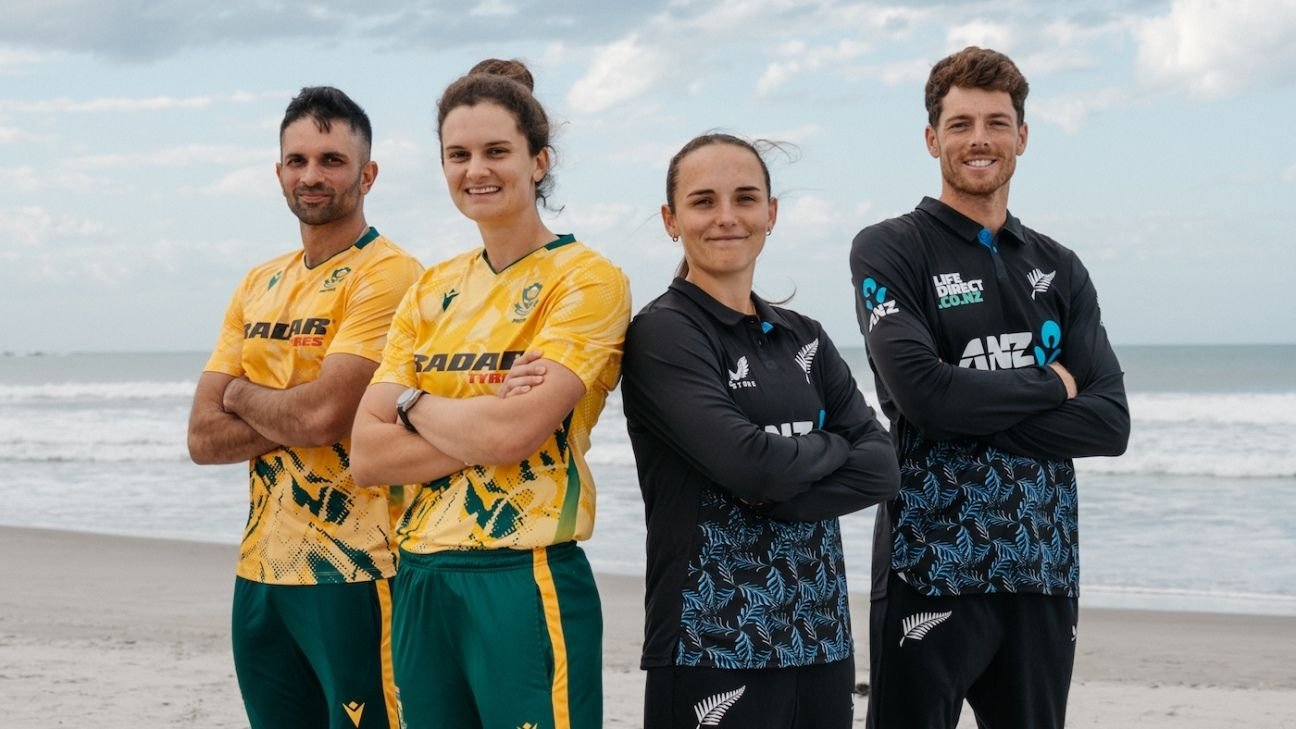
Perhaps the last people South Africa‘s teams want to see right now are New Zealand but they’ve got a double dose of them. Both the women’s and men’s teams have series against each other with memories of the women’s T20 World Cup final in October 2024 and the men’s T20 World Cup semi-final last month still fresh in minds.
New Zealand won both meetings and will be more than happy to welcome South Africa, given the history, but there may still be a hangover in the air given the way things ended for the men’s team in India. Just a week ago, New Zealand went from the highs of beating South Africa to folding tamely in an uncompetitive final they would probably rather forget. South Africa spent that week trying to get home. Both sides could be wondering why they need to play this format again so soon. The reason? The FTP said so and the men’s sides seem to be regarding it as the side show it is.
South Africa have gone almost all-change and have only three members of their World Cup squad – Keshav Maharaj, George Linde and Jason Smith – on this tour. Of those only Maharaj, who is also the stand-in captain, is a first-choice starter. New Zealand have eight of their World Cup squad, including regular skipper Mitchell Santner at their disposal (though only for the first three games) but have given their assistant coaches Luke Ronchi and Jacob Oram special dispensation to work in the PSL. They will miss the series but Rob Walter, who has been in charge of both South Africa and New Zealand at men’s T20 World Cup finals, will soldier on and take on familiar foes.
The women’s matches are arguably the more important set of fixtures as both teams prepare for another T20 World Cup, just three months away. There are no newcomers in either squad, which reflects their consistency as they plan for another major tournament with New Zealand hoping to defend their title and South Africa aiming for a third successive final, and a different result.
As we get ready for a 10-day carnival of cricket in New Zealand, here are some things to look out for across this unique series.
Double-headers
It’s been a decade since we’ve had men’s and women’s T20Is played on the same day, at the same venue (the 2016 T20 World Cup, according to ESPNcricinfo’s stats whizzes) and it could revive a discussion around the value of this kind of double-header. On the one hand, its a cute idea which maintains a through-line between cricketing narratives across the genders; on the other it can be seen as demeaning to the women’s matches, which inevitably act as curtain-raisers for the men. Given the growth of the women’s game, the latter argument may be losing its validity, and the twin fixtures could present an opportunity for fans to have a full day out and watch two games for the price of one.
For Maharaj, there’s also a tactical advantage, for the men. “It’s an opportunity to see what the conditions are like when the women play (first),” he said, perhaps not entirely seriously. “But more importantly, women’s cricket has come along leaps and bounds, and it’s wonderful for them to have the stage as well. They’ve played some amazing cricket and it’s also exciting for us to be able to witness it live. Not many guys get the opportunity to watch women’s cricket due to various commitments so, it’s a lovely opportunity for us to get to witness what they’re about and how they go about their games.”
And the information is flowing both ways, with the women’s team enjoying learning from their counterparts too. “It’s very cool to tap into their knowledge as well. They have some experienced players and coaches in their staff too, so it’s pretty cool just chatting to them about what they think is par or what we should do or what has been working for them,” Laura Wolvaardt, South Africa’s women’s captain said. “You sort of feel like one big team over here. It doesn’t happen a lot that you sort of tour side-by-side. It’ll be very cool cricket-wise as well to watch their game after ours.”
(In)experience and potential debutants
This applies to the men’s sides where New Zealand hold a massive advantage. Between them, their squad has 649 T20I caps compared to South Africa’s 160. While New Zealand have three players – Santner, Jimmy Neesham and Tom Latham – with over 100 T20I caps, South Africa’s most experienced is Maharaj, who will earn his 50th cap in the first game. They also have four newcomers: batters Connor Esterhuizen, Dian Forrester and Jordan Hermann, and seamer Nqobani Mokoena, all of whom can be expected to be capped during the series.
Of those, Jordan is likely the best known because his older brother, Rubin, has played seven T20Is and an ODI for South Africa. Jordan was the eighth-highest run-scorer in the most recent edition of the SA20 and the brothers are expected to have big futures for South Africa. Forrester, who is from the Bloemfontein-based Knights, had a good SA20 for Joburg Super Kings, where he scored 175 runs at a strike rate of 165.09. And Esterhuizen is the one who has been around the most, with three seasons in the SA20, and will likely take the wicket-keeping gloves.
South Africa’s production line of bowlers is the gift that keeps on giving and they’ve included 19-year old quick Mokeona, who was the fourth-highest wicket-taker in the SA20, and the best among uncapped bowlers. He is a death-bowling specialist and one to watch in future.
New Zealand will unveil two new players: batter Katene Clarke and left-arm spinner Jayden Lennox. Clarke was the leading run-scorer in the Super Smash while Lennox made his ODI debut against India earlier this year. Several other New Zealand players are fresh to the international scene including Bevon Jacobs (five caps), Josh Clarkson (eight) and Dane Cleaver (nine).

