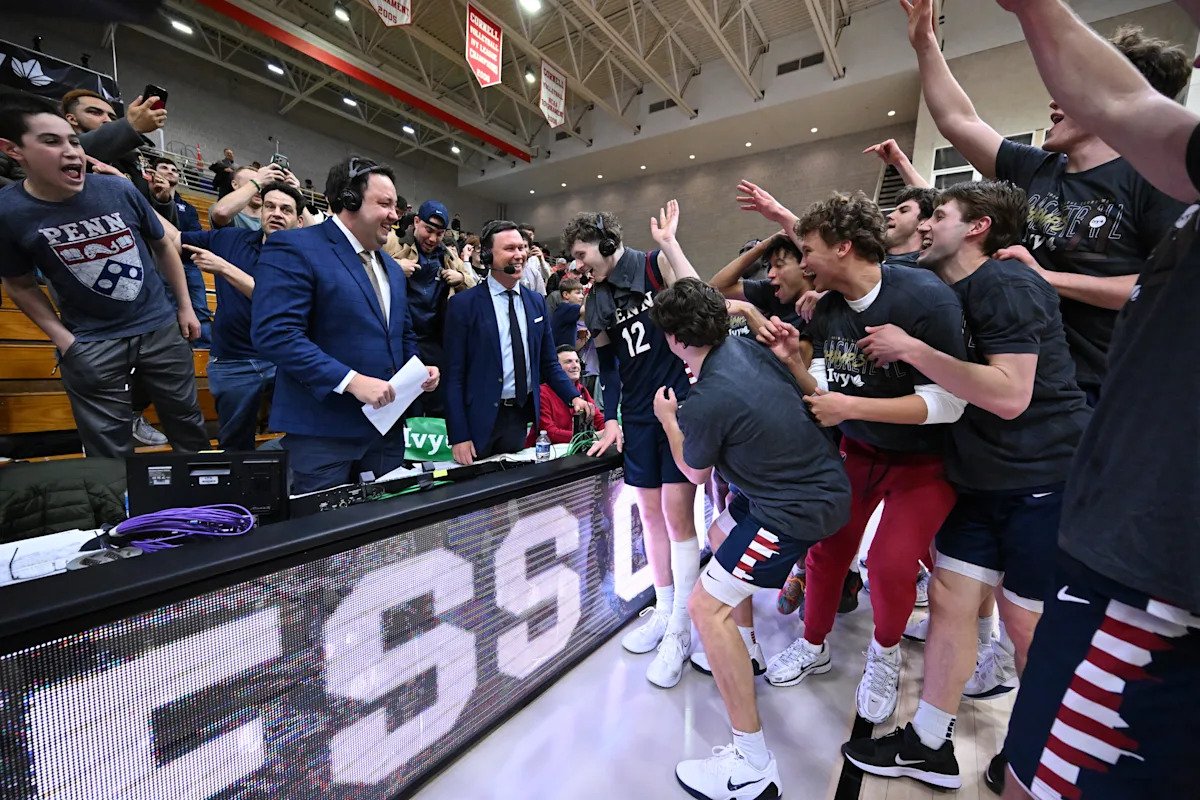
ITHACA, N.Y. – T.J. Power had his hands on his knees at midcourt. His line of sight covered by the brand new championship t-shirt that he put over his head, but not around his body yet. Did that really just happen? His brain had no other reaction to what had just occurred.
“I was super emotional, I’m sure I’ll be emotional all day,” Power said.
Advertisement
Everybody was overcome with emotion because not only did Power play the game of his life, but he rode the roller coaster ride of the game of basketball over the last three seasons to get to this moment. Nobody could have possibly believed that he could do this in this game against that opponent on that stage.
To lead your team to the NCAA Tournament is one thing. To do it while scoring 44 points, making two outrageous three-pointers in the final 20 seconds, and upsetting the No. 1 seed in your conference in overtime, less than 24 hours after a hard-fought OT win over the No. 2 seed in your conference? That’s just impossible.
Not if you’re T.J. Power.
His historic performance broke the Ivy Madness scoring record by a significant margin and is the highest scoring individual game that a Quaker player has had since 1989. He scored half of Penn’s points, and it was just barely enough to squeak past Yale, 88-84 inside Newman Arena. In one of the best basketball games of the season, Penn punched its ticket to the NCAA Tournament for the first time since 2018.
Advertisement
For Fran McCaffery, it marked a homecoming vindication at his alma mater just about 365 days after being fired from his post as the longtime head coach at Iowa. This is the fifth different school that the 66-year old head coach has taken to the NCAA Tournament.
“They’re all incredible,” McCaffery said. “But I do think this one’s a little different.”
It took a bought-in and scrappy group to scrounge together and win seven of the final eight regular-season games to go from 2-4 in the Ivy League to 9-5 and the third seed. Then, it required an even grittier two-day performance from the Quakers over the weekend with second-leading Ethan Roberts sidelined due to a concussion.
On Sunday, Power seemingly decided that he’d take it all into his own hands.
Advertisement
Early on, Yale decided to give the First Team All-Ivy forward space in the pick-and-roll game, trying to double the ball handler. It opened up driving lanes and facilitatating opportunities for Power, who started off hot. But the Bulldogs quickly switched to a more aggressive denial of Power, like they were doing to sharpshooter Mike Zanoni. He still went off.
After going down 25-16, Power put on a show, drilling a bunch of tough shots to bring Penn ahead 31-30. Then, he connected from the right wing in transition to give the Quakers a four-point lead and score his 23rd point of the night. It forced a Yale timeout.
Power was never supposed to be playing in this league in the first place. He was deemed too good for the league by virtue of his five-star recruiting ranking and commitment to play at Duke for his freshman season two years ago. He probably thought it was more likely that he’d be wearing an NBA jersey by now than an Ivy League one, but the journey was all worth it on Sunday.
He never quite made it work at Duke, nor at Virginia, but found a home at Penn, with McCaffery, who recruited him harder than just about anybody back when he was at Iowa.
Advertisement
“I came to play for Coach McCaffrey,” Power said. “That was the bottom line wherever he was going. I made the mistake twice, saying no to him. I didn’t want to make that the third time.”
“It’s been a long journey for me,” he said. “Some dark times, sometimes where you start to kind of give up on yourself a little bit. And I give so much credit to my support group, you know, my mom, my dad, my parents, my sister, my sister. Because, man, it took a village to keep me up. And now I’m here.”
With 12 seconds left in regulation, Trevor Mullin made two free throws to put Yale up 73-69. That’s it. The Bulldogs were going to go to their third straight NCAA Tournament. Everything from there on out was just window dressing.
But Power had the last word. He dribbled down the court and stuck a three from the top of the key with seven seconds left. Mullin would make two more free throws, and Yale called a timeout.
Advertisement
In theory, it gave McCaffery time to draw something up, but he didn’t have to.
“There’s really nothing overly complicated about that,” McCaffery said. “We’re putting the ball in his hands. That doesn’t put me in the Hall of Fame.”
Power came down the court, expecting the Bulldogs to foul, and he let a three-pointer fly from the right wing, falling away. It somehow went through.
“I thought they were going to foul, they didn’t, they kept backing up,” Power said. “So I just kept pushing it down the floor. And, you know, Casey can he’s a good shot blocker, so I put a little extra on it, little extra arc, and it sunk through, but I think when it left my hand, I knew that if I could get one off, it was, it was going to go in.”
Advertisement
Mullin had one more heave. It looked good in the air, but clanked off the back rim. Overtime.
How did that happen? The arena was dumbfounded.
That’s too much of a momentum swing to overcome for the Bulldogs, and this was Penn’s moment to bury them.
“We didn’t expect two overtime games,” Power said. “But I knew once it went to overtime, that’s our advantage every time. We’re fighters. And I think we just have this mindset that we can switch into when games get close, especially later in the year. I just knew we were going to pull away.”
They certainly didn’t pull away, but the Quakers scored the first points of overtime and continued to sink free throws. As a team, Penn shot 16-of-16 from the line; Power himself was nine-for-nine.
Advertisement
When the game ended and Penn rushed the floor, it served as a reminder of a few valuable lessons. The first is that there’s nothing more powerful than finding your fit. Whether that’s about Power, McCaffery, or anybody else in that locker room.
The second?
Always believe in miracles.

