A gripping Formula 1 season continues with the Japanese Grand Prix, as Mercedes and Ferrari renew their battle in the third round of 2026.
Mercedes have claimed a one-two in each of the first two rounds — with George Russell and Kimi Antonelli winning a race each — but Ferrari have been closer than expected. Lewis Hamilton, who sealed his first podium in red last time out in China, and Charles Leclerc have also been battling each other.
Further back, McLaren will be looking to bounce back from a double DNS disaster in Shanghai, while Max Verstappen — winner of the last four races in Japan — faces another tough weekend in a Red Bull car he continues to lament.
So you don’t miss a thing, here’s all you need to know ahead of Suzuka, the last race for over a month in F1 due to the cancellation of the Bahrain and Saudi Arabian GPs.
– Antonelli, Ferrari give F1 feel-good race in China, but critics remain
Japanese Grand Prix schedule
All times in GMT
Friday, March 27:
Practice One: 2.30 a.m. – 3.30 a.m.
Practice Two: 6 a.m. – 7 a.m.
Saturday, March 28
Practice Three: 2.30 a.m. – 3.30 a.m.
Qualifying: 6 a.m. – 7 a.m.
Sunday, March 29
The Japanese Grand Prix: 6 a.m.
How to watch
Sky Sports has exclusive F1 rights again in 2026 in the UK, with every session live on Sky Sports F1. Japan’s sessions are also on Sky Sports Main Event.
For non-subscribers, highlights of the Japanese Grand Prix will be on free-to-air television on Channel 4.
In the U.S., subscribers can watch every session on Apple TV, via a new F1 channel on the platform.
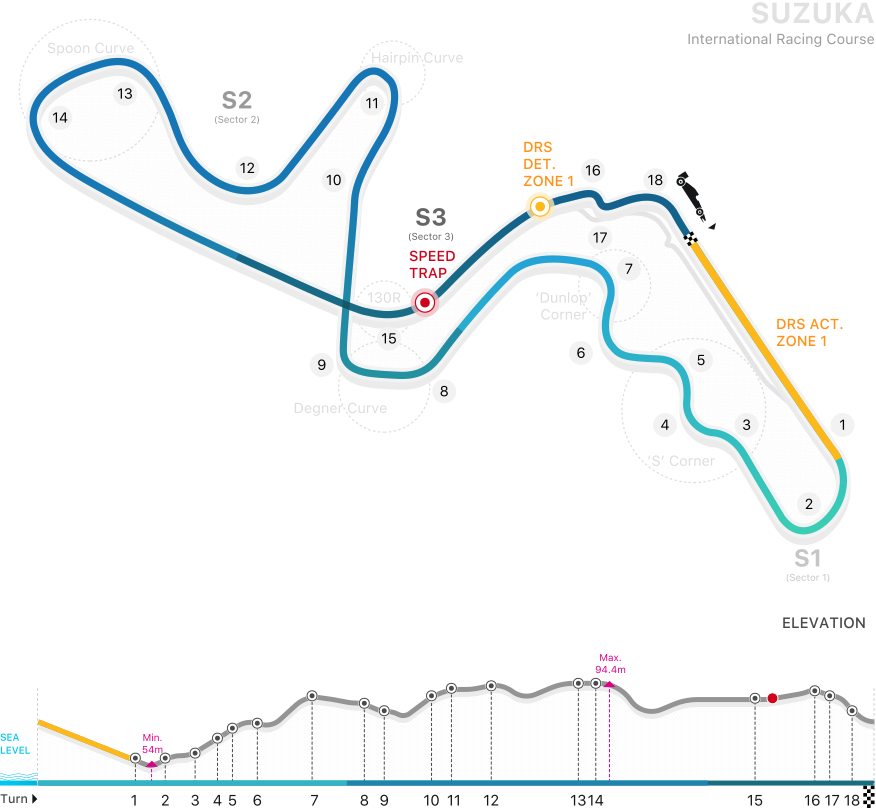
Japanese GP track: Suzuka
Suzuka first made an appearance on the F1 calendar in 1987; it has hosted all but four Japanese Grands Prix and it’s one of the favourites on the calendar for drivers and fans alike with a circuit layout like no other.
Prior to Suzuka, F1 raced at Fuji Speedway in 1976 and 1977 before it returned for a second two-year period during McLaren’s last dominant period in 2007 and 2008 with Fernando Alonso and Lewis Hamilton.
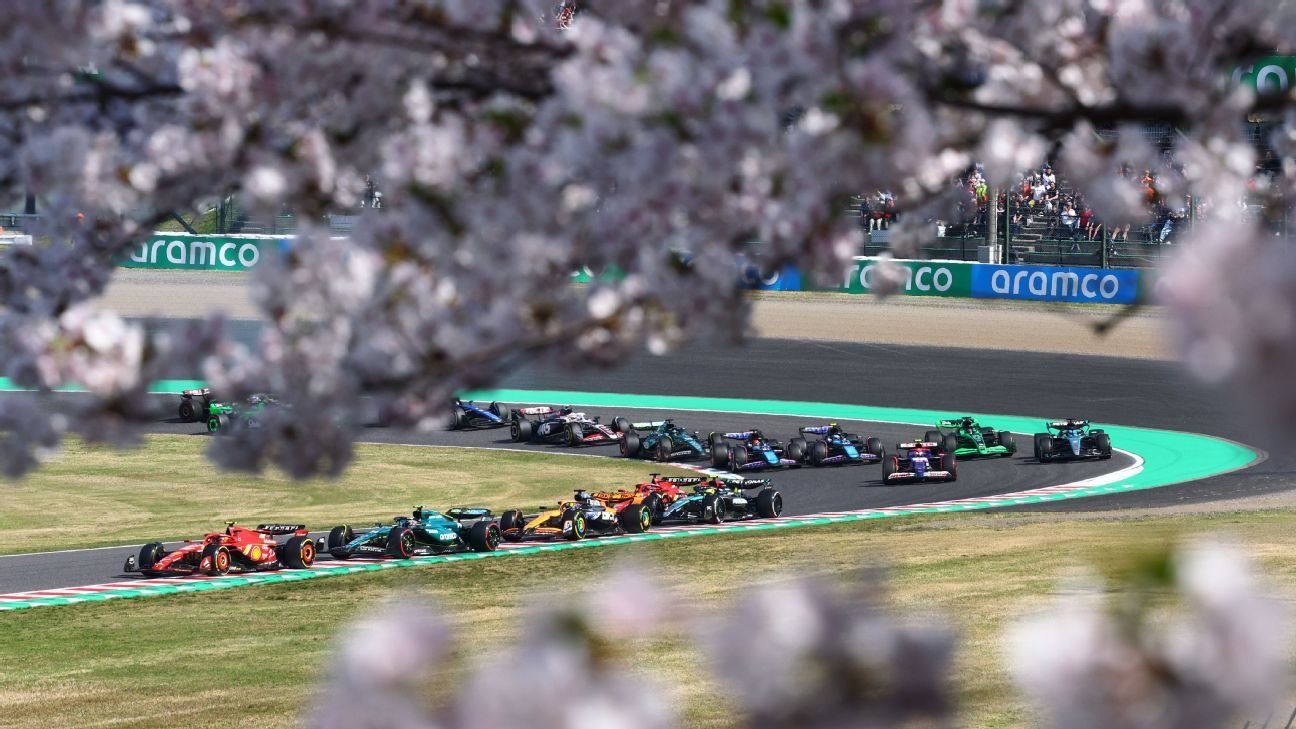
The race at Suzuka previously took place in October, but in 2024 the race was moved to spring as part of F1’s attempt to group races together by geographical location for sustainability reasons. The move to April falls during the peak of sakura, Japan’s cherry blossom season, and teams have previously designed special liveries around the flowers of the iconic trees.
Previous winners
2014: Lewis Hamilton, Mercedes
2015: Lewis Hamilton, Mercedes
2016: Nico Rosberg, Mercedes
2017: Lewis Hamilton, Mercedes
2018: Lewis Hamilton, Mercedes
2019: Valtteri Bottas, Mercedes
2022: Max Verstappen, Red Bull
2023: Max Verstappen, Red Bull
2024: Max Verstappen, Red Bull
2025: Max Verstappen, Red Bull
Other key stats
First race: 1987
Laps: 53 laps of 5.8km. Total race distance 307.4km
Lap record: 1:30.983 Lewis Hamilton (2019)
Most wins: Michael Schumacher with six (1995, 1997, 2000-2002, 2004). From the current grid, Hamilton has five (2007, 2014-2015, 2017-2018), Verstappen has four (2022-2025), and Fernando Alonso has two (2006, 2008).
Most poles: Schumacher with eight (1994-1995, 1998-2002, 2004). From the current grid, Hamilton has four (2007-2008, 2017-2018), as does Verstappen (2022-2025).
The weather
One of the reasons the Japanese GP was moved from October was to avoid typhoon season, seemingly swapping the rain for cherry blossoms aplenty.
That being said, we’ve seen plenty of wet races in Japan over the years whatever the month, and the weather is once again looking changeable for the third race of the F1 season. It’s looking like it’ll be less than 20 degrees Celsius, with rain currently forecast on all three days of track action, to varying degrees.
What happened last year?
Verstappen won his first race of the season after again tussling with Lando Norris at the Japanese Grand Prix.
Norris had been well clear of the four-time world champion in the opening two races as McLaren won both — one each for the Briton and Oscar Piastri.
But Verstappen upset the form book on Saturday by producing a scintillating qualifying lap to claim a shock pole and the pair reignited their rivalry on Sunday at Suzuka.
The drama arrived at the pit stop as they came together on the exit — Norris driving over the grass on Verstappen’s inside as the accusations flew.
The stewards did not agree with Norris’ claim that he was pushed off and no action was taken as Verstappen retained his advantage and kept the championship leader at arm’s length to cut the gap to one point.
Who will win this year?
We’d be foolish not to say Mercedes after the Silver Arrows claimed one-twos in each of the opening first two races — in qualifying and the race — but Suzuka’s track layout could favour Ferrari through the corners more. With potential rain, it’s then anyone’s guess.
That being said, let’s go with Kimi Antonelli again to make it back-to-back F1 victories.

