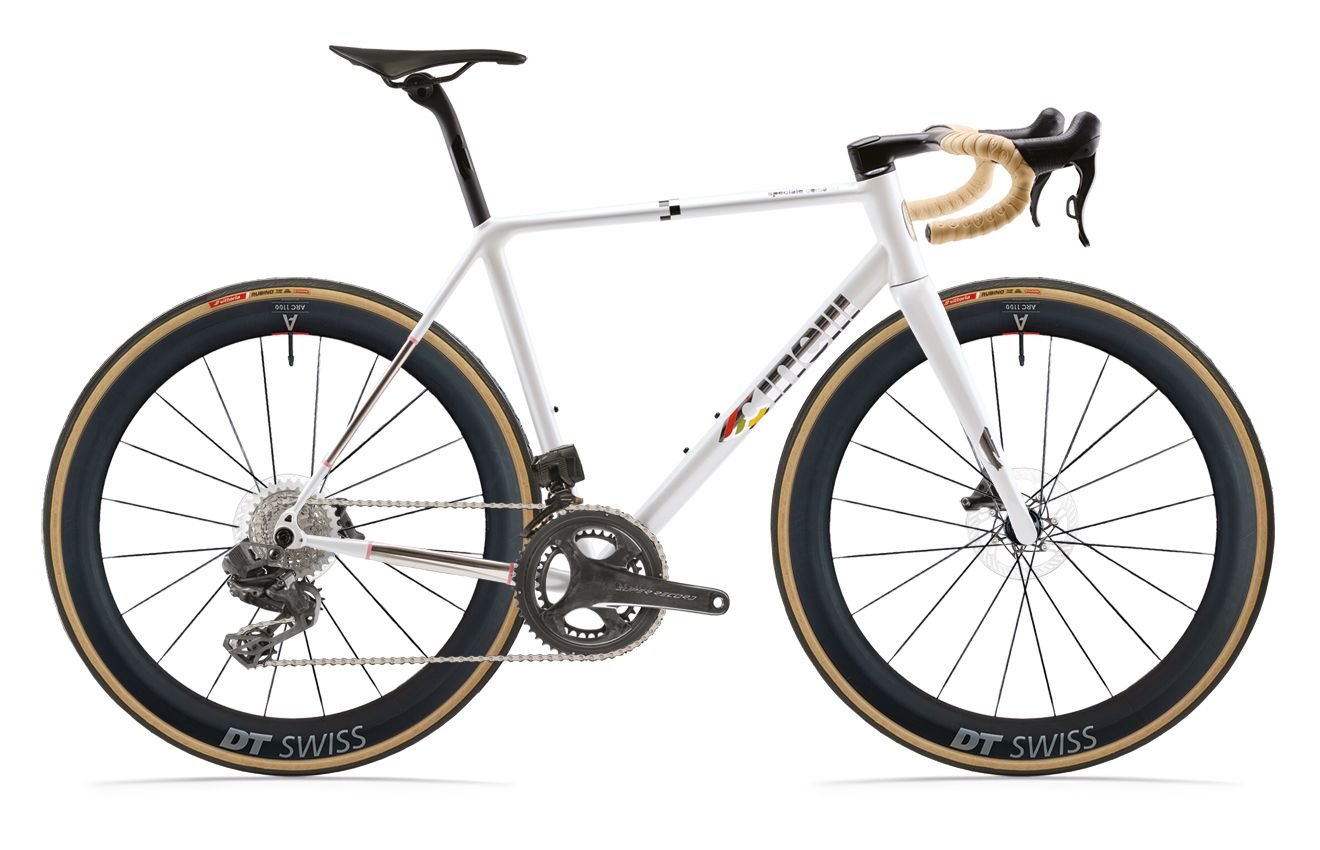
Cinelli was founded in 1947 by the ex-pro cyclist Cino Cinelli, quickly gained renown for making innovative components, such as stems and saddles, and racing frames for riders such as Fausto Coppi.
The company enjoyed close links with Columbus, the storied Italian steel tubing innovator, which was and remains the dominant force in high-end steel bicycle tubing. In 1978, the Columbo family (owners of Columbus) took over Cinelli, cementing one of cycling’s oldest collaborations.
XCR tubing is the only cold-drawn, seamless stainless steel tubeset in the world, representing the pinnacle of the technology. Even Reynolds 953, similarly regarded in the marketplace, cannot claim to be truly seamless.
The XCR tubeset is a martensitic stainless alloy, delivering an extremely high strength-to-weight ratio. This allows it to be drawn to incredibly thin wall thicknesses and profiles that provide excellent stiffness-to-weight characteristics. When built into a well-considered road frame, it offers a ride quality few materials can match.
And that is what the Cinelli XCR has always been known for: ride characteristics that deliver the feedback steel is known for, yet are light enough, and drawn to a sufficiently high profile in key areas of the main frame and stays, to deliver contemporary levels of performance in terms of pedalling response.

(Image credit: Future)
This new version takes an already high-tech steel tubing material and marries it to 3D-printed components. This opens up a much wider variety of shapes and structures for Cinelli’s engineers, aiding the delivery of the vaulted ride quality the XCR frame has become known for.
At comfortably north of £5k, it is one of the most expensive steel framesets available. More expensive even than Colnago’s steel road frame, the Steelnovo. If you wanted to spend more, you’d likely need to get a bespoke builder in Europe or the USA onboard, one whose customers covet this material. This XCR tubed frame will set you back more than a Specialized Tarmac SL8.

(Image credit: Future)
However, this is not your run-of-the-mill mass-produced road race bike. It’s made by what Cinelli simply identifies as Italian artisans. The trouble is, not every artisan who builds bicycle frames is comfortable working with XCR. It’s incredibly hard, making it tough on tools, almost as much as titanium, and the tubing itself is often far more expensive these days. Furthermore, thin-wall tubing requires careful heat management.
Like many high-performance steels, XCR is designed to be welded into a bicycle context and is made of a material known for precipitation hardening, meaning it takes on its final desirable mechanical properties, hardness, and tensile strength after welding. Distortion and even cracking can occur in thin-wall steel tubing around the heat-affected zones if the fabricator lacks sufficient expertise.

(Image credit: Future)
Despite having their own master builders in-house, the Speciale Corsa XCR is outsourced—albeit to a workshop just down the road. Thankfully, Cinelli knows that if you want to make the best stainless steel bicycle frames in the world, you speak to Alberto Barco and his family, who operate out of a workshop in Padua.
The long-term collaboration is an open secret among those in the know, and few are. Of the people who do know, even fewer will ever work with Barco, as they are extremely selective about who they build frames for. The family worked for Scapim for many years before going it alone, maintaining a few key, relatively tight and well-hidden relationships ever since.
Their hallmark is all over the frame, mostly hidden under the paint, of course. The neat welds and high standards of precision they are known for are clearly evident, despite the presence of some well-considered Colnago Steelnovo-esque tube junctions. In fact, at first glance, you are hard-pressed to spot the differences with that bike, which really only show up in the drop-out (UDH compatible), the headtube assembly, where the downtube joins the headtube in a traditional way, and subtle differences like compatibility for a braze-on adapter mounting front mech.
That makes this XCR very interesting indeed. Especially given it replaces a Barco-made, traditionally constructed model XCR model, which was already so elegant, and excellent, for its round tube simplicity. The question, then, is: Has the 3D printing and high technology on show here added magic, or just complexity?
Specification
My test bike came in a gleaming cocaine-white paint job, with polished stays. At first glance it looked exceptional. The pewter-style headbadge with the traditional Cinelli logo nods to the original bike, a bike which was finished in a mirror polish and was distinctly metal. This new model could trick many casual observers into thinking it’s more modern, or dare I say it, made of composite, which is of course, very deliberate.
As you start to look more carefully, you can spot exceptional details left over from the old bike, such as ‘Cinelli’ etched into the T47 threaded bottom bracket shell. Paired with contemporary new details, where the bars carry the Columbus logo, the ‘dove of peace’ (Columbus means peace in Italian) in a subtle contrasting gloss lacquer on the matte, integrated cockpit. The fork has a neatly integrated magnetic cap concealing the flat-mount drop-out hardware, and the axle is captive on one side, signalling performance intent.

(Image credit: Future)
The seat pin is also by Columbus, with a subtle layback, disappearing into a sculpted 3D-printed seat tube junction, which is a work of art to look at—though very familiar if you are used to seeing 3D junctions of this type. The shape is already a classic, perhaps, and how many ways are there to create a smoothed seat tube/top tube/seat stay junction anyway? Aesthetically, it is executed ‘correctly’, for sure.
The seat clamp hardware is an internal wedge type, with adjustment accessible via an Allen bolt concealed underneath. These arrangements are perfectly efficient, look great for being invisible, and tend to work well; some are placed a little close to the neighbouring tube, making you feel like you are running the gauntlet to avoid chipping the paint, but I had no such trouble with this one.

(Image credit: Future)
It’s not all perfect though. Some of the details feel like a missed opportunity to lean into what made the outgoing bike so wonderful. The Cinelli logo here is a foil sticker. It sits awkwardly and rather obviously, alongside the traditionally polished stays.
The UDH compatible drop out isn’t as clean as the hooded drop-out on the previous version either. It’s got more visual bulk in this new version. Nor is it as smooth as the more sculpted drop out on Colnago’s equivalent, Steelnovo.
The bike I had was not fitted with a Campagnolo groupset, which in its latest Super Record incarnation is squarely back on the performance map. With pricing now on a par with, or not far off, Shimano’s Dura-Ace, has no business on an Italian steel thoroughbred like this. I’d have loved to live out a full pasta-fantasy on board a Campagnolo 13-speed version, but the Shimano equipment is flawless and operates beautifully. The braking on the latest version is superb, and shifting is as precise as anything else. I do think Campagnolo does now once again top Dura-Ace for aesthetics, shifting, and braking performance, although there’s just a tickle of fresh grated parmesan in it these days. The saving grace is perhaps the value available on the Shimano equipped bike. It’s a grand cheaper than the Campy spec, at ‘just’ €12,500.

(Image credit: Future)
That brings me to the wheel choice: Mavic Cosmic SL 45 DISC, with a 23mm internal rim width. Just like the Dura-Ace groupset, they are perfectly functional, but the bike’s spec sheet feels like a meeting of the United Nations, not the Opera Seria I would want if I were laying down this much cash for this bike myself. They are also 1,575g, which, with the big tyres (32mm supplied), lacked the get-up-and-go that a sprightlier wheelset can deliver when you’re already paying for that lovely steel ride quality in extra grams in the frame.

(Image credit: Future)
Performance
My expectations were high for a frame this posh; it’s built using a material I know well, having delivered hundreds of frames with this tubeset for customers, and ridden more Columbus-tubed bikes than I’ve had spaghetti dinners.
Cinelli’s outgoing XCR model represents one of the finest made ‘off the peg’ steel frames of all time, thanks mostly to its tubeset and careful construction. I don’t say that lightly. To mess with something that capable, delivered exactly as XCR’s designers intended, and constructed by the finest steel tube fabricator in the world, Barco, is a bold move.

(Image credit: Future)
But, under new ownership and coming out of a period of relatively difficult trading across the bicycle industry, Cinelli’s new owners are keen to push the brand on. They want it to mean something fresh and new for performance again in Italian cycling, not just serve as a heritage vehicle known for its artistry. I admire the ambition they’re showing, and if the Steelnovo didn’t exist, then this frame would really stand out and be a marker of its design intent.
But Steelnovo and plenty of swoopy-3d junctioned bikes do now exist, at a lower price. And the outgoing version of Cinelli’s own bike wanted for absolutely nothing already. So, I’m sorry to say that while I wanted this frame to be better than the outgoing model, it’s just not. And in a number of areas, mostly related to finishing, it’s not on a par with the jewellery available with a similar product over at Colnago, even if Colnago is asking you to run the gauntlet with steel’s nemesis, rust.

(Image credit: Future)
To explain the issue, we have to give some context as to how and when XCR had its heyday. This will help frame why the Cinelli XCR might have been due an update. Steel tubing, and XCR in particular, enjoyed a period peaking around the turn of the decade where, alongside carbon which could deliver lighter weight performance, XCR frames offered something more special. They had a ride quality that felt more connected, communicative, and that tracked the road better than most carbon frames—better than almost anything in fact, in my view.

(Image credit: Future)
Now when builders using XCR ‘out of the box’ adopt the commonplace oversize seat stays it results in a rear end that feels a little harder than is really necessary.
These larger-profile seat stays deliver a huge amount of directness in the rear end of these frames, directness which once helped show just how relevant steel still was, but the reality is, that in these larger profiles at the rear of the bike, carbon has now overtaken it in to a large degree, offering better damping and road holding without the harshness that XCR once trumped. Indeed, it’s fair to say, the XCR can feel a little harsh if the tubing selection is a little heavy-handed.
This feeling can be tuned out of frames when tube selection is managed alongside knowledge of the rider’s inputs, weight, and use case, just as it is in a bespoke, custom-built frame context.
But in this case, where the tubeset is predetermined there’s less scope for that. And thanks to the use of 3D-printed tube junctions, where here, we have more material in the critical tube junctions, the ride quality in this new model is, of course, now harder. The net result is that it is lacking some of the communication that XCR was once famous for. And perhaps more annoyingly, it has missed an opportunity to further refine the ride, and bring this wonderful material bang up to date.

(Image credit: Future)
In essence, while I’m going on feel alone here and can’t see inside these parts, or know much of their internal design, the 3D-printed top tube and seat stay junction is likely the culprit.
There is simply more metal there now, bracing a key frame component responsible for damping. The same can be said of the front end. Not only do you have to cope with a bulked-up head tube, and stiff profiled downtube, but you also have an unconventional steerer in the fork, which reduces the feel usually transmitted forward from the flex in the fork steerer. Fork steerers contribute a huge amount to front-end feel, and an overly stiff fork steerer (see the Delta steerer in the previous incarnation of the Cannondale SuperSix for a contemporary example) can make the fork feel jarring. It doesn’t entirely feel like that here, but it lacks some of the finesse of the old fork run in concert with a 44mm steel headtube.
Where some builders, such as Number 22, or Sturdy Cycles, have optimised their printed tube junctions to reduce material, evident in ever-lower overall frameset weights, these junctions appear to have added material, evidenced by the higher frame weight, which tops the outgoing XCR frameset by several hundred grams. That matters in a frame made with a tubeset that, thanks to its age — now largely untouched for a decade — was already losing ground to some of the better-riding carbon competitors.

(Image credit: Future)
That’s not to say this frame rides poorly—quite the opposite. It is and still does offer a wonderfully communicative and responsive pedalling platform, just like the best XCR frames can. But on the less-than-perfect road surfaces most of us are forced to ride, the extra material in the frame starts to show up as a hindrance to the ride quality, rather than a benefit. I suspect on an alpine descent this bike still tracks and rides with the magical, confidence-inspiring feedback of the previous model, but it just can’t show up like that on normal roads, and it lacks finesse in the ride quality department as a result.
It’s worth noting that the bike was supplied to me ran some fairly wide tyres, in 30mm+ width, spread well over that wide rim bed. I wouldn’t want to go narrower, which may be a moot point given the fitted tyres suit current fashion.
Value
While it’s easy to see why Cinelli has chosen this route with a modern update of an ageing but wonderful product line, there are some own goals here. Set against the Steelnovo from Colnago, which has absolutely nothing to prove and is never likely to be compared to the much softer, older-fashioned ride quality of the Colnago Master, the Colnago is priced around £500 cheaper, and is, in my view, the better buy.
If you want a fancy steel bike no one else has, and you don’t care about any of the other benefits of steel-framed performance bicycles, then both bikes represent a lovely, justifiable, if not whimsical foray into owning something unusual that you will feel special on every time you look at or ride it. Price may not be important to those customers.
But before we depart this line of thought, it’s also worth clearing up a small personal bugbear, and that is some bike companys’ tendency to market XCR as a higher performance frame than one made with the Spirit tubeset. Mechanically, it is true to say the material is ‘higher performance’. Metals are after all sold on their performance, as metals.
In that case, metallurgically speaking, it’s fair to say the tubing is higher performance because it doesn’t rust, and it’s harder. But those factors don’t make a jot of difference to what it feels like in a bend, or when you’re stamping on the pedals in anger.
In terms of performance, as it applies to a racing bicycle, a very similar ride quality and weight can be achieved with either Spirit or XCR. That makes a bike with the Colnago brand marque on the downtube at £500 less, feel ever more compelling. Or perhaps Condor’s XCR frame, made in the same workshop, by Alberto Barco. Or indeed, dare I say it, one of their own Barco branded frames. All are considerably cheaper than this bike.
However, this bike isn’t really competing with the Steelnovo, or a Barco, or a Condor at all. People will love Cinelli, or Colnago, and that brand association is more likely to be a deciding factor perhaps. The competition this bike should have been incredibly concerned about in development, is the outgoing model. Cinelli’s own XCR.
Whilst the previous model of Cinelli’s XCR screamed artisan but also whispered connoisseur, this one tries to shout it: “Look at my 3D printed junctions,” which, of course, as discussed already, has done little to nothing for the ride quality.
What was once a somewhat eccentric but informed choice for customers who love the Cinelli brand, is now more frivolous and whimsical, for less benefit. And that’s hard to square, particularly when it’s dearer than many of the frames in the WorldTour, and a good many genuinely custom-built XCR steel frames—not least, Barco’s own.
Verdict
This is a brave and sensible step in the right direction for Cinelli. It is clearly serious about moving the brand on, but like we saw with the Aeroscoop, where wind tunnel claims were made on the strength of third party say so (leaving it exposed when independently tested), this bike shoots for the stars but has hit the moon.
The expertise is available to print junctions which would have enhanced the exemplary characteristics of their own hallowed tubes, but instead, they’ve added complexity at the price of one of the reasons why people spend money on a frame like this.
The metal effect stickers on the downtube jar against the hand-finished polish on the chain stays. Why, oh why, didn’t they polish the downtube in the same way and let the material peek out from under the paint? People buy bikes like this for the care and the detail, and that’s not quite there on this version – like it was in abundance on the outgoing model.
If you’re a Cinelli superfan, of course, this is going to stand out more for you than the Steelnovo or the Condor. Even with the price hike. But if you’re just a lover of XCR tubing then given Cinelli no longer makes the previous version, your best chance for that lovely steel-feel is probably the excellent Nemo-Tig, made in Columbus Spirit.
That’s still pretty firm out back, but it’s not trying to be something it’s not, and will save you a packet so you can invest in some super-dooper flyweight wheels, which will really bring a frame like that to life. Just in the way Columbus’ tubing wizards intended.
Let’s be clear. The Cinelli Speciale Corsa XCR is a very cool bike, in a sea of sometimes ordinary offerings. It still has that accolade. It rides nicely, and will make you smile, but it could be so much better. And for the money, it doesn’t make as much sense as it once did.

