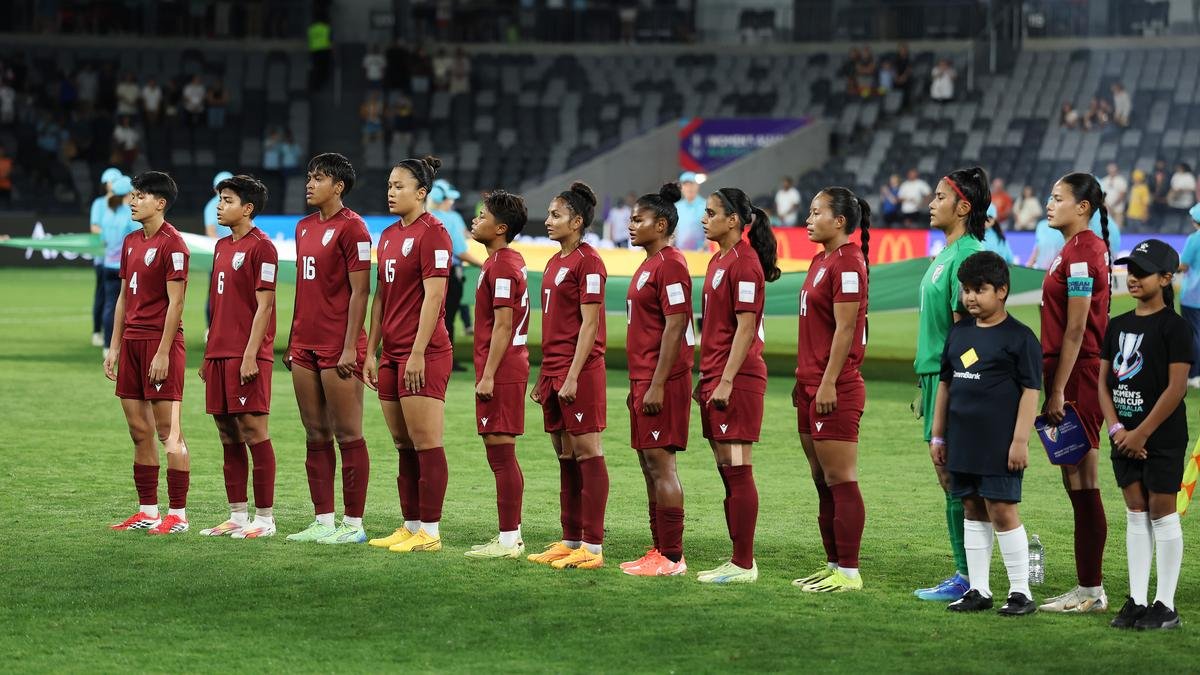
In the last 24 months or so, if there’s one faction in Indian football that has kept the embers of national team football burning, it has been the women’s game.
Having secured AFC Women’s Asian Cup qualification across senior and age-group categories, and a first senior Asian Cup qualification on merit, women’s football in India seemed to have found its voice.
At the AFC Women’s Asian Cup 2026, a historic qualification for the FIFA World Cup loomed, but just then, the hopes came crashing down. Three losses in the group stage, 16 goals conceded and an early exit: India’s historic qualification run was eclipsed by a forgettable group-stage campaign.
This wasn’t just a loss on the field; it was an accurate depiction of the state of affairs of the Indian football ecosystem—a fractured domestic league structure, late appointments and poor management: a pandemonium packaged under the brand of the All India Football Federation (AIFF).
The Blue Tigresses qualified for the Asian Cup on July 5, and the AIFF promised a competition calendar with the Indian Women’s League (IWL) to begin earlier than scheduled, in September instead of October.
“The earlier than usual scheduling would allow for ample preparation time in the lead-up to the AFC Women’s Asian Cup, scheduled for March 1 to 21, 2026,” the AIFF said in a statement.
“In addition, the Blue Tigresses will undergo 83 days of preparation camps, conducted in three phases. This will include 10-12 international friendlies and five to seven matches with domestic teams.”
The league began in December, three months later, and, unlike what was planned, the India U-20 team — also set to feature in the Asian Cup — did not participate in the league.
And India played three (official) international friendlies, instead of the 10-12 that the AIFF tom-tommed. The team’s visas for a tour of North Macedonia fell through, and though the Federation didn’t have much of a say about the visas, there was no plan B.
The next internationals awaiting the team were against Japan, Vietnam and Chinese Taipei—all of whom have previously played in the FIFA World Cup.
Football is never just about the shouts from the sidelines on weekends; it’s the quiet preparations and adept planning on Monday and Tuesday mornings. The AIFF probably skipped that chapter.
Then came the coach’s appointment: a World Cup-tested, veteran tactician from Costa Rica, Amelia Valverde. Valverde had managed the Costa Rican women’s team in two World Cups and arrived with a rich CV. But you see, the AIFF had skipped another chapter here: timing.
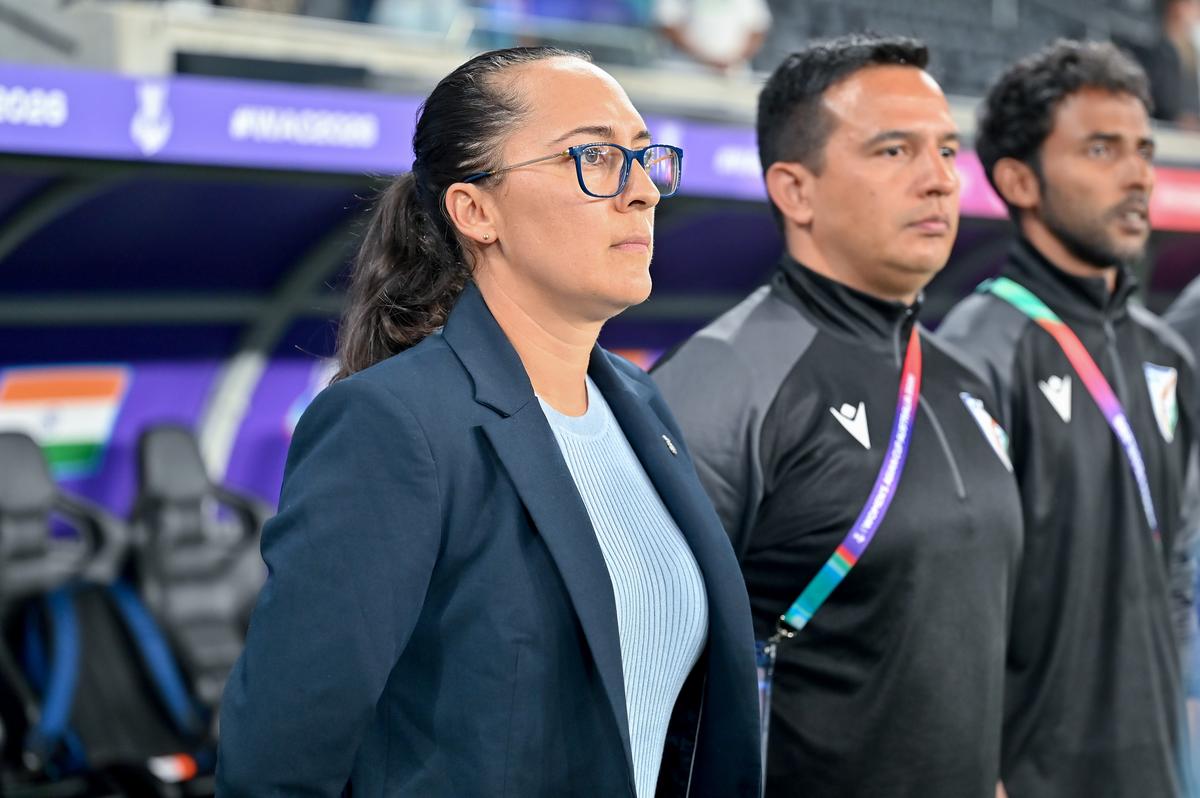
Amelia Valverde was instrumental in professionalising the women’s game in Costa Rica and can transform women’s football in India, too.
| Photo Credit:
Getty Images
Amelia Valverde was instrumental in professionalising the women’s game in Costa Rica and can transform women’s football in India, too.
| Photo Credit:
Getty Images
A team shaped and built around Crispin Chhetri’s plans over 48 weeks had six weeks to get used to a new coach, fresh tactics, and yet appear as a smoothly oiled engine at the Asian Cup.
Let’s compare it with Japan. Nils Nielsen was appointed in December 2024, while Mai Duc Chung, Vietnam’s manager, has been with the women’s team in various capacities for the last decade.
India lost 1-2 to Vietnam and was picked apart by Japan in an 11-0 demolition job.
The final nail in the coffin came in the form of ill-fitting jerseys. Days before the tournament began, the Indian team received jerseys which were ill-fitted, with at least 80 per cent of the players uncomfortable in the kits supplied.
The kits were changed in a hurry, but what about dented morale and the shame of embarrassment on foreign soil?
If this wasn’t enough, the on-field troubles began with injuries — India lost one of its most important attacking midfielders, Anju Tamang, before the tournament, and its captain, Sweety Devi, the best Indian defender in the tournament, played all matches with heavily-taped knees.
If planning off the pitch was chaotic, the execution on it followed suit.
At the Asian Cup, India started in its 4-4-2 shape, different from Valverde’s preferred 3-4-3 formation, but the flanks remained completely exposed: Vietnam scored three goals, including one that was disallowed for offside, and all three were built up through the flanks.
Against Japan in the second game, nine out of 11 goals came through build-up along the flanks. Full-backs like Sanju Yadav and Nirmala Devi Phanjoubam will have to take a long look at themselves, and so must Valverde, who failed to rectify the same mistake not once but three times in a row.
Goalkeeper Panthoi Chanu Elangbam, having denied 20 scoring chances to the opponent, and Sweety fought valiantly, but football is a team game. Twelve of India’s 16 goals conceded in the tournament came from attack through the flanks—areas out of their ambit.
Up front, Pyari Xaxa barely had a single clear chance at goal, while a younger alternative, Lynda Kom Serto, and Sanfida Nongrum, one of the goal scorers, got limited game time.
Sangita Basfore, India’s star in the qualification campaign, remained invisible, barring a long-ranger against Vietnam in the opening game.
Losing balls cheaply in India’s half, lack of communication, and lack of intent only made things worse.
Amid the wreckage, however, there were some positives from the campaign.
India scored two goals in the tournament, one of them being a stunning free-kick by Manisha Kalyan, India’s best player on the pitch by some distance.
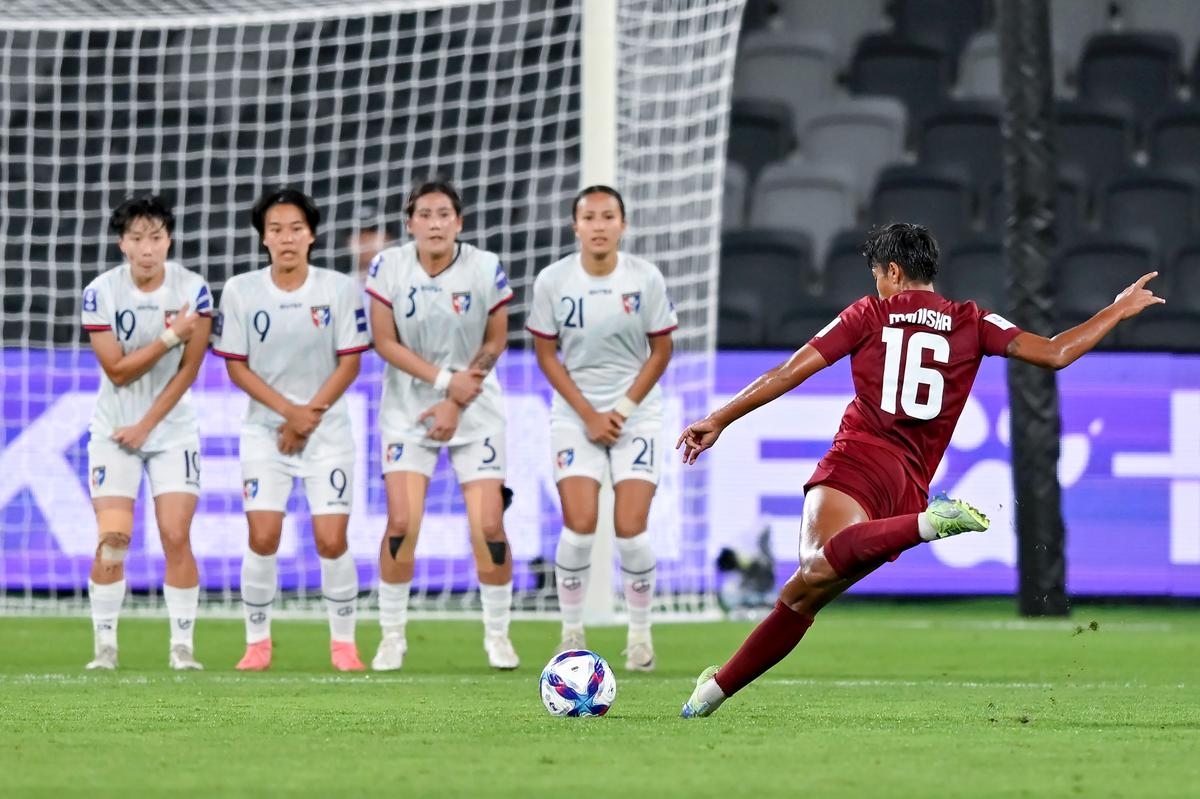
Manisha Kalyan of India scores a goal from a free-kick.
| Photo Credit:
Getty Images

Manisha Kalyan of India scores a goal from a free-kick.
| Photo Credit:
Getty Images
Manisha is the only national team regular to be playing in a foreign league — Peruvian top-flight side Alianza Lima — while several other national team members have featured in leagues abroad.
Soumya Guguloth was runner-up with Dinamo Zagreb in Croatia in 2022-23, Grace Dangmei won the Uzbekistan Women’s League with Sevinch Karshi in 2022, while goalkeeper Panthoi played for the Australian second-division side Metro United, and Aveka Singh still plays for Danish second division side Næstved HG.
More Indian players have moved to foreign shores — Kajol D’Souza (Al-Amal, UAE), Rivka Ramji (Lion City Sailors, Singapore) and Harshika Jain (ACS Atletic Olimpia Gherla, Romania).
There is potential for the winds to change in India, and Valverde, given her experience despite the recent disappointment, is a step in the right direction.
The Costa Rican was instrumental in professionalising the women’s game in her country and can transform women’s football in India, too.
But she will need what the AIFF has been terrible with so far: time; and it looks like the AIFF only learns after failing miserably, with Valverde likely to continue as India Women’s coach.
The women’s team is ranked 67th, compared to the men’s lowly 141st, and if India is to dream of a World Cup spot, the Blue Tigresses remain its best shot, provided the system meant to nurture them stops being its biggest impediment.
Published on Mar 18, 2026

