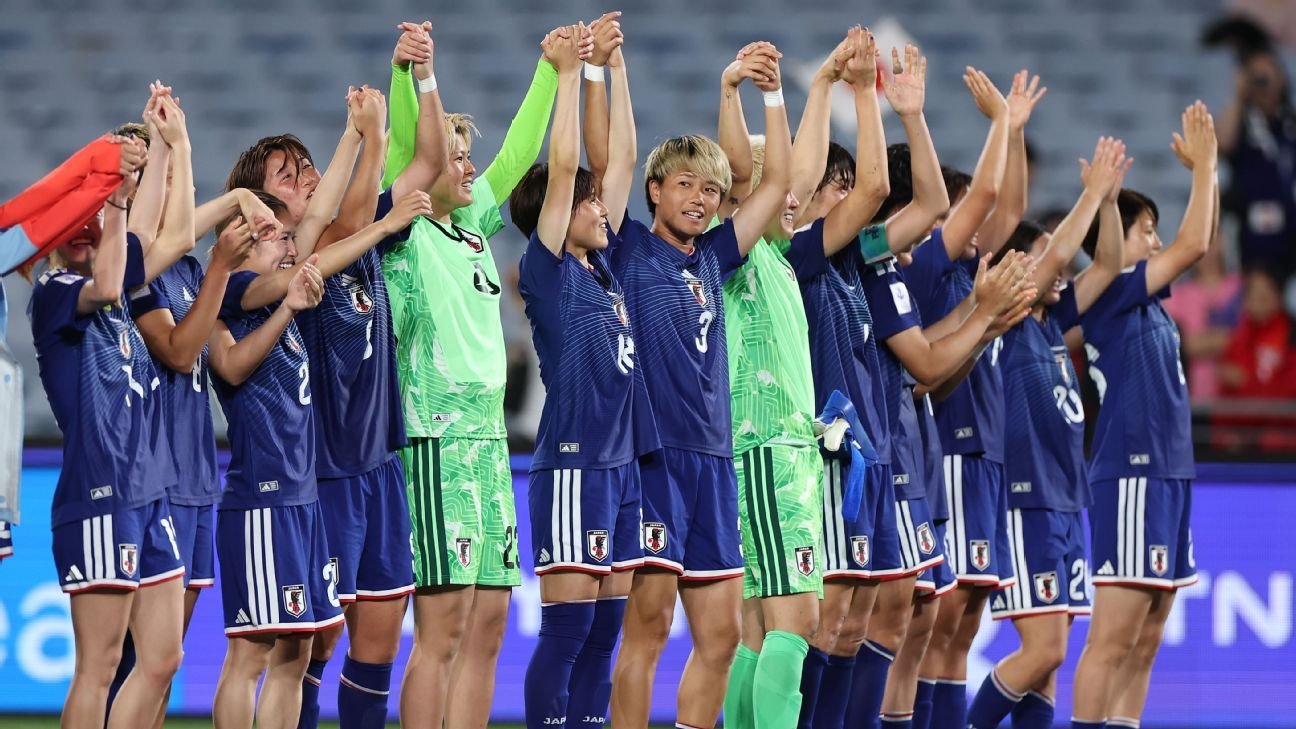
And lo, did the march of Japan roll on, logging a 4-1 win to defeat South Korea at Stadium Australia and book a place in Saturday’s AFC Women’s Asian Cup final against Australia.
Yet again, the tournament favourites looked imperious as they strode beyond a would-be challenger, a Taegeuk Ladies outfit that nominally presented the sternest test of their campaign at times rendered little more than spectators themselves as their foes sliced their way through them.
Can anyone stop Nils Nielsen’s side? The Greenlander has tried his hand as a youth novelist during his eclectic career, and mimicking one of the tropes of fiction aimed at a younger cohort, there feels a sense of destiny surrounding the group he has brought Down Under; so dominating across their five games so far that you’d perhaps be accused of writing a ‘Mary Sue’ if it were a work of fiction.
With Riko Ueki, Maika Hamano, Saki Kumagai and Remina Chiba‘s goals against South Korea, the Nadeshiko have netted 28 times across the tournament. And despite scoring four times, the number of chances created suggested that this number should be at least a few more
Up the other end, not only was Kang Chae-Rim‘s 78th minute effort the first goal they have conceded all tournament — and coming when they were 3-0 up with less than 15 minutes to go, it wasn’t exactly existential — they’ve controlled games so thoroughly that they’ve only conceded, per the AFC, eight shots across the 450 minutes of football they’ve played thus far. Just about half of Japan’s Mina Tanaka‘s total alone.
– Lordanic: After recent ‘nearlys,’ Asian Cup in touching distance for Matildas
– Iran women’s team exits Malaysia after asylum reversal
– Women’s World Cup qualification via Asian Cup: How does it work?
Some of these numbers may have been swelled by hammerings handed out to nations occupying a lower weight clash in Asia, such as an 11-0 win over India, but coach Shin Sang-Woo’s unit didn’t exactly enter Wednesday as babes in the woods; the South Koreans had reached the finals of the 2022 iteration of this tournament and topped Group A after forcing the Matildas to stage a last-gasp fightback to secure a 3-3 draw.
Yet while they probably put up a greater fight than any opponents Japan have faced to this point, six of those eight shots were fired in by the South Koreans, and Kang finally found a way past Ayaka Yamashita, that’s still a statement couched in relativism — there was never a sense that the Japanese were going to do anything other than win this game.
Less than a minute into the contest, Fujino was having an effort deflected wide. In the seventh minute, Hamano teed up Hana Takahashi to shoot with a gorgeous backheel, with Yui Hasegawa somehow conspiring to slice a point-blank effort wide on the follow-up after Kim Min-Jung saved the initial attempt.
Park Soo-Jeong‘s attempt to mount some level of resistance for South Korea — whose task was made harder by opening half injuries to Mun Eun-Ju and Jeon Yu-Gyeong — was immediately met by a Fūka Nagano chance up the other end, and twice more in the opening 45 minutes Japan would have the ball in the back of the net, only for the goal to be disallowed.
Living legend Ji So-Yun thrown on just before the main break, there were some signs of resistance in the second stanza, some forays into the box and a few set-piece opportunities as the vocal South Korean contingent in the crowd brought the noise.
Kang got her goal. But this was paired with chances to the likes of Takahashi, Fujino and Ueki, and Kumagai’s header to make it 3-0 was followed by substitute Chiba striking just three minutes after the Korean strike to crush all hope.
If anything, that Japan dominated the balance of play as much as they did and took as long as they did to kill the game harkens back to perhaps one of the major historical weaknesses of their game, one that Nielsen identified as a priority upon his appointment: searching for clinical finishing in the opposition penalty area.
Indeed, just how Hamano was able to bend geometry to her will to score on the most acute of angles, when the likes of Fujino and Hasegawa were squandering much greater chances, would have been confounding if they weren’t paired with an otherwise dominating performance.
And if there was any silver lining for the Matildas, the last obstacle standing between Japan and a third continental crown, it’s that their opponents didn’t deliver the coup de grâce until the final 15 minutes.
And when you’re a side possessing the likes of Sam Kerr, Caitlin Foord, Hayley Raso and Mary Fowler, who can make art out of transition when there’s space to run into — just look at the two goals they netted against China — then you’re always going to have a pulse, regardless of how much territory and possession your opponent has, if you can keep the ball out of the back of the net.
Indeed, football has a way of making hypocrites of us all; that’s one of the reasons it’s so beautiful, the way that it can strip away pretences and reveal what truly matters to us, winning, when the chips are down.
And against an opponent like Japan, few of the Aussie persuasion would object if Joe Montemurro’s vision to implement a more ball-dominant approach gave way to a smash-and-grab approach for one night, nor would tapping into a never-say-die attitude that, at times, can mask deficiencies that create heart-in-mouth moments, but would on this evening be required to withstand a blue onslaught.
Indeed, whatever approach was adopted, if it delivered a Golden Generation of players who have done so much for Australian sport an opportunity to lift silverware, very few, for one night only, would care how the sausage was made.
“We went very, very deep again, and it must be in the DNA,” Montemurro told Paramount after his side’s win over China. “It must be in the water or something. We just need to play higher and need to be braver. But look, it’s tournament football, and we got the result we wanted.”
Make no mistake, Japan will enter Saturday’s final as favourites. They deserve to. And regardless of the approach the Australians bring, they’ll need to bring, by far, their best performance of the tournament.
They’ve previously lost two finals to these foes, and against two common opponents in 2026, the Matildas have ground out a 1-0 win over Philippines and drew with South Korea, while Japan breezed past both.
Whereas the Nadeshiko have never looked threatened, the Matildas had to dig deep and find a way to win against a North Korean side that dominated them, just days after being knocked off their mental game when they fell behind the Taegeuk Ladies.
After being disappointingly knocked out of the 2023 Women’s World Cup and Paris Olympics, this side that has come to the 2026 Asian Cup, finishing notwithstanding, looks to be a new beast under Nielsen.
Four years ago, 17 members of the squad that was eliminated on penalties by China in the semifinals played domestically. By the time of the subsequent year’s World Cup, that number had shrunk slightly but was still a healthy 14.
Just three years on, however, and the current group of players assembled has just four players plying their trade at home, compared to 16 alone that are signed to clubs in the Women’s Super League in England.
This is a unit honed with the technical ability we’ve come to expect from sides coming from Japan, but increasingly battle-hardened by playing in some of the best leagues in the world.
And as they set their sights on securing Asian glory this weekend, nights like Wednesday make one wonder if that’s simply a pitstop on the way to 2027 Women’s World Cup.

