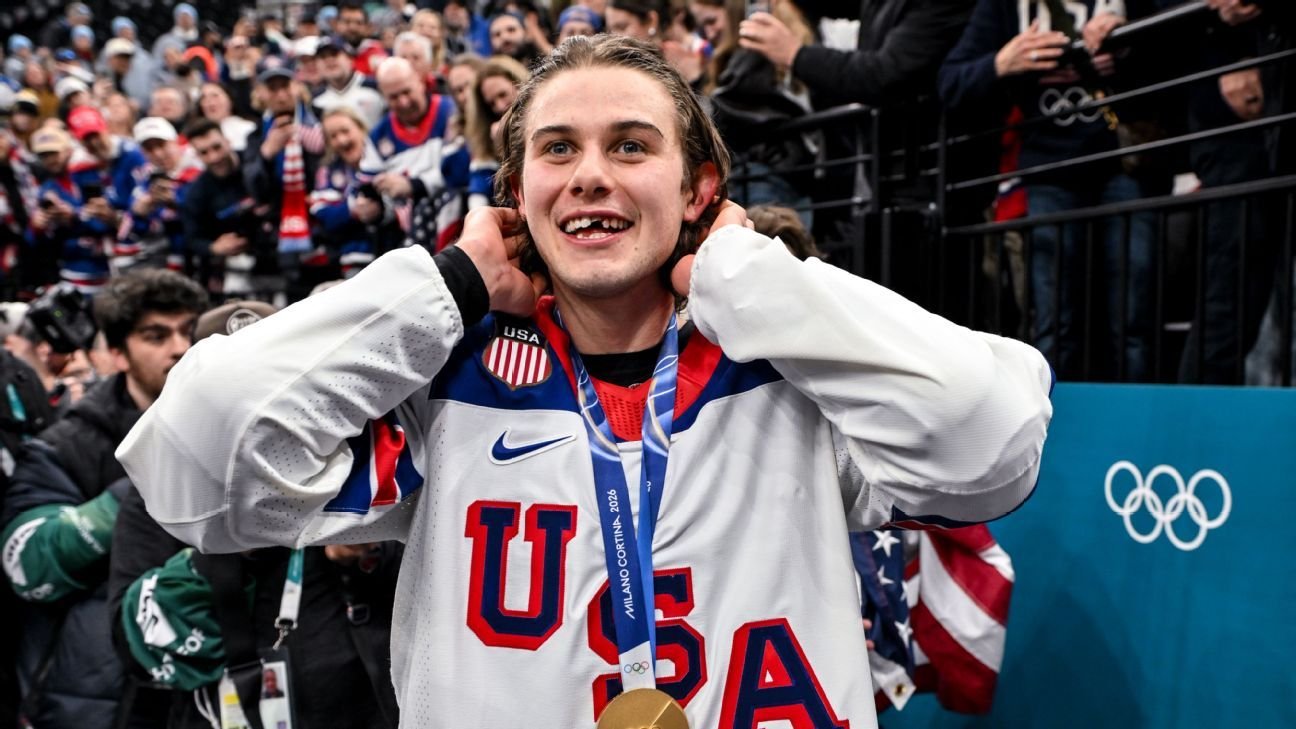
The Hockey Hall of Fame said it will not give Jack Hughes the puck from his gold-medal-winning goal for Team USA in the Milan Cortina Olympics.
“Unfortunately, in the easiest words, it was never Jack’s puck to own,” Philip Pritchard, vice president of the resource center and curator for the Hockey Hall of Fame, told ESPN on Wednesday.
“It’s been donated to us now. For every artifact that’s been donated, we have a paper trail and signed paperwork of where it’s come from.”
Hughes beat Canada goalie Jordan Binnington with a shot at 1:41 of overtime to give the U.S. men their first Olympic gold since the Miracle on Ice in 1980.
That “golden goal” puck, as well as the one scored by Megan Keller to win Olympic gold for the U.S. women’s team, were among the Olympic hockey items put on display this week at the Hall of Fame in Toronto.
Hughes, a star center for the New Jersey Devils, believes the pucks belong with the players who scored those goals.
“I’m trying to get it. Like, that’s bulls— that the Hockey Hall of Fame has it, in my opinion. Why would they have that puck?” Hughes told ESPN on Tuesday. “I don’t see why Megan Keller or I shouldn’t have those pucks.”
When a milestone moment happens in the NHL, players are typically allowed to keep pucks and gear for themselves. The Hockey Hall of Fame will frequently request an item for its collection, but it’s not guaranteed the players or teams will donate them.
That’s not the case in many international tournaments. The Olympic tournament was a joint production by the International Olympic Committee and the International Ice Hockey Federation.
Pritchard said the IIHF has been responsible for collecting, authenticating and preserving items from the Olympics and world championship tournaments since 1998. The Hall of Fame also had staff in Milan to assist in that process.
When a milestone goal is scored — like Hughes’ “golden goal” — an on-ice official will collect it before an off-ice official, like the official scorekeeper or timekeeper, wraps tape around the puck to identify it. The puck is given to the IIHF, which then formally and officially donates it to the Hockey Hall of Fame.
“Items are formally transferred to the Hall through IIHF’s established artifact donation process and added into our permanent collection. These artifacts are preserved, exhibited and shared with fans worldwide through our museum and international outreach programs, ensuring that defining Olympic and World Championship moments are preserved, and remain accessible to the global hockey community,” the Hall of Fame said in a statement.
Pritchard said there are legal considerations regarding that ownership as well.
“Part of being a nonprofit registered charity in Canada is it becomes kind of a legal document that we’ve received it as a donation,” he said. “We’ve insured it, we’ve preserved it, we conserved everything. It becomes part of our institution.”
Hughes said he hadn’t formally petitioned the Hall of Fame yet but hoped to get the puck and give it to his father.
“I wouldn’t even want it for myself. I’d want it for my dad. I know he’d just love, love having it,” said Hughes, who said his father Jim Hughes is like an archivist for Jack and his brothers Quinn (Minnesota Wild) and Luke (Devils).
“When I look back in time in my career, I don’t collect too many things for myself, but my dad’s a monster collector for the three of us. I know he would have a special place for it.”
Pritchard said the Hall of Fame has been asked over the years to give artifacts to players — or families of players — who were associated with those moments of hockey history. Some of the pleas are heartfelt and well-intentioned, but the mission remains the same for the Hall and its curators.
“We try to take the emotion out of it. We’re here to preserve a game that Jack’s lucky enough to play or we’re lucky enough to work in,” Pritchard said. “That’s why the Hockey Hall of Fame museum exists as an institution: We’re preserving the game of the past, present, and the future.”

