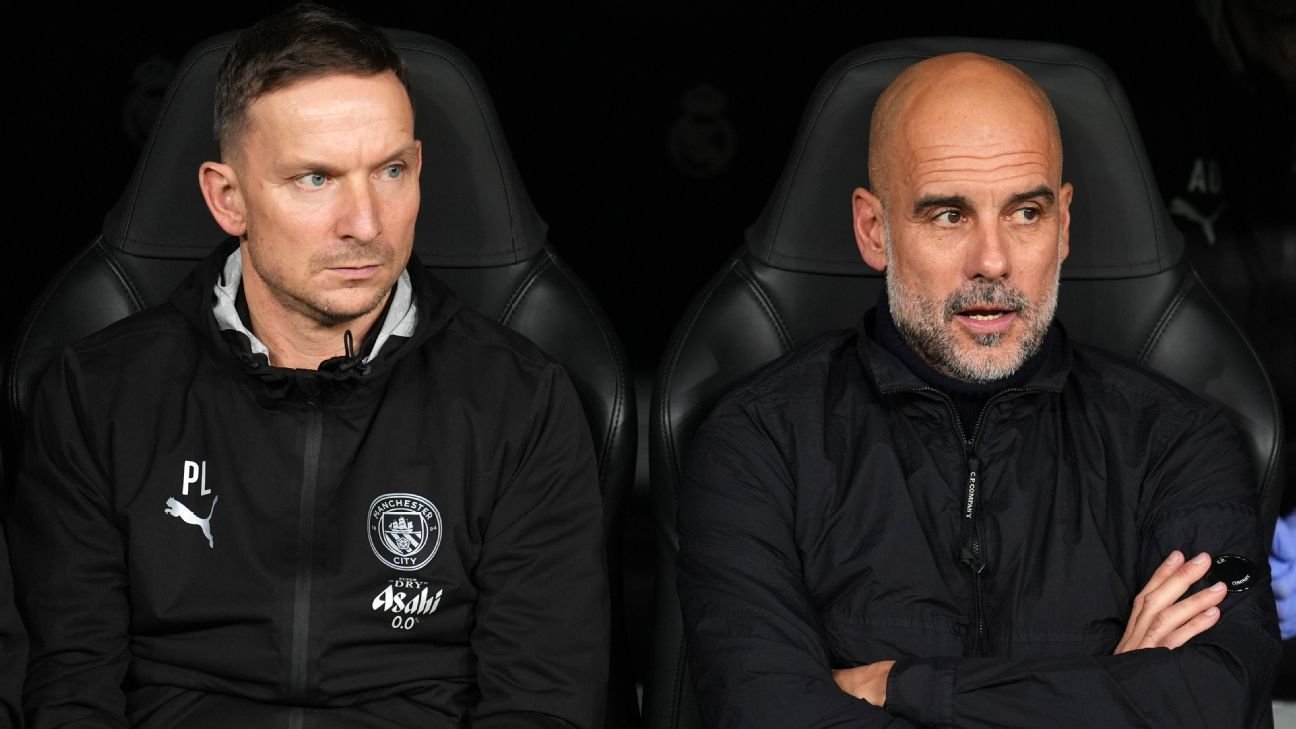
When Tijjani Reijnders scored Manchester City‘s opener against Nottingham Forest in December, Pep Guardiola’s first thought was to turn and recognize assistant manager Pep Lijnders’ contribution. “You did that!” Guardiola shouted to Lijnders.
At halftime, Lijnders had relayed some weaknesses he’d seen in the way Nottingham Forest defended, and three minutes into the second half, City found the breakthrough. A ball in behind Forest’s defensive line found Reijnders, who fired back across goalkeeper Matz Sels to give City the lead.
Some of City’s success under Guardiola comes from inspiration drawn from those around him. Guardiola has seen ex-assistant managers Mikel Arteta (Arsenal) and Enzo Maresca (formerly Chelsea) become managers for Premier League rivals — a testament to Guardiola’s teaching. This season, the new additions were Lijnders, Jürgen Klopp’s former assistant at Liverpool, and Kolo Touré. “They inspire me and I learn a lot, all of them,” Guardiola said last month. “Today in modern football, you cannot do it alone. Now you need incredible staff to support you.”
– Messi hits 900 career goals: Can he reach 1,000? Can he pass Ronaldo?
– Giving Morocco AFCON title was correct, but why did CAF take so long?
– A back three isn’t always defensive: It might be just what your team needs
Behind every successful manager is an accomplished No. 2 who played a crucial role in making that success possible. There are many examples over the years: Alex Ferguson’s dynasty at Manchester United was aided by Brian Kidd, Steve McClaren and Carlos Queiroz, similar to Guardiola’s approach of learning and evolving thanks to new voices. At Liverpool there was Bob Paisley and Bill Shankly, and in the 1970s and ’80s, assistant Peter Taylor formed a famous double act with Brian Clough at both Derby County and Nottingham Forest.
“What is important is their knowledge, their honesty, their loyalty, and of course their competence in every subject, as well as their winning attitude,” former Arsenal manager Arsène Wenger tells ESPN. “They are the guys who can get easier into the heart of the players because they do not make the decisions.”
But the role is changing and the demands are different these days as assistants must wear different hats simultaneously: therapist, tactician, planner, diplomat, and analyst. So what’s it really like to be an assistant manager?
Paul Nevin and John Carver have spent years working with managers like Gareth Southgate, Bobby Robson, Alan Pardew and David Moyes and are well equipped to provide insight into the selfless, but essential, job. As Canada manager Jesse Marsch tells ESPN: “My assistant and video analyst are like my right-hand men. They often know me better than I know myself!”
‘I don’t think people understand the intensity of it all’
Before earning a UEFA Conference League medal in 2023 and becoming a key figure of Southgate’s time in charge of England, Paul Nevin was a lower-league professional player. He stepped into coaching under Jean Tigana at Fulham, and in the years since, the 53-year-old has been an assistant under Moyes at West Ham United and Patrick Vieira at Strasbourg, while maintaining his England duties with Southgate from 2021 to ’24.
“You’ve got to know yourself first before you can really help and assist someone else,” Nevin tells ESPN. “As an assistant manager, you must be self-aware and stick to your core principles.”
There are two types of assistant managers. First, there are those who follow a specific manager wherever they go: think Clough and Taylor. For more contemporary examples, think Roy Hodgson and Ray Lewington, or Mauricio Pochettino and Jesús Pérez. Nevin falls in the other school. “I like working with different managers and trying to adapt to what they need and how you can support that,” he says.
Wenger, now FIFA’s chief of global football development, looked for certain characteristics in his assistant managers. “I liked to have my closest assistant represent the culture of a local team and country, which helps you to not make too many mistakes,” Wenger said. “Pat Rice was ready to die for Arsenal Football Club, and the same with Steve Bould. When I arrived at Arsenal, Pat Rice was a big help for me because he knew the club inside out. We were in touch before I arrived, and he was exceptional — a very helpful man and a top-quality coach.”
“When you do well in your life, most of the time it’s down to the fact you have good people around you.”
Nevin says role clarity is crucial at the start of a new working relationship. “The worst thing that can happen is, as an assistant, you go in with one expectation and the manager’s got a different expectation. Somebody’s going to get frustrated very, very quickly.”
When a team is stuck in a Saturday-midweek-Saturday match schedule, the assistant manager usually plans everything: training, liaising with the right people on travel (even down to things like sleep patterns) and ensuring all logistical matters are taken off the manager’s plate. “The manager will still tweak things, but doing all that allows them to make informed decisions with the minimum amount of time committed to the nuts and bolts of it all,” Nevin says.
The assistant manager can also deliver pre- and post-training talks to players, highlighting anything more detailed than the manager’s key messages. “I don’t think people understand the intensity of it all: the prepping, the review, the delivery, and then the performance,” Nevin says. “That cycle just goes, goes, goes. You have to work hard on bringing freshness as those December to March months can be very difficult, dark nights.”
Over the past decade, the assistant’s role has evolved to include liaising with the analysts, set-piece coaches and other technical staff. With so much information available, the assistant has become increasingly important as the person who can distill it all for the manager. “If we had someone from each department pass on their information to the manager, it would be chaos,” Carver says.
Judging the mood and picking the right moments
Players can instantly spot how the dynamic between a manager and their assistant works. If a manager has a strong personality and is hands-on, the assistant will have a more logistical role. But if the dynamic is flipped, the assistant’s man-management capabilities are key. “The assistant manager is really important if the manager is standoffish, a tough guy who speaks to you on game day and around meetings but not really much in training,” former center back Curtis Davies tells ESPN.
Everything is a balancing act. Whether they’re dealing with elite players such as Harry Kane, Alan Shearer and Jude Bellingham, as Nevin and Carver have, or helping to integrate the new signing who doesn’t know anyone, it’s up to the assistant manager to maintain a sense of equilibrium.
“Sometimes the manager has to be the bad cop, so the assistant has to play good cop,” Carver tells ESPN. “You have to feel the room, understand it, smell it, and go and put an arm around certain players, and try and have a conversation where you’re not undermining the manager, but you’re trying to help the player and the manager and the club come together.”
Carver started working at Newcastle United in 1991, leading their youth development, and held various roles until former Netherlands international Ruud Gullit appointed him his assistant manager in 1998. Gullit left a year later; his replacement, Bobby Robson, kept Carver on, and the pair worked through to his departure in 2004. He’s now manager of Lechia Gdansk in the Polish Ekstraklasa, but has also been an assistant for Scotland, Leeds United and Sheffield United, among other teams, and also managed MLS side Toronto FC across a rich career.
Carver says building trust with the manager is key as it is with the dressing room, and former Man City and Queens Park Rangers defender Nedum Onuoha agrees. “A good assistant manager is a great intermediary between you and the head coach. They’re warm and trustworthy. Though a bad one can be a snake,” he tells ESPN.
England and Brighton & Hove Albion forward Fran Kirby believes the No. 2 should be approachable for the players. She tells ESPN: “The assistant manager should be the one that is more a people person. They’re the ones the players can speak to as they don’t make the rough and tough calls.”
Arjan Veurink was Sarina Wiegman’s longtime assistant across the Netherlands and England national teams, and Veurink would more likely be the one asking about how things are at home. “He would know more about your life, and would have more personal conversations to check in with you,” Kirby says.
Some conversations, though, are directed straight to the manager. “Ultimately the manager makes the selection calls, so if a player has a direct issue with selection, then that needs to come from the manager,” Nevin says. “But if there’s a conversation about an element of your game you need to improve, for example, then we can work on that.”
It’s not plain sailing; the partnership between manager and assistant is sometimes tested. Carver says one of the key things he learnt from his first job as assistant under Gullit was to trust his instincts. “You can’t be a yes man, and you have to give your opinion,” Carver says. “It’s then down to the manager to make the decision, and you back that decision 100%. You need to have a clear conscience.”
When Nevin worked with Moyes at West Ham, all his fellow assistants (Kevin Nolan, Alan Irvine, Stuart Pearce) had also held manager roles. Moyes wanted staff around him who could relate to the pressure of the job. “When you’re in a tough run of form, it’s about the skill of judging how to get a message to land,” Nevin says. “I think you can still [say to the manager], ‘Right, I know you don’t want to hear this, but I’m going to tell you this.’ And then it’s down to trust and respect. The manager will want to hear it and then may well respond, ‘No, thanks for that, but I disagree. I’m going with this.’ That’s all part of it.”
Never in the headlines
You’ll catch glimpses of the assistants on the sidelines during every game, but how long you see them largely depends on the manager’s preference. “There are some managers that wouldn’t want their assistant to be up and down off the bench on the sideline, but I’ve been fortunate to work with managers that really welcomed my input on the sideline and was open to me intervening whenever was needed,” Nevin says.
Carver fine-tuned his own approach through years of experience. At Scotland’s national ground, Hampden Park, the distance between the bench and the technical area was significant, so Carver would pick his moments. “I would wander down after 20 minutes and say to [manager Steve Clarke], ‘Steve, what are you thinking?’ Just to get a feeling for what he was thinking about because I’m watching the game from a tactical point of view further back. I’d listen, go away, digest it and head back with my feedback.”
Regardless of the role’s evolution, some principles stay the same. Both Nevin and Carver feel the assistant should never be in the headlines. If they are, then something has gone wrong. “The manager’s the leader,” Carver says. “I would never ever go into the technical area and start shouting.”
Assistants can end up on the wrong side of the officials, or in arguments with the opposition bench over a contentious decision. In 2013, after an awful knee-high tackle by Wigan Athletic‘s Callum McManaman that escaped punishment from referee Mark Halsey, Carver had words for McManaman at halftime. The Wigan bench responded by pushing and shoving Carver, and a scuffle ensued. Carver was red-carded by Halsey, who later said missing that tackle was the worst call of his refereeing career.
United States men’s national team coach Pochettino bans his coaches from interacting with the opposition bench, but you frequently see tempers boiling over. “If it’s a regular occurrence, then that’s an issue,” Nevin says. “It’s important the manager remains the decision-maker and is in the spotlight.”
Handling the pressure
When a team is going through a rough patch — usually after conceding a goal — you’ll see the TV cameras pan to the manager and catch his thousand-yard stare or his brief look of sheer anguish. “You feel that exactly the same, but you have to be even more vigilant,” Carver says. “You have to protect them even more if you can. … If your manager is under pressure, you’re there with them shoulder to shoulder.”
“[Loyalty] is the most important thing, and something I look at in friendships, too. It’s all or nothing,” Sabrina Wittmann, manager of Germany’s FC Ingolstadt, tells ESPN. “Building trust is important as they know what’s important to me, and how I lead a team. It’s the most important position for me, and if you are to achieve long-term success, it’s because you’re working as a team.”
From providing advice to managers ahead of post-match media duties to putting an arm around them in quiet moments, assistants are there to provide whatever support is needed. “[Being a manager] can be so lonely most of the time,” Guardiola said in February. “Even surrounded with a lot of players, you can feel lonely, and you need people close to you can rely on and trust in the bad moments, and to have the ability to make you convinced that there are positive things even in defeats.”
In international tournaments, teams can spend seven weeks non-stop with one another. Relationships are tested, but the strength of the coaching group can help maintain general morale. Nevin was on the England staff under Southgate for the Euros in 2021, the 2022 World Cup and Euro 2024. “Within those periods, life goes on,” he says. “There are births, deaths, and the impact those things have within camp and the stress, can cause things to explode. So it’s about how you control the noise, and keeping the ship steady inside.
“[Southgate] was so good at that. Even when he was in the middle of the height of criticism, you couldn’t tell with him. He was the same. He never brought negativity to the camp, and it was amazing to witness.”
Aiming for the top job
At some stage, the itch to branch out on your own becomes too hard to ignore. There’s a history of assistants doing well as managers — Arteta and Zinedine Zidane come to mind. But there are also cautionary tales such as Lijnders at RB Salzburg or Mike Phelan at Hull City.
Assistants are sometimes thrust into the hot seat when the manager is dismissed. A successful spell can lead to their job shifting to caretaker, interim or even permanent manager. But it’s a hard gig. “I would never [be a caretaker] again,” Carver says. “If you’re well-connected with the manager, then your ideas are the same as his. So you won’t really offer anything different.”
By accepting the manager role at Lechia Gdansk in November 2024, Carver called time on his assistant role with Scotland. “I’ve always had in the back of my mind, ‘I still want to have a proper go at management,'” he says. “I felt I was more qualified now after everything I went through Newcastle and in Cyprus, and you never stop learning. Luckily Steve [Clarke] gave me his blessing, and he knew I’d always wanted to go alone again at some point.”
Nevin is currently between jobs and is waiting for the next opportunity. He remains open-minded on whether it’ll be a manager or assistant manager role next. “I’m very much a hands-on coach, and it is becoming harder and harder for a manager to be on the grass all the time.”
Both know the dynamics of each role. Even if you’re a successful assistant, you’ll still be in the shadows. It can be seen as a pretty thankless task, but longtime assistant managers have an immense sense of pride and fulfilment at what they’ve achieved.
“I won a trophy with West Ham, and nobody needed to say thank you to me then. It’s the biggest thing I’ve achieved,” Nevin says. “You get those sorts of rewards, and across the country, there are so many amazingly talented coaches working in academies, youth systems, schools and at weekends helping children, and they don’t get any recognition. So you learn that fulfilment comes through other ways.”
“Praise and recognition used to matter more to me when I was younger,” Carver says. “But the more mature you become and the more experience you get, you don’t need the pats on the back. Because if the manager and players appreciate you, that for me is enough.”

