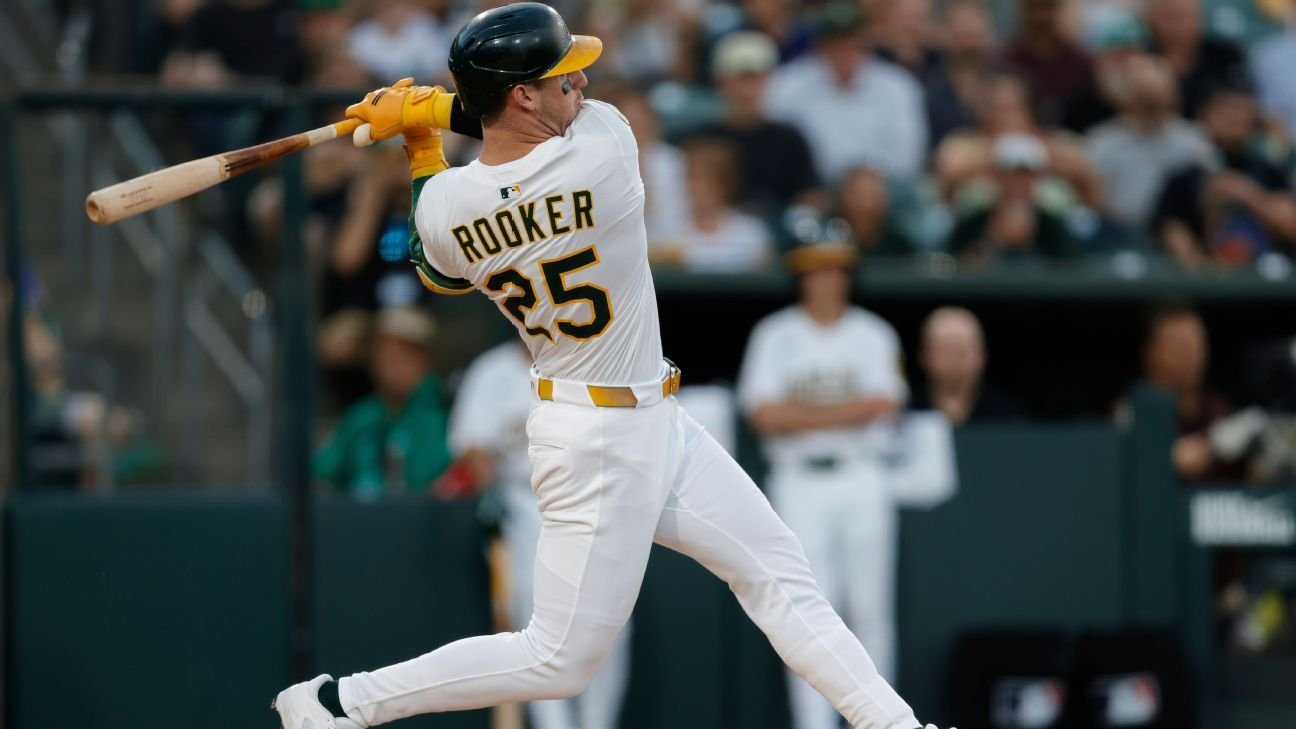
It’s a gorgeous Saturday in late February in Mesa, Arizona, and Athletics designated hitter Brent Rooker is full of joy — partly because two days earlier, he had gotten his first hit of spring training after an 0-for-5 start. Not 0-for-50. Not 0-for-15. That’s right: 0-5.
He’s discussing a salary cap, meteorology, dunking a basketball, X, karaoke, country music, throwing a football, his two daughters and changing diapers — a skill which, he says, “I am good at. And I’m sure my confidence in that will never waver.” On most other things, however, he is charmingly self-effacing.
What’s something you’re terrible at?
“Baseball,” he answered.
That’s coming from a player who, over the last three MLB seasons, has hit 99 homers, competed in the Home Run Derby and made two All-Star teams.
“I’m not great at baseball most of the time,” Rooker said. “And I let myself know it. My teammates will tell you that’s my way of coping. Negative self-talk. There are a lot of people that will tell you that you must be positive all the time. I don’t think that’s true. To each his own. People handle failure differently, there are different coping mechanisms to get you back to where you need to be mentally. For me, that tends to be self-deprecation, negative self-talk and telling myself how bad I am. That’s my way of dealing with it.”
It explains why he was so hard on himself about his spring training “slump,” which he broke with a single.
“Then he hit a missile over the wall in right-center,” said A’s manager Mark Kotsay, chuckling at Rooker’s constant worries.
“It happens the beginning of spring training every season. I wonder, ‘What if I never get another hit again?”’ Rooker said with a soft laugh, but he wasn’t kidding. “It is very challenging right now. I know at one point in my career, there will be a last hit. What if that has already happened? Every spring, I have to figure out if I can still do this. Maybe it’s gone now? Then you get your first hit of the spring and you say, ‘OK, maybe I can still do this.’ Those feelings creep in all the time for people on this level, especially for hitters.”
Rooker is entitled to feel this way about his career, given it was filled with failure until three years ago, when he emerged as a premier power hitter — the leader of a young and talented A’s team. Now 31 years old, he finally achieved financial security in the game he loves after signing a five-year, $60 million deal in 2025. Yet, true to his nature, Rooker doesn’t talk much about finally arriving. He seems more comfortable reliving his time before arriving in Oakland in 2023: his three years in Triple-A, his two disappointing years with the Minnesota Twins, his seven at-bats with the San Diego Padres and 25 with the Kansas City Royals.
“There were plenty of times that I questioned whether I could play at this level,” he admitted.
Rooker was a great player in his three years at Mississippi State and was taken by Minnesota in the first round of the 2017 MLB draft. After that, he had some marvelous minor league seasons. “He might be the greatest Triple-A hitter ever,” said former Twins teammate Mitch Garver. But it still took three seasons before Rooker made it to the major leagues.
“It was frustrating,” Rooker said. “I felt like I was in Year 4 in AAA trying to prove I was ready.”
He made his major league debut in 2020, had an impressive first week in the big leagues and then got hurt. He returned in 2021, batted .201 and struck out 70 times in 189 at-bats. “In 2020-21, there was a lot of swing-and-miss, but everyone on that team knew he was the best hitter on that team,” Garver said.
“This is the first I am hearing of that. I wish someone would have told me that at the time, I wish Mitch would have told me that, that would have been great,” Rooker said with a laugh.
“In 2021, I thought I could produce, be a good player, then I would have stretches of weeks at a time where I felt lost. I felt hopeless. I wasn’t sure what I was doing on a major league field. Sometimes, it just feels impossible. But that comes with the early adjustment period and first exposure to this level of competition. I don’t know why confidence is so fragile in this sport, but it exists for most guys who play it.”
Garver never doubted that Rooker would succeed, though, because “[Rooker] had hit at every level, he never got a full opportunity. He needed 500 ABs, we were going to see some bad ones, but the good ones are better than most.”
In 2022, the bad at-bats outnumbered the good ones, so the Twins traded Rooker to the Padres. He went 0-for-7 there, then was traded to the Royals, where he went 4-for-25. In 32 at-bats in 2022, he did not hit a home run and had only one extra-base hit. Kansas City designated him for assignment.
“I wondered if I’d ever play in the big leagues again,” Rooker said.
The A’s, recognizing the power possibility, claimed him on waivers. Near the end of spring training in 2023, Rooker was so unsure of his spot on the team, he asked the team’s traveling secretary, Mickey Morabito, what he should do with his car. Ship it? Keep it? He was advised to ship his car to Oakland — he had made the team. He went on to hit 30 homers en route to his first All-Star selection that season, followed that up with 39 home runs in 2024 and then another 30 last season.
So, when did the light go on?
“Second half of ’24, I remember the very specific moment, I was getting an MRI on my elbow,” Rooker said. “I played most of ’24 with a torn tendon in my elbow. [Seattle Mariners star closer] Andres Munoz was in the doctor’s office getting an MRI at the same time. I told him, ‘I hate to see you in the doctor’s office, but if it means I don’t have to face you tonight, that’s great. That’s fine with me.’ Munoz said, ‘You know, our whole staff is scared to face you.’
“It was that exact moment where it clicked: ‘Oh wow, opposing pitchers kind of see me in the same respect that I see really good pitchers.’ That was a year and a half into playing consistently for the first time in the big leagues. I thought, ‘Maybe I actually am decent.”’
But even now, after three straight productive seasons, Rooker’s stardom hasn’t sunk in.
“I still have to remind myself that I’ve had success,” he said. “Sometimes in the offseason, I’ll put my own highlights on TV to trick myself, remind myself that I am good. I can hit.”
Former A’s teammate and pitcher Ross Stripling said that Rooker’s comp is to players such as Max Muncy and Justin Turner. “Rook just kept plugging away until he found his swing. The big chase is gone, to some degree. The damage has always been there. His first run at it there was failure, which was huge to have that. Now he passed that at the full dance. He is very vocal about things, he is very player-centric, he is not afraid to speak his mind. He is not going to sugarcoat anything.”
Rooker brings that same energy to social media, where he is also very vocal: “It’s something I enjoy. It’s about authenticity. You have to be genuine,” he said.
And that isn’t just Rooker’s online persona — it’s how he lives his life.
He playfully talks about his meteorological skills. He asks who is more dominant in their respective sport, Scottie Scheffler or Shohei Ohtani? He describes some of his favorite foods. He dunks a basketball every year on his birthday just to remind himself that he can still do it. And he tries to explain the concept of a proposed salary cap, saying, “The solution that people believe that a salary cap offers, when you dig deeper into the numbers, you dig deeper into the NFL system and the NBA system and other cap systems, the surface-level things that people think a cap will accomplish, it does not do a good job of that, and ends up being detrimental for not only the players, but for the league and competitive balance.”
Stripling said Rooker’s outspoken and honest voice has made him “the clear leader of that team.” Indeed, Rooker has been a huge help to the young stars on the A’s, including first baseman Nick Kurtz and shortstop Jacob Wilson.
“It’s cool because if you had told me four years ago that I’d be in any kind of leadership situation, I’m not sure I would have believed you, I didn’t see that in the cards,” Rooker said. “In all the roles I have played in my major league career — I was a fairly high draft choice, I’ve been a fringe player on a 40-man, a bench player, a platoon bat, pinch-hit guy — I played every role you can on a roster. So, I think no matter where guys are in their career, I can offer some kind of insight, some kind of advice, some value on how to attack that role.”
Rooker’s family — his wife, Allie, and daughters Blair, 4½, and Blake, 18 months — has helped make all the roles he has played easier, and made him stronger.
“You have a bad game, they are right there after, and they don’t care,” he said. “That takes some stress off your plate. They change your routines. The mornings are now spent playing with them or in the pool rather than hyper-focusing on the game eight hours before the game. That’s beneficial. Instead of waking up at 8 or 9 and harping on the game the night before, you can distract yourself, then lock in when you get to the field. They are the best part of my life and they make every day better. They make failure easier.”
The game is never easy for Rooker — it’s almost as if he wants it to be that way. But it is getting slightly easier. And just maybe, for the first time, he will open a season knowing that the last hit of his career hasn’t already happened.

