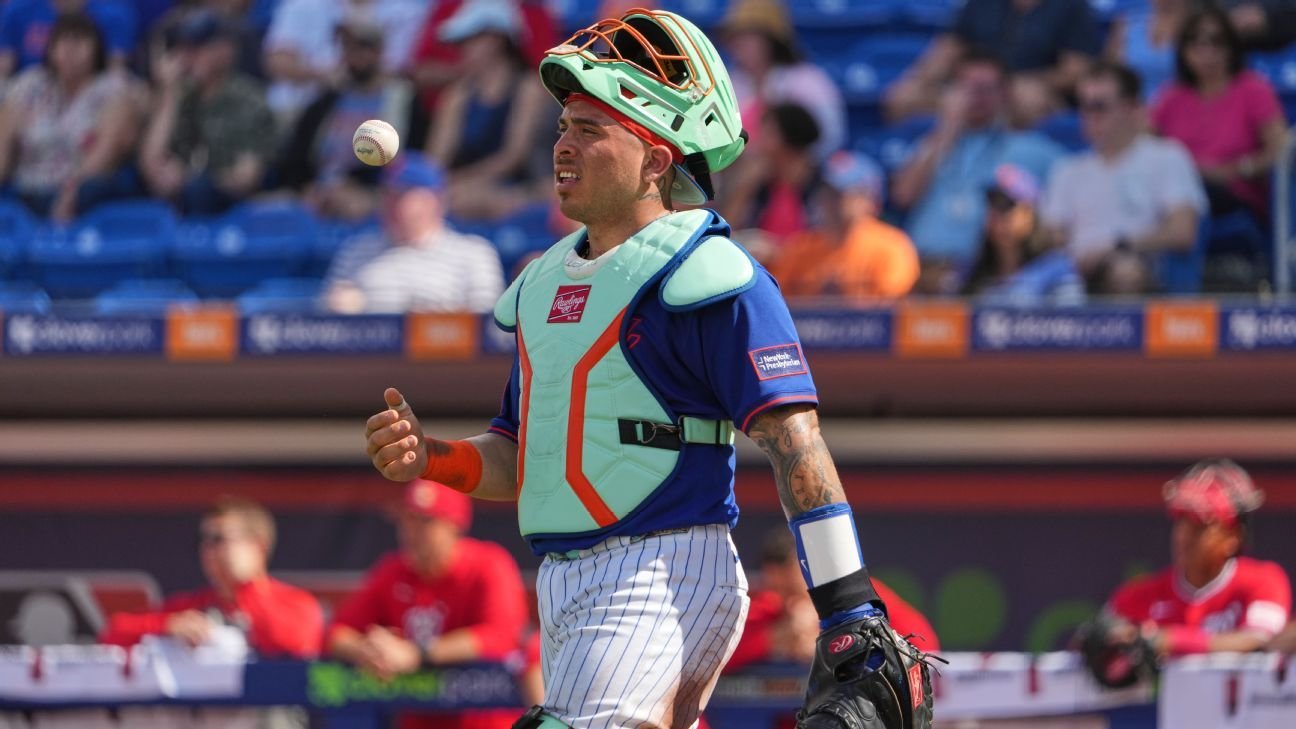
WEST PALM BEACH, Fla. — The New York Mets are experimenting in spring training games with calling pitches from the dugout, following in the footsteps of the division-rival Miami Marlins.
The added wrinkle was on display during the Mets’ Grapefruit League matchup against the Houston Astros on Thursday. Often, but not for every pitch, Mets catcher Francisco Alvarez looked over to his club’s dugout and received a signal from catching coach J.P. Arencibia before pushing the buttons to call for starter Kodai Senga‘s next offering via PitchCom.
“We’re working through it,” Mets manager Carlos Mendoza said before Thursday’s game. “There’s a lot. It’s new. It’s new for a lot of people here. We’ve done it with [minor league pitchers]. They need to be working on pitches. And the feedback, the buy-in has been really good. So I don’t think we’re going to call every pitch, but we’re kind of working through some scenarios where if they need help, we’ll be ready.”
Marlins coaches called pitches from the dugout throughout the minor leagues last year and brought the concept to the majors for the last nine games of the regular season, a controversial decision that the team believes worked in its favor. The Marlins will continue to call pitches from the dugout at the major league level in 2026.
Mendoza emphasized the Mets are “not doing this like Miami’s doing it.” Mets catchers can look to the dugout for a sign but can also decide on a different pitch. If the catcher does call for the dugout’s pitch, the pitcher can shake him off. One Mets player described the dugout sign as a “suggestion.”
“They’ve got to have a feel for the game,” Mendoza said. “They’ve got to be able to make adjustments.”
How widespread the strategy will be in the Mets’ minor league system is not yet known.
With the Marlins, the assistant pitching coach — Alon Leichman last year, Rob Marcello this year — relays signs to the catcher, who then checks the sheet on his wristband and inputs the selection into PitchCom to relay to his pitcher. If a pitcher shakes off, it is then up to the catcher to decide what’s next.
The Marlins initially received pushback organizationally from catchers who wanted more control over the way a game played out, and pitchers who were worried about pitch-clock violations with a third party involved. Marlins coaches, though, were pleased with how efficiently the process worked. In their minds, any potential drawbacks were outweighed by the additional information coaches have at their disposal in the dugout.
The Colorado Rockies, who hired Leichman as their pitching coach this offseason, have also considered calling pitches from the dugout in 2026.
Unlike the Marlins and Rockies, the Mets are a big-market, big-money operation. The Mets are expected to carry a top-two payroll for the fifth consecutive season while the Marlins and Rockies are projected to have two of the 10 lowest payrolls in the majors.
Looking to rebound from a disappointing 2025 season, the Mets acquired frontline starter Freddy Peralta over the offseason and overhauled their bullpen, bringing in Devin Williams, Luke Weaver and Luis Garcia, among others. Nolan McLean, a favorite for the National League Rookie of the Year Award, is expected to take on a vital role this season, with veterans Clay Holmes, Sean Manaea, David Peterson and Kodai Senga filling out the rotation. Alvarez and Luis Torrens will return as the team’s two catchers.
They’re scheduled to open the season next Thursday against the Pittsburgh Pirates with Peralta on the mound for his Mets debut.
“If the catcher looks, we’ll give it to him,” Mendoza said. “But [the catcher] and Freddy, they’re calling their game.”

