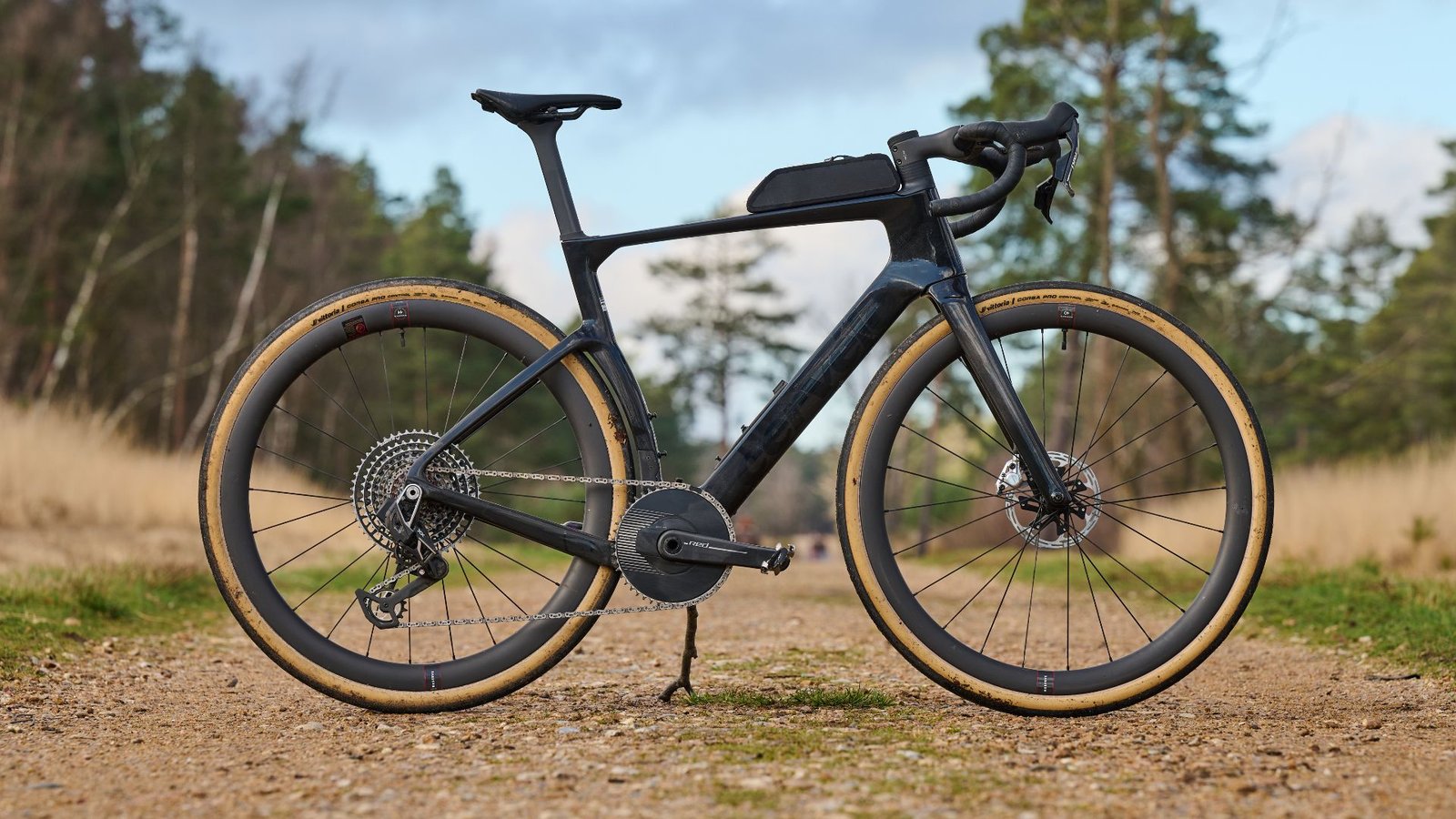
The Cervelo S5’s design language, developed by founders Gerard Vroomen and Phil White, remains clearly visible in Cervelo’s latest work, even long after the company joined the Pon Group.
The deep headtube, boxy downtube, huge bottom bracket, and trademark seat tube that follows the tyre—creating a fairing and the ‘snapped back’ look—are all present.
Recent independent tests show this vintage design is still incredibly effective at cheating the wind. While this thinking has stood the test of time, and it’s hardly actually vintage, what was once a pro peloton standout now looks understated next to bikes like the Factor One. The S5 template, a technical triumph of iterative design, is now ported to the Aspero-5 gravel race bike.
(Image credit: Future)
The Aspero-5 is essentially an S5 for the dirt, responding to the industry’s new ‘gravel race’ category: bikes for fast, sub-four-hour events where aero advantages matter.
At the launch event I attended, Cervelo’s engineers were clear: this was a category no one asked for, yet its existence is a commercial response to the market. The original Aspero was an extremely capable, practical, and aero-enough all-road machine. I initially saw no point in this more S5-like iteration, assuming it was a marketing-led design study to sell to gravel-bike-reluctant road bike consumers. I wanted to hate it, believing the need for the category was completely unassured. I was wrong. More on that later.
Design details
The Aspero-5 adds even more S5 influence to a bike that already borrowed heavily from its design language. At first glance, it could be mistaken for a road bike, perhaps a new Soloist. However, a closer look reveals file-tread balloon tyres, fitted purely for their aero performance, to demonstrate the difference a tyre can make. While interesting, these are not truly gravel tyres, but they look awesome and work brilliantly on the road.

(Image credit: Future)
My test bike was finished in a stealthy black lacquer with a black decal. It also comes in Royal Mercury (pearl grey) and a flat Blue Nitrate. The handlebar and stem look more road than gravel in fact, with an out-front bar section designed for multiple hand positions. Crucially, the stem integrates neatly but does not fully conceal the cables internally. This is a clear, practical nod to Aspero customers, saving them from costly headset bearing changes and cable wear— and an approach more road and gravel bikes should follow.

(Image credit: Future)
Specifications
This bike is loaded with fancy kit, and bolt ons but the groupset spec sheet suggests this bike is a race homologation model, or more likely, given we don’t have such a thing in cycling, pitched at the top end. Force, the second from top tier SRAM option, is the entry level here.
The bike is strictly 1x only—a deliberate, clean-looking design choice suited to its race intent. Although you could build your own 2x set up as there is a concealed front mech braze on mount. Gearing is similarly race-focused: 48t with a 10-52 cassette (SRAM Force or Red) or 10-51 (Shimano GRX 825 Di2). They could have selected different gearing here, but this set up is spot on.
The wheelset is the in-house Reserve 40mm depth, ideal for most gravel situations. The top-spec bike uses the benchmark DT Swiss 240 hub—the best choice for easy servicing, superior geometry, and excellent weather sealing. The lower-spec 350 hub on the Force and Shimano options is nearly as good. The wheels felt strong and responsive in operation, and are a really nice build.

(Image credit: Future)
Tyre clearance is just 45mm. Next to more recently designed bikes that accommodate mountain bike rubber, this feels restrictive. However, 45mm is ample for the fast gravel conditions where this bike excels. The supplied Vittoria Corsa Pro Control TLR G2.0 700x42c tyres roll like road tyres but are only suitable for dry, champagne gravel or the road; they performed poorly in the wet, resulting in a crash.
Regardless of tyre choice, I should warn against using the Aspero-5 in sticky mud. The kind that plagues anyone, almost all year here in the UK. Whilst there is clearance for width, the tyre hugging design of the seat tube will pick up and retain stones, and will likely get blocked with clay-type mud, very quickly. Bear this in mind if you’re used to sliding around single-track and need something a little more open in it’s design.
The bike comes in six sizes (48 to 61cm). Framesets are £5,250 / $5,500, and the highest spec is £10,250 / $12.600. This price is steep, but includes a Cervélo out-front mount, rear accessory mount, in-frame storage with a neoprene roll, a bento box-style top tube bag, two Arundel Mandible carbon bottle cages, and a Hammerhead Karoo 3 head unit.

(Image credit: Future)
My size 56 test bike has a front end notably higher than an S5, closer to the Soloist in numbers, if you disregard the bigger clearance and longer wheelbase. Compared to the standard Aspero, the head tube angle is slackened from 72 to 71.6 degrees, the seat tube from 73 to 72.6, and the BB drops 5mm to 80mm. The wheelbase is shorter at 1029mm with 422.5mm chainstays. The 395mm reach is 2mm shorter, and the stack height is 5mm lower at 395mm.
Nothing strange about that on paper perhaps. Except this stack height is the same as a Cannondale Super Six Evo, and the trail value (~62.5mm) is in the range of fast road bikes like the BMC Teammachine. This confluence in numbers hints at why this bike is special, and whilst it might not have the clearance for UK quagmires, assigning it to gravel only, and not using this on the road too might be selling it short.
Performance
Let me get a spoiler out of the way right up front. Despite my initial desire to dislike it, I love this bike.
What Pon achieves with its vendors in Taiwan, evident in the Aspero-5, is extraordinary. The S5-like aero shapes should compromise ride quality, yet they don’t. I’d argue it rides better than the standard Aspero, a credit to the iterated layup and S5 learnings. Even with 28mm road tyres inflated high, the ride was dreamy compared to other bikes with similar tube proportions, demonstrating meticulous attention to the carbon layup.
This refinement is a key difference when compared to the Factor Aluto and 3T Racemax, two bikes we tested alongside the Aspero-5, whose manufacturing methods (for example, the 3T’s is made using a braided carbon process) can limit tuning precision.
The Aspero-5’s ride quality competes directly with the Factor, which has much skinnier tubes – a bonkers achievement given the once-presumed-unyielding nature of large aero shapes.

(Image credit: Future)
The bike excels everywhere. It’s less an excellent gravel bike and more an excellent all-road bike with extensive gravel capability. I disagree with the commonly held view that the 45mm tyre clearance is a fatal limitation when the performance compromise is this minimal. I don’t have a wind tunnel, but my comparative efforts show this frame rewards you with less effort—it feels wickedly fast and is addictive.
Reach feels better than in the Factor, with the front end easier to lift for me, adding to the fun, but that is very fit dependent. The 3T Racemax Italia

If you’re riding in UK mud whilst you will get a wide tyre in this bike, you do not have room to carry much crud on the tyre. Doing so will make a terrible racket.
(Image credit: Future)
The balance across the available numbers gives lovely handling akin to a road bike, anchored by a slightly-longer-than-road geometry out back, it keeps it flying and fun.
This bike strikes a better balance for mixed-surface riding than both the Aluto and the 3T, although there’s not much in it. The 3T has the lowest trail value, but the slightly more upright riding position on that bike made it feel more rowdy, and easier to lift on rough trails, so it is arguably the better bike on really rough stuff. And the Factor beats both, because whilst no roomier really in terms of tyre clearance, it’s design means you’re much less likely to get stones and mud jammed in the frame. So it’s fair to say the three bikes I tested are very close.
Value
With a frameset costing £5250 / $5,500 it’s hard to call it good value, but it’s comparable to the Enve Fray and other bikes here on test, and comes with big brand kudos and accessories like the fancy Mandible cages. It also has a significantly considered aero template in the frame, which the other two either don’t have to the same extent in the case of the Factor, or in the case of the 3T, seem to rely on the ‘older’ version of the same concept.
Where it does start to look like very good value is against the S5, being £2,000 cheaper in the UK. This bike flatters your riding, feels both neutral and fun, and unlike the S5, can be taken off-road. You can stick a chocolate bar in the down tube too, so what’s not to like.
Verdict
If you’re buying a Cervelo, choose the Aspero-5 over the S5 or Soloist. For minimal off-road work, just fit road tyres. With 32mm or 34mm tyres, you’ll be riding in luxury and chasing down S5s. There is no higher-tech, slipperier, or better option in this test; it is my winner.

