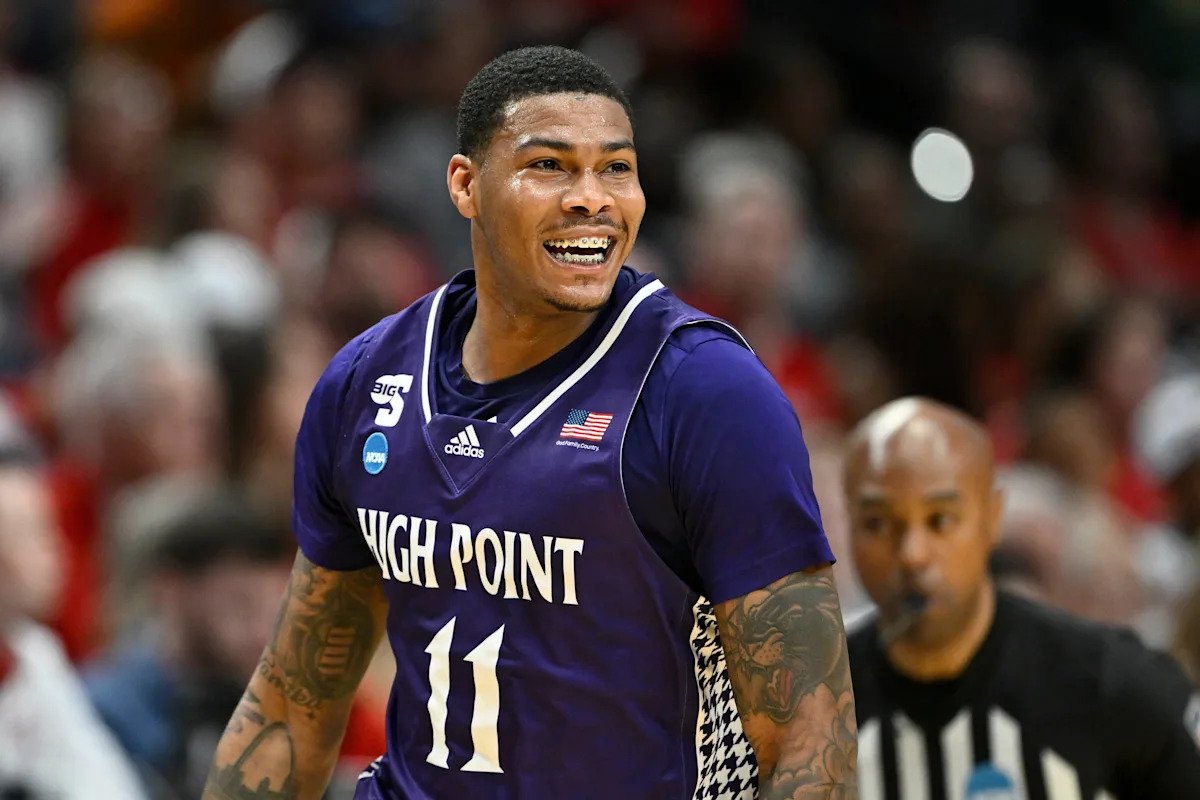
PORTLAND, OR – As the mid-majors continue to succeed in the NCAA Tournament, the noise around the difficulty in getting opportunities to prove themselves gets louder.
After No. 12 seed High Point knocked off No. 5 Wisconsin in the first round, coach Flynn Clayman drew attention when he said his team couldn’t get games against major opponents.
Advertisement
“It’s pretty obvious to me that something needs to be done about this nonconference scheduling,” he said. “That team (Wisconsin) right there is a fantastic team that beat five top-10 teams. If we can get games like this on neutral courts and some home games, I think we’d know who’s really the best teams.”
Opinion: Miami (Ohio)’s March Madness run is over, but it won’t be forgotten
More: Travis Steele advocates for analytic scheduling change with high-majors
It’s been a major talking point this season, mostly surrounding the historic season Miami (Ohio) had. Despite going 31-0 in the regular season, its NCAA Tournament resume was debated because of the quality of opponents the RedHawks faced, not facing any Quad 1 or 2 opponents during the campaign.
Advertisement
However, Extra Points reported Miami (Ohio) tried to schedule several Power conference teams, but weren’t successful, highlighting the struggle quality mid-major teams face in trying to prove themselves.


With Miami (Ohio) beating SMU in the First Four and High Point and VCU advancing to the second round, they showed they could hang with Power conference teams. Ahead of playing Arkansas, Clayman said his comments were misunderstood, and the main issue he has is high-major teams don’t really benefit from playing teams like his.
“They are doing what’s best for their program. I would love to see a system for the fans and for the game of college basketball where it’s better for them to play those games,” he said. “I’ve seen over time that now the good mid-majors don’t get a chance to play anymore because of the system. If we can just tweak that a little bit, then they’ll be right back to playing.
“I put zero blame on high-major programs for doing what’s best for them,” Clayman added.
Advertisement
It’s a similar sentiment to what Miami coach Travis Steele said after it lost to Tennessee in the first round, mentioning how so much of the struggle is “analytically driven” and things such as KenPom and NET rankings need adjustments.
There’s been plenty said from mid-major coaches, but what about those in charge of major programs?
Arkansas’ John Calipari, as well as Gonzaga’s Mark Few, know all about it. Calipari got his start at UMass and recalled playing two-for-ones — two games at a Power school for one home game — and how it was frustrating even then to get that.
“We did anything we could to schedule games. To get home games. I’ve been there. It’s hard,” Calipari said. “No one wants to play a team that they think are going to be really good, and they’re not going to do it on the road. You’re just not going to go on the road. That’s why I was doing two-for-ones.”
Advertisement
Calipari commended High Point for its season, noting “do you know how good they must be and well-coached” to have 31 wins. He mentioned how getting administrative investment is a key for mid-majors to reach the next level of success. Arkansas did play an NCAA Tournament team in the regular season in Queens, and barely beat another notable mid-major in Winthrop.
No one may be better suited to talk about it than Few. With Gonzaga since 1989 and in charge since 1999, he’s led the Bulldogs’ evolution from mid-major trying to prove itself to a national power.
The simplest way to get those games in Few’s eyes? Be a consistent winner, starting with the Big Dance.
“We were in that plight 25 years ago. You just have to win. You have to break through in the tournament. The tournament gives you an avenue to do that and a stage to do that. Once you do that, you do it a couple years in a row, then you are able to get those games,” Few said.


He added of all the things needed to become a national power, scheduling was by far the most difficult thing to do, needing sustained success rather than little spurts of stardom to gain respect.
Advertisement
“It’s not something you’re going to be given. You’re going to have to go out and earn it. You’ve got to earn it for quite a while,” Few said. “Once you prove yourselves, everybody wants to play you.”
While there isn’t any indication changes will be made or not, mid-major teams have proven they can back up their outstanding records by playing with the big boys. It may be frustrating to deal with ahead and during the season, but when these teams reach the NCAA Tournament, there’s no way to avoid them any longer.
It only helps their case when you let those Cinderella stories thrive.
“I think there was some teams that ducked us this year. But, I mean, like coach Flynn say, ‘we’re here now,’” said High Point forward Cam’ron Fletcher. “There’s no ducking anymore.”
This article originally appeared on USA TODAY: March Madness upsets unveils mid-major scheduling hurdles

