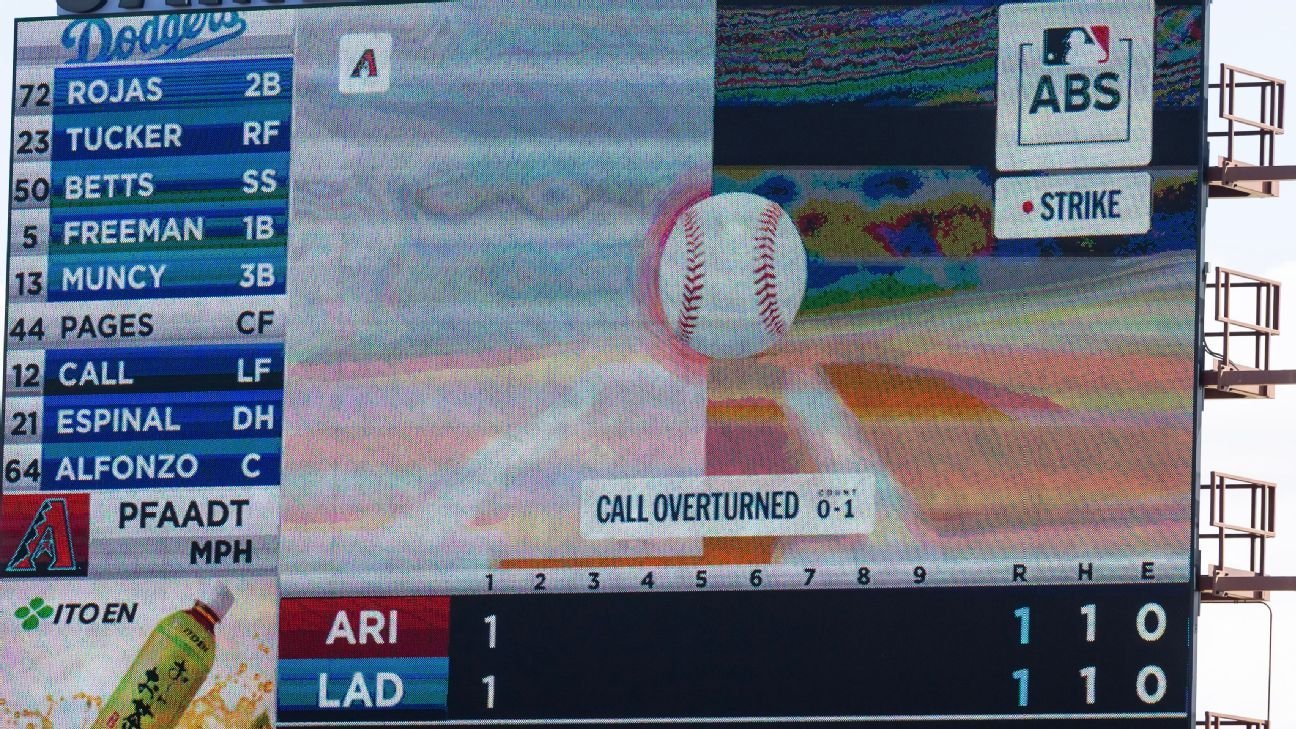
Major League Baseball’s new automated ball-strike challenge system is finally here.
Beginning with Wednesday night’s New York Yankees–San Francisco Giants 2026 MLB season opener, players will be able to appeal the ball and strike calls made by plate umpires.
Each team will get two challenges to start the game. Immediately after a pitch is thrown — and with no help from the dugout in deciding — the pitcher, catcher or hitter can challenge the ball or strike call by tapping his helmet or hat.
The umpire will acknowledge the challenge and the pitch will then be replayed in real time via animation on the stadium videoboard and TV broadcast. The outcome of the challenge will be shown publicly through that replay. If a team wins a challenge, it can keep challenging. As soon as a team loses two challenges, it won’t have the ability to challenge a pitch for the rest of that game.
The process has been tested for years in the minors and during the past two MLB spring trainings. The data shows that deciding when to challenge a call is often a tougher decision than fans might think. In 2026 spring training games, 53% of 1,844 challenges were successful. Only 45% of batter-initiated challenges worked, compared with 60% for the defense. Overall, there were an average of 4.32 challenges per game — 2.28 of which were successful.
Chicago Cubs hitters had the best overturn rate at 65%, while 75% of St. Louis Cardinals’ challenges on defense were successful, tops among pitchers and catchers. Meanwhile, Kansas City Royals hitters were right only 31% of the time, while the Toronto Blue Jays were successful on defense just over 50% of the time, last in the majors.
Who will be the first player to ask for a ball-strike call review in a regular-season game? What strategic approaches are teams taking on what — and when — to challenge? And what unexpected consequences could arise during the season?
ESPN asked 19 team executives about one of the game’s biggest additions since replay review was first instituted in 2008. Because the questions involve team strategy, we granted anonymity to our respondents.
What have you learned about ABS this spring?
Teams are most concerned with calls at the top of the strike zone. Every player’s height was measured during spring training specifically for ABS. How detailed is the process? The league is being particular about taking measurements in the morning as studies have shown people lose height throughout the day.
The new measurements are based on a player’s height, not anything to do with their stance. In practice, those with upright stances — think Cody Bellinger — could have some pitches overturned in their favor, whereas the opposite is true for those with a pronounced crouch.
“Height of the zone has been the most hot-button topic,” one executive said. “Players have asked a lot of questions about the height of the zone relative to stance. That’s been hard for them to internalize. A lot of focus when ABS was introduced was on the sides of the plate, but it sure seems like in early days the calibration to the top of the zone, especially, will be a challenge.”
Another added: “It does seem like umpires miss the top of the zone a lot more than other areas. Particularly, breaking balls that clip the top.”
Even umpires recognize the difference. “You can’t call anything high,” one major league ump said. “Nothing. The bottom is a little bit more true.”
Several executives were quick to praise umpires, noting that many of the spring calls that were challenged and/or overturned were on pitches that barely clipped the zone or just missed it — by less than an inch on many occasions.
“In terms of things we’ve learned, umpires are better than expected, with few missed calls on average and most of their misses being on pitches very close,” one respondent said.
But because even the slightest fraction matters, two executives expressed a desire for more than two challenges. There are just too many close calls that deserve to be reviewed.
“It feels like it’s going to be a frequent occurrence that a team is out of challenges in the eighth and ninth innings and important — maybe the most important — pitches are still going to be missed.”
Will you let pitchers challenge?
Yes: 5
Yes, but strongly suggest they don’t: 4
No: 10
On the surface, it seems like a silly question. Of course, the player who actually threw the pitch should be allowed to challenge the call — right? But that’s not the case for many teams that think pitchers aren’t in the best physical position after throwing a pitch or are too emotionally invested to make that decision. Those teams would much prefer their catchers do it. When strategy discussions first came up at the MLB winter meetings, more managers than not were already saying they wouldn’t allow pitchers to challenge.
“Pitchers have shown limited ability to identify where the pitch actually was,” one executive said.
Another “no” respondent added: “I think it’s also human nature that if a pitcher taps his head, the catcher will also probably tap. Have seen that a couple times this spring.”
But not every team is steadfast in not allowing pitchers to challenge — though several who answered yes did so with a caveat.
“Yes, allowing pitchers to challenge,” one executive stated. “But preference is to let the catcher do it unless they feel extremely strong about it.
Another added: “We don’t have an explicit rule prohibiting it, but we’ve suggested they not challenge.”
Even in mid-March, two team executives said they were still unsure whether they would let their pitchers challenge, putting it down as one of the final things to sort out before the regular season begins.
“We let them challenge during the spring, but I’m not so sure that’s a good idea when the games matter,” one executive opined. “I might just leave that up to the manager.”
Another thing some teams have learned is that the modern-day pitcher could be less equipped to challenge a call compared with his counterpart from past eras. The theory is that their follow-through is more violent than ever, meaning they’re not landing in a position to see where their pitch actually hits the mitt.
“For some guys, that head ‘thwack’ is where they fall off to either side and the head goes with,” one respondent said. “Old school was finish in fielding position, right? [We see] the more modern violent follow-through since guys throw harder.”
What’s your general strategy, knowing you have two challenges per game unless you keep winning them?
When to challenge has generated the most discussion within teams this spring, as personnel are giving general guidelines to players for the regular season. And a Day 1 strategy might be different by Day 30 or 60 as initial data is collected.
One team said it would “trust the instincts” of its players — but will that last? “High-leverage” situations was a popular term in camps, though every player’s definition of that could be different.
“Try to hold challenges until later in game, more for just the leverage and strategy with only having two,” one executive opined. “If you do want to use one early, make sure it’s a high-base-traffic situation.”
Another exec agreed: “Basically just trying to tell them to make sure we use it when the leverage is high — full counts, close games, late — and we’ll adjust from there.”
Early in games, teams mostly want “egregious” calls to be challenged. Those are the ones that “everyone knows when you see them,” one executive said.
“Take the emotion of the close call out of the decision, only challenge when 100% sure. It’s easier said than done.”
Several teams said they will allow “more freedom” if the team has two challenges as opposed to being down to just one. Running out with high-leverage moments potentially remaining is a fear among all teams.
“We’re telling them to be much more selective with one challenge,” one executive said, echoing the approach of many teams. “Has to be late and close games. With two strikes only.”
One executive simply emailed: “No 0-0 count challenges.”

