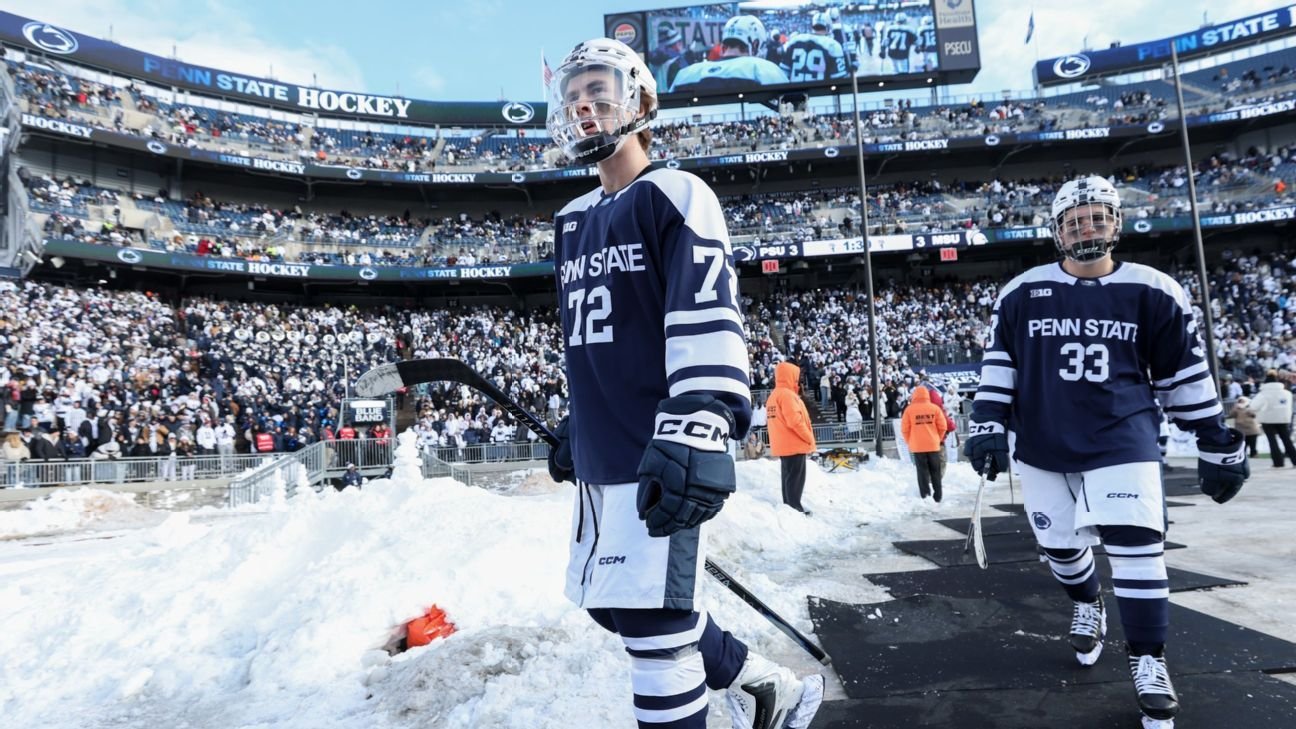
ON THE LAST day of January, Penn State deputy athletic director Vinnie James surveyed Beaver Stadium, marveling at the scene. Nearly 75,000 people had gathered to watch a college hockey game, held in the nation’s second-largest football stadium.
Before 2012, Penn State hockey had operated primarily as a club program, recording only five varsity seasons in the 1940s. Less than 15 years after becoming an NCAA program, the school was hosting the second-largest crowd to see college hockey.
“It felt surreal,” James told ESPN. “Almost like a movie.”
The event was a testament to Penn State’s investment in hockey, which began long before terms like NIL and rev share infiltrated college sports parlance. But Penn State also had accelerated its push into the hockey compensation space by adding forward Gavin McKenna, a star in Canada’s Western Hockey League, who shook the college hockey world by announcing in July that he would play the 2025-26 season for the Nittany Lions.
McKenna, the presumptive No. 1 pick in this June’s NHL draft, had a goal and two assists for Penn State at Beaver Stadium in a 5-4 overtime loss to No. 2 Michigan State. Penn State announced the outdoor game less than two months after McKenna’s decision, and it was easy to draw a connection between the two events.
“When you get to a certain level of player, they’re real investments for [an athletic] department, and the things that those players allow you to do are absolutely critical,” said James, Penn State’s hockey administrator. “Not just Gavin, but we built this program to get it to the level where we can go do an outdoor game and have 75,000 people in the building. That’s not easy to pull off, but when you put the right players on the ice and the right quality of team on the ice, you can do those things.”
After reaching its first Frozen Four in 2025, Penn State has gone all-in on hockey. But the biggest schools with the biggest athletic budgets and arenas — and football stadiums — aren’t the only ones operating at a championship level. As the NCAA tournament begins Thursday, Michigan is the top seed and three other Big Ten teams, including Penn State, are in the field of 16. But a Big Ten member hasn’t won the NCAA hockey title since Michigan State in 2007.
The National Collegiate Hockey Conference has produced seven of the past nine champions, a group that ranges in profile from teams supporting football at the FBS Group of 6 level (Western Michigan) to FCS (North Dakota) to Division II (Minnesota Duluth) to no football at all (Denver). After Western Michigan won the national title in 2025, coach Pat Ferschweiler told ESPN the Broncos would “probably be the last major-sport team to win a national championship with zero NIL dollars,” adding that the school would be investing some for the 2025-26 team. The Broncos are back in this year’s NCAA field as a No. 1 seed.
College hockey might be late to the athlete compensation game, but there’s no turning back, especially after the NCAA in November 2024 cleared the way for Canadian Hockey League players to be eligible. The twist is how such a wide mix of contending programs approaches spending and roster construction.
“There’s lots of layers to it, especially in hockey, because there’s such a diversity of schools,” Denver coach David Carle said. “You have some in the Power 2, some in the Power 4. You’ve got us, Division I without hockey, you’ve got some that are Division III [football] with Division I hockey. It’s a really vast landscape, which has always been good for hockey because kids have a lot of options.”
McKENNA’S ANNOUNCEMENT THAT he would play for Penn State rocked college hockey.
“A big moment in the NIL hockey world, for sure,” Quinnipiac coach Rand Pecknold said.
James said Penn State expected a reaction, not just because of the player it was acquiring, but because the program is “a bit of an outlier,” not located in college hockey hotbeds like the Northeast or the Michigan-North Dakota corridor. In evaluating McKenna, Penn State needed a player with superior skills but also the personality to not disrupt a dressing room where teammates would be earning a lot less than him.
Penn State’s pitch to McKenna revolved around the resources it could offer — strength and conditioning, athletic training, nutrition, recovery — that the school believes are on par with those of NHL teams.
“We offered a competitive package financially,” James said. “When we looked at the finances, we felt like just him being a part of our program would do so much for us that we thought we could capitalize on additional revenue. So you’re taking a little bit of a risk, but it was a calculated risk that we felt like would pay off.”
Pecknold, who coached Quinnipiac to its first national title in 2023, loved the McKenna move from afar. Although he doesn’t know exactly what the school paid for the Canadian star, he sees Penn State benefiting for both its present and future.
“A great investment, not just hockey-wise, but from a marketing perspective,” Pecknold said. “Over the next 20 years, he’s going to be a superstar in the NHL, and they’ll get their money back. They realized the value of their hockey program and this athlete.”
Quinnipiac is a different type of program, a private school in southern Connecticut with an enrollment of around 6,500 (36,000 fewer than Penn State). The Q supports seven men’s sports but not football.
Men’s hockey is Quinnipiac’s premier program, and the team will make its 12th NCAA tournament appearance with a first-round game against Providence on Thursday. The Bobcats reached the national title game in 2013 and 2016 before beating Minnesota three years ago for the championship. They play in the Eastern College Athletic Conference, which includes six Ivy League institutions (that also play in the FCS), some members that have Division III football (Union, RPI, St. Lawrence) and another, like Quinnipiac, that doesn’t sponsor football (Clarkson).
The on-ice product is elite, but Quinnipiac takes a more grassroots approach toward player compensation.
“We have to fundraise for our NIL money,” Pecknold said. “It’s not the number where we want to be, we need to get it up, because it’s becoming even more relevant in our sport. … If we want to stay and continue as a top 10 team, we need to adapt and find a way to either fundraise or get the school to help us out.”
Pecknold is directly involved in every element of the program, including NIL funding, as Quinnipiac doesn’t have the staff of Big Ten schools and some other national competitors. There are more enjoyable parts of his job, but he sees athlete compensation similarly to the transfer portal, which he said directly helped Quinnipiac win a national title. The choice: Adapt and thrive, or get left behind.
Moves like McKenna’s to Penn State are new to college hockey, and carry some mystery, as the terms of his agreement and others like it aren’t made public. What happens next is difficult to predict.
Will similar moves be made, especially with CHL players available?
“One thing that factors into the equation is most of the kids on our team have been drafted [by NHL teams],” Boston College athletic director Blake James said. “Their [financial] situation is different than a lot of other sports because the kids in those sports don’t know their draft status.”
James added that top players view major college hockey as the logical platform for their development before making the jump to the NHL. The potential benefits of adding superstars like McKenna, including another deep tournament run for Penn State, could spark other splash signings.
“There’s a couple programs and a couple players where there’s a considerable amount of money being thrown at them,” Western Michigan athletic director Dan Bartholomae said. “I still think it’s a pretty unknown space beneath that. Like, what is your top-line player making at North Dakota or Denver? I don’t know that. And how do you spread the money out? Is it going all to a McKenna? There’s not much left for anybody else.
“We’re all still learning, and it’s kind of fun.”
PETER MANNINO WAS a concrete wall in goal for Denver, setting a team record with 15 career shutouts and helping the Pioneers to the 2005 national championship, their second straight and seventh overall. After an NHL and AHL career, he entered coaching, first with the USHL’s Chicago Steel before moving to the college ranks with Omaha, Miami (Ohio) and Colorado College.
Last year, he returned to his alma mater in a different role: assistant athletic director and general manager for name, image and likeness. Denver, which has won the most NCAA hockey championships (10) and does not sponsor football, wanted to ensure it was ready for athlete compensation in its top sport.
The school never launched an NIL collective but now assists athletes with third-party agreements that can be greenlit by NIL Go, the NCAA’s clearinghouse. Mannino oversees NIL for all of Denver’s teams, but much of his attention goes toward hockey and supporting Carle.
“Information is key,” said Mannino, who draws from his network in scouting and coaching. “You gather, you dissect, you absorb that information. You’re grabbing things from this person, this source. Then you take it and siphon it down to the Denver way and how we can do it. There are the different sizes of schools and the different success paths and development.
“We feel we have all the boxes checked here.”
Denver has had widespread athletic success despite the absence of football. The school also leads the nation in skiing national titles, won a men’s lacrosse championship in 2015 and regularly makes the NCAA tournament in soccer and other sports.
“It’s almost like a boutique,” Mannino said. “In really empowering our revenue generators, we’ve been able to do that because we’re not driven and shadowed by one.”
There’s a tradeoff for nationally competitive programs without football, like Denver and Quinnipiac, or those who play football on smaller stages, like Minnesota Duluth or Maine.
They will never host 75,000 for a game like Penn State did at Beaver Stadium or receive the residual resources of having major college football. But they can focus more on providing resources for their hockey programs without being guided, or pulled away, by football.
Carle said Denver’s decision to opt into the House settlement in February 2025 allowed the school to craft a revenue-sharing model that fit its mission.
“The Power 2, Power 4, they’re probably going to have to use a lot of NIL collectives and outside entities because their internal rev share is going to be driven toward football and basketball,” Carle said. “At a place like Denver or some of the others who opted into the settlement, obviously we’re capped at the [$20.5 million]. None of us will ever spend that much on our hockey programs, but there’s a little bit more flexibility and autonomy within that.”
Boston College’s James said he expects the “vast majority” of national-contending hockey programs to participate in revenue sharing. But the investments and strategies, like many other elements of the sport, will have some variance. Boston College plays in Hockey East, where it is the only member with Power 4 football but one of three that play in the FBS (UConn, UMass). Hockey East also includes programs that play in the FCS, like Maine and New Hampshire, but also those without football, like Providence, which won the conference’s regular-season title and enters the NCAA tournament as a No. 2 seed.
“I don’t think schools with football programs are at an advantage. I don’t know if I would say they’re at a disadvantage, either,” James said. “It’s institutions doing what’s right for them. When you look at some of the schools that are sponsoring college hockey, that might be the premier program and their largest revenue generator.
“The position it takes on campus is different.”
Last week, Maine athletic director Jude Killy wrote an op-ed in the Bangor Daily News, announcing that the school began directly compensating some athletes “to stabilize our rosters and keep top talent in Maine rather than being recruited away.”
Killy invited fans to support the efforts and noted that no tuition dollars or state funds would be used for athlete compensation. He closed the piece by writing: “While more resources won’t guarantee wins, by innovating and investing in Black Bear athletics, we are keeping Maine in the game.”
Killy told ESPN that launching the Black Bear Student-Athlete Experience Fund is an extension of the school opting into the House settlement.
“In a lot of ways, it’s TBD,” Killy said, referring to athlete compensation in hockey. “The FBS football landscape and basketball landscape are a couple years ahead of pretty much every other sport. And dovetailing that with the CHL component, what a wild set of circumstances to all be taking place at the same time. The one thing that we do know is if you sit idle and don’t move forward and find ways to support your programs, you’re not going to be in a good position to be competitive.”
Carle took notice of the McKenna signing and doesn’t find fault with any competitor’s strategy, but Denver’s path is different. The clearance for CHL players hasn’t changed Denver’s outlook.
The Pioneers currently have 10 freshmen, six who came from the CHL. According to Carle, none asked how much they were getting paid this season.
“It’s a new world … but we’re not going to be a school that pays player X an exorbitant amount more than someone else on our team and create potential issues within our locker room,” Carle said. “We view it as a tool, just like any other major rule change that’s occurred, whether it be transfer portal, CHL [player eligibility].
“We don’t want this new world to change what we do. We want it to enhance what we do.”
VINNIE JAMES AND other Big Ten hockey administrators meet regularly and discuss athlete compensation and other changes in the sport. They don’t reveal specific player agreements and financial strategies, but those in college sports’ richest league are working to get a leg up.
“The Big Ten is positioned really, really well,” James said. “We talk about it for sure, about what we’re able to do and how we’re able to grow this thing and hopefully separate ourselves from other hockey conferences. But it really doesn’t guarantee you anything coming down the stretch, when you get in the regionals and the Frozen Four.”
Recent results have reinforced that hockey is more unpredictable and variable than other major sports, even in its biggest games. In 2023, Minnesota had a high-scoring team loaded with NHL-drafted players and seemed set to end its 20-year title drought. But Quinnipiac rallied from a 2-0 deficit to stun the Gophers in the championship game.
Last year’s tournament featured Boston College and Michigan State — programs that have Power 4 football and storied hockey traditions — as the top two seeds. But Western Michigan, which had never reached the Frozen Four, won it all.
“There’s Big Ten versus NCHC, it’s not the same, and it never has been, from the beginning,” Mannino said. “But we just continued on our own way. And you can see the numbers, you can see the success and the results between the two conferences.”
The financial calculus gets interesting even within a league like the NCHC. Take Western Michigan. The Broncos followed their national title in hockey with their first MAC football championship since 2016. The school is also hyperfocused on the $515 million Kalamazoo Event Center, a transformative facility set to open in 2027.
Bartholomae’s goal is to keep contending nationally in hockey, win more MAC football titles and ultimately make the College Football Playoff, and rise up in basketball. But big ambitions don’t come cheaply.
“We have to look at ourselves differently than St. Cloud State, but we also have to look at ourselves differently than North Dakota,” Bartholomae said. “And if not, then we’ve got to figure out what’s the best allocation of those resources, and then we’ll proceed accordingly. We know the Michigans and the Michigan States can be built to last. What we don’t want to be is a program that just fades away after one glorious year.”
Coaches and administrators agree that college hockey is truly distinct — in the range of programs that compete for championships, in the randomness of big-game outcomes and even in how athlete compensation unfolds. The money isn’t as big as in football and basketball, and the demands from top athletes, many of whom already know their NHL draft destinations, aren’t that high yet.
Moves like McKenna’s could alter an evolving market and ultimately give the biggest athletic departments an edge that they’ve lacked. But small schools have no intention of vacating the national stage.
“If a university is committed enough, it can happen,” Pecknold said. “If they’re like, ‘We’re going to do everything it takes to be a top 10 program and win a national championship,’ they’ll find a way to get you the money. Certainly it seems easier for the Big Ten schools, because football and basketball are kind of their driving force, but I think it’s possible anywhere.”

