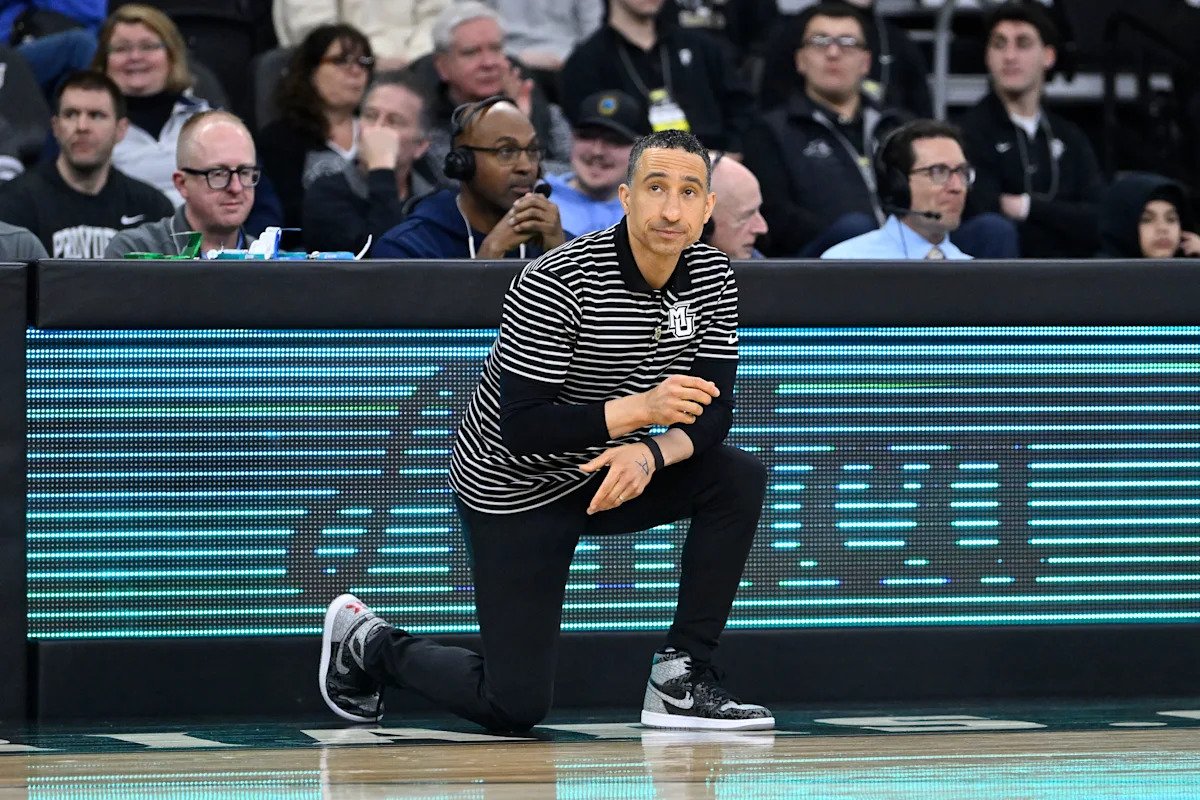
As we inch closer towards putting together our Player Reviews (I wait until the NCAA tournament is over for the most accurate stat rankings!), there’s still some unpacking of what happened in the 2025-26 Marquette men’s basketball season. In today’s case, we’re going to look at some things that we thought were pretty established ideas about the Golden Eagles during Shaka Smart’s first four seasons in Milwaukee and try to reconcile the fact that these things did not continue to hold true in Year #5.
There’s not going to be any answers as to how we ended up with Marquette going 12-20 here, it’s more “let’s look at our prior beliefs and assumptions and figure out whether or not we should still be holding onto them.”
Advertisement
Shaka Smart knows how to develop guys into Big East starters if not NBA players
VERSUS
Shaka Smart failed to develop Big East rotation-level players for 2025-26
On his very first Marquette roster, Shaka Smart had
-
The Atlantic 10 Freshman of the Year who was most definitely not a point guard at 2.3 assists in 30 minutes a game
-
A little used ACC backup who played 2 minutes in the conference tournament and not at all in the NCAA tournament as a freshman
-
A 6’9” beanpole who played in five games at Marquette as a freshman
-
The #92 and #166 prospects in the 2021 247 Sports Composite rankings as signed prospects and the #124 prospect that he brought with him from his Texas signing class.
Does any of that sound like the building blocks for four NCAA tournament teams, much less two #2 seeds, the best ever in program history, as well as a Big East regular season and tournament champion team? It doesn’t jump off the page that way, right?
Shaka Smart and his staff turned — in order — Tyler Kolek, Olivier-Maxence Prosper, Oso Ighodaro, Stevie Mitchell, Kam Jones, and David Joplin into Big East starters. They turned Prosper into a first round NBA Draft pick. They turned Kolek, Ighodaro, and Jones into second round NBA Draft picks. They turned Mitchell into a G League rotation guy. They turned Joplin into an overseas pro.
Advertisement
They turned Kolek — again, not a point guard at George Mason! — into arguably the best point guard in Marquette history, because he would have taken a run at the program’s all-time assists record if he had returned for his COVID bonus season of eligibility. They turned Jones into the #2 scorer in program history and just the second player to ever tally at least 2,000 points in MU history.
No matter how you want to slice it up, Shaka Smart and his staff found a way to take the talents and abilities and skills present in the players on the roster — three of which they inherited at Marquette and did not even recruit! — and turned them into the best possible versions of themselves on the court.
The evidence is there to tell us that Smart and his staff know how to grow their players in the offseason and make use of that development when the lights turn on in the season.
And yet.
Advertisement
Sean Jones shot 31% from the field in his 170 minutes of action in 2025-26. Tre Norman has shown no growth as a player from the moment he stepped foot on campus. Zaide Lowery backslid from what appeared to be his jumping off point at the end of 2024-25 to the point where he was no longer welcome/interested in being a part of the program. Caedin Hamilton could not pass the eye test as an on-court contributor in his third year in the program and second season of active competition. Damarius Owens was up and down and all over the place in terms of reliability in the back half of the season after not playing much at all to start his sophomore campaign.
Is the problem merely that the guys that were around on Day 1 were occupying so much playing time that the rest of the roster never got a chance to figure themselves out in games? That doesn’t feel right, because obviously most of the work that goes into developing as a player is not in the 40 minutes in between tip and horn on FS1. What happened? Why haven’t these guys popped in a development sense the way that the roster core from Shaka Smart’s first season did? Why did it work with that first group of relatively unheralded players but not for the next group? And how does Smart and his staff fix whatever went wrong for the future?
Shaka Smart is a proven defensive mastermind
VERSUS
2025-26 Marquette could not get stops on a regular enough basis
This is as simple as reading off Shaka Smart’s history page on KenPom.com. In his first season as a head coach at VCU in 2009-10, the Rams had what is still Smart’s worst defense, ranking #98 in the country in efficiency at the end of the season. The next year, VCU finished at #78, although it’s likely that they were much worse than that after losing to Old Dominion in the CAA tournament. See, that was the season where Smart took the Rams from the First Four to the Final Four, beating four straight KenPom top 40 opponents in the process, which included holding a top 30 Georgetown offense to just 0.87 points per possession in the Round of 64.
Advertisement
After that, VCU turned in the #23 defense in the country, and from there through Smart’s final year at Texas, his defenses were ranked somewhere between #40 and #6. The VCU teams were powered by Havoc, ranking #1 in the country in turnover rate three straight years and then #11 in his last year in Richmond. Smart’s Texas teams did not generate turnovers anywhere close to that rate, but after a #40 ranking his first year in Austin, Smart put together top 35 finishes the rest of the time and was top 30 in each of the middle four years.
Smart’s first year in Milwaukee was a step back, but not to a gross degree. Marquette was #55 in defensive efficiency that season, and then they went #43, #17, and #26, all while starting to bring a little bit of the Havoc back, at least in terms of turnover rate. You could say 14 straight years of figuring out a way to be competent on the defensive end of the floor if you squint at the first season at Marquette, or if you just want to be “top 50 or not,” then that’s 13 of 14 seasons in a row accomplishing that.
This is where I note that Marquette’s 2025-26 defense is currently ranked #57 in the country, but with three sub-50 teams still alive in the NCAA tournament, we’ll have to wait and see where they actually rank when the season is over. #57 sounds an awful lot like the defense that wasn’t too far off the pace in Smart’s first season with MU, but there’s a catch. That 2021-22 team had an efficiency number of 96.2 points per 100 possessions to rank #55. This year? 102.1 points per 100 possessions is #57. On a national comparison scale, it’s about the same, but it’s clearly much worse than it was four years ago.
That #57 is also clearly being propped up by Marquette’s last six weeks. Remember this graph from the “Actually, Shaka coached the hell out of the team since the first of the year” article?
See how the five game rolling average hits a season low on that red square? That’s the road loss to Butler. Using the BartTorvik.com filtering: Marquette was #105 in the country in defensive efficiency at that point of the season. Credit where credit is due: Smart and his staff figured out how to make things work from there on out, as from then until the Big East tournament loss, MU was playing with the 13th best defense in the country. However, as you can see from the chart, it still wasn’t perfect. Don’t worry so much about the oscillation from the green squares down to the red squares right by the season long average, but look at the two clunkers that Marquette threw up against Xavier well under the lines.
Advertisement
Again: What happened? Smart has dealt with changing personnel throughout his collegiate career, that’s the nature of the business. No matter who was pulling on a jersey for him for the past 14 years, he’s been able to assemble a defense that either was or should have been good enough to prop up an NCAA tournament contender. For two-thirds of 2025-26, the Golden Eagles were the worst defense Smart had ever coached as a Division 1 head coach, and only a late season flurry turned it into merely the worst defense he’s coached since 2011. Why the change? What went wrong? Perhaps even better: What went right at the end of the year after everything had been going so poorly and is that something that can be carried over to next season?
Shaka Smart and Nevada Smith know how to generate great offense
VERSUS
Marquette’s 2025-26 offense was awful
In the 2019-20 season, the Texas Longhorns had an offensive efficiency that ranked #153 in the country according to KenPom.com. That was the second time in Shaka Smart’s time in Austin that his offense was ranked outside the top 100 and the third time it was outside the top 80 in just five seasons running the show at UT. That offseason, Shaka Smart hired Nevada Smith, former NBA G-League head coach, as his Director of Program Development. The development that Smart specifically wanted? Better offense.
Advertisement
He got it, as the Longhorns ranked #28 in the country in efficiency the next season.
That wasn’t enough to quell rumblings in the Texas booster base, and so Smart and Smith both departed for Milwaukee and Marquette. Year #1 with the Golden Eagles resulted in the #64 offense at the end of the season, but mixed with a top 60 defense and a few things getting moving in the right direction as the season went along and the roster jelled together, and ta-da: MU was in the NCAA tournament.
The next year? #7 offense in the country after Marquette was picked to finish ninth in the Big East by vote of the league’s coaches. The next year, as the preseason favorite in the Big East? #21 offense, and I’d imagine that missing All-American point guard Tyler Kolek for six games late in the year might have drifted that ranking back a tiny bit. One year later, with no Kolek at all, with Kam Jones shifting over to a lead guard role instead of a pure #2 guard, with truly atrocious three-point shooting (#237 in the country!) weighing the entire thing down? #35 in offensive efficiency, still good enough to keep Marquette ranked in the AP poll for most of the season and get the Golden Eagles into the NCAA tournament as #7 seed.
Marquette is currently #120 in offensive efficiency this season. That is mostly because BartTorvik.com says that MU had the #220 offense in the country up through the first full week of January. To be clear: Marquette merely stopped being a black hole where fun could not escape after that point of the year. Since that point of the campaign, Torvik has Marquette at #72 in offensive efficiency. That ranking itself would be enough to justify writing this entire section, much less the #120 or #22o mentioned a moment ago.
Advertisement
Again: What happened? Is it as simple as the three-point shooting got even worse from last year? Is it as simple as the fact that the Golden Eagles ended up reliant on freshmen Nigel James and Adrien Stevens to carry a heavy load on the offensive end of the floor and Freshmen Being Freshmen explains a lot of the issues? Is it the sub-140 turnover rate ranking? How much of the past few years was propped up by MU just never turning the ball over on offense? Was it the failure to get shots at the rim to fall, as the Golden Eagles had the fourth shortest two-point field goal attempt distance in the country but the #146 two-point shooting percentage? Was it a little bit of everything? Is it just as simple as the system gets the shots that Smart and Smith want the players to get, but the players involved just couldn’t make the shots this year?
And if that last one is the case, what’s the solution to fixing that if it’s going to be James, Stevens, and Royce Parham carrying the offense once against next year?
Shaka Smart knows how to assess what he has on his roster and maximize it
VERSUS
It took until Christmas for Shaka Smart to figure that out in 2025-26
Year #1 for Shaka Smart at Marquette: Picked to finish 9th, went 11-8 and tied for fifth, made the NCAA tournament.
Advertisement
Year #2: Picked to finish 9th, won the league by two games, won the conference tournament, earned the program’s best ever seed in the NCAA tournament.
Year #3: Picked to win the league, finished tied for second, earned a second straight #2 seed, went to the Sweet 16, the first for the program in a decade
Year #4: Picked to finish 5th, spent 10 consecutive weeks in the top 10 of the Associated Press poll, finished tied for fourth, made the NCAA tournament for the fourth straight season, success largely tied to the ability of Year #2 & 3’s leading scorer suddenly turning into an All-American point guard.
For Shaka Smart’s first two years in the Big East, he turned in campaigns that were better than his peers in the Big East expected from his team. In his third year, he lived up to the expectation of his fellow coaches by turning in what the NCAA selection committee evaluated as one of the eight best seasons in the country and then capped it with his biggest tournament success on a personal level since 2011.
Advertisement
Year #4 got a little shaky in the back end, but it will be a cold day in hell before I turn my nose up at a #7 seed in the NCAA tournament, much less at the idea of Kam Jones proving that he could be a Big East Player of the Year candidate as a point guard, not just a scoring guard.
Over and over again in Milwaukee, Shaka Smart has assembled rosters that easily meet the expectation of “make the NCAA tournament.” Even in the one situation where it appears at a glance that he was just running back the previous campaign’s roster, that was still coming off the slightly unexpected loss of two-year starter Olivier-Maxence Prosper to the NBA Draft with eligibility remaining, although by the time he went #24 overall, it stopped being a surprise. Even if you consider Year 4 to be The Bad Year by giving Year 1 a pass as a massive Vibes-Only success, it still resulted in Marquette starting the year in the preseason top 25 and then spending the majority of the campaign in the top 10. Time and time again, Smart looked at what he had in the Kasten Practice Gym and said, “Guys, I know how to make this work.”
And then the 2025-26 roster came together and Shaka Smart just completely biffed it.
Go back and look at the Player Preview I wrote for Caedin Hamilton in early October, nearly a month before the season started. My reasonable expectation for him at the time was “contribute more.” My gut instinct was he would be backing up Ben Gold at center, either a little bit or a bit more if Gold drifted to the 4 to play with Hamilton at the same time. It would seem, that six months ago, the idea that Hamilton would start with Gold AND play nearly 20 minutes a game through the end of non-conference play was, if not a complete fantasy, at least the “oh, man, what if this really works out to the best possible potential??” level of imagination.
Advertisement
The idea that Shaka Smart, the guy who is cornerstoning the entire program in the mantra of Relationships/Growth/Victory to the point of getting merchandise made and sold in the Spirit Shop, would see his relationship with Zaide Lowery deteriorate to the point of Lowery looking like he was actively trying to subvert the program with a cartoonishly bad 0-for-7 from the field against Valparaiso, which led to Lowery leaving the program three weeks later in the middle of the season? Dumbfounding to even think of, and that’s before you mix in the context of hearing the stories of pregame retreats where the players talked out what everyone’s role on the team should be in previous years.
And on top of all of that: How much of the structure and preparation for 2025-26 was based on the idea that Sean Jones could return from his knee injury and just be The Next Great Marquette Point Guard? Instead, he shot under 30% from the field through MU’s first two games, including a grotesque 1-for-8 on three-pointers, injured his shoulder, missed a month, lost his starting job to Nigel James, played five more games, and then was lost for the year with another injury. What’s worse: Thinking that Jones was going to be able to do this….. or not realizing that James actually was what Marquette fans were sold on Jones being as the point guard for the Golden Eagles?
What was Shaka Smart’s blind spot with this collection of guys? Why was it seemingly obvious after six games that Marquette had very obvious problems with how the rotation was set, but it took another seven games for the minutes to change and another two for the actual starting lineup to change? How long would it have taken Smart and his staff to realize that they needed to give Nigel James the keys if Sean Jones had never gotten hurt the first time? Was this the payoff on “you can’t be right all of the time,” and Smart had been right 17 times in a row before that so something was bound to go wrong and it turned into a lot of things at once? And maybe most importantly for 2026-27: What is being built into the system to stop mistakes sooner next time?
Follow Anonymous Eagle on social media
Advertisement
Facebook: AnonymousEagle
Instagram: AnonymousEagleSBN
Bluesky: AnonymousEagle

