Now that the collective bargaining agreement has been ratified unanimously by the WNBPA and the league’s Board of Governors, the first big piece of business this offseason will be the expansion draft on April 3. This is the first opportunity for the Toronto Tempo and the Portland Fire to begin to build their rosters for the rapidly approaching 2026 WNBA season.
Although the league had an expansion draft last year for the Golden State Valkyries, the situation is different in 2026 because that process is collectively bargained, and there is a new CBA. The rules of the expansion draft were only announced on Wednesday, creating even more of a time crunch for the two new franchises.
Advertisement
Each of the 13 existing teams can protect five players — these can be players who are under contract or free agents. They can also be previously drafted players who haven’t yet joined the team. For example, the Atlanta Dream drafted Nyadiew Puoch from Australia in 2024, and she hasn’t yet come to play in the U.S., but the Dream would still have to protect Puoch to avoid losing her to Toronto or Portland.
Once teams submit their protected lists to the Tempo and Fire by Sunday, the new teams will review the names and formulate a draft strategy. They’ll choose players in a snake draft format, and the first pick will be decided by a coin flip. It is expected that each existing team can have a maximum of two players selected.
Per the CBA term sheet, which was released to teams and obtained by The Athletic, Toronto and Portland can select only one unrestricted free agent each during the expansion draft and then offer her the core designation, which allows the team to pay the player up to the supermax salary. If the incumbent team fails to protect that unrestricted free agent during the expansion process, that team cannot core the player afterward.
In an offseason with more than 100 unrestricted free agents, this setup limits the pool of players available to the Tempo and the Fire, who figure to have to do most of their team-building work through the college draft and free agency. Nevertheless, as the Valkyries demonstrated in 2025, value can be found at the edges of other teams’ rotations, even in a unique offseason such as this.
Advertisement
With those constraints in mind, here are the top 15 players projected to be available (since we can only guess who teams will protect) in the upcoming expansion draft. We’ll limit it to two players per team since that’s how many can be selected.
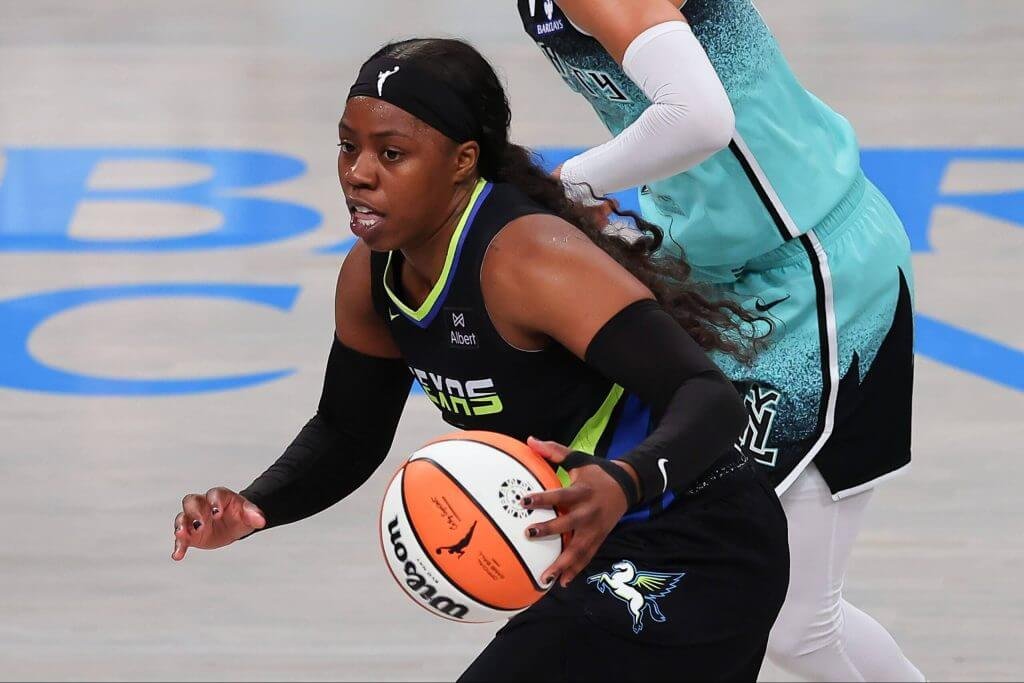
1. Arike Ogunbowale, Wings, guard (UFA)
The Dallas Wings have some tough decisions to make on their protected list. Assuming they prioritize youth to build around Paige Bueckers, that could leave Ogunbowale unprotected. She is one of the lone UFAs who would actually be worth paying a maximum contract, if not quite a supermax. Ogunbowale can get buckets, even if she isn’t the most efficient scorer, and shot creation is an important skill for an expansion team. This isn’t to say that Toronto or Portland would necessarily prioritize a high-usage guard as their first pick, but there’s no denying Ogunbowale’s talent.
2. Azurá Stevens, Sparks, forward (UFA)
Stevens has been miscast as a defensive center for the Los Angeles Sparks, but her offensive production in Lynne Roberts’ system was something to behold. She runs the floor, keeps the ball high in the paint, and has a smooth jumper, especially from the corners. Not many players can shoot 38 percent on 3s and also grab eight rebounds a night. If Toronto or Portland can deploy her as a wing defender instead of asking her to hang with bulkier players at the five, she could be worth close to a maximum contract. It’s worth noting that even if an expansion team cores her, it doesn’t necessarily have to give Stevens the max.
Advertisement
3. Cecilia Zandalasini, Valkyries, forward (Restricted FA)
The Golden State Valkyries are another team with a deep roster that seems ripe for the picking. Assuming Veronica Burton, Justė Jocytė, Iliana Rupert, Janelle Salaün and Kayla Thornton are protected, Zandalasini is arguably the best player remaining. She is a big wing who shoots well from distance, can handle the rock and can scale up her usage if necessary. Zandalasini is already 30 years old, but she just had her best WNBA season in 2025 and is coming off a great World Cup qualifying tournament with Italy. She is an ideal complementary player.
4. Carla Leite, Valkyries, guard (rookie scale: $289,133)
Leite is a great downhill attacker; she shot 66 percent in the restricted area and made 52 percent of her other shots in the lane in 2025. She has some flair in her passing and handling. And she’s only 21, with three years remaining on her rookie contract. She is a bargain and is oozing potential. María Conde may be more established, but it’s too hard to pass up Leite given her youth.
Advertisement
5. Julie Allemand, Sparks, guard (Restricted FA)
The Belgian point guard was a steadying force for the Sparks in 2025, as L.A. went 16-11 in games she started. Allemand is an excellent floor general who doesn’t often hunt her own offense but finishes well from 2-point range (77 percent in the restricted area). Allemand hasn’t been especially impactful defensively in the WNBA, but she hasn’t had great surrounding personnel. Her FIBA track record — two-time EuroBasket champion — suggests she has even more to give in the W. Allemand gets the nod here over Sparks sophomores Sarah Ashlee Barker and Sania Feagin, despite her age, because of the dearth of quality point guard play across the league.
6. Dorka Juhász, Lynx, center (rookie scale: $318,910)
The Minnesota Lynx have some other young frontcourt players in the pipeline, including Anastasiia Olairi Kosu and Maïa Hirsch, but Juhász is proven and still only 26. She has good size at 6-foot-5, can adequately defend the paint and is mobile offensively. The former UConn product is having a strong season for Galatasaray, averaging 13.7 points and 7.7 rebounds in EuroLeague play.
Advertisement
7. Maria Kliundikova, Lynx, forward/center (Reserved FA)
This isn’t the highest upside play either from the Lynx, but Kliundikova is smart, physical and can toggle between the four and five positions depending on the lineup. Kliundikova enjoyed being back in the WNBA last season after a six-year absence to once again play against the highest-caliber competition, since WNBA players have mostly avoided Russia of late. Any team can feel confident that Kliundikova will give 20 minutes of quality frontcourt play per game.
8. Maya Caldwell, Dream, guard (Reserved FA)
Caldwell is a quality rotation guard who averaged 18.5 minutes for the 30-win Atlanta Dream. She is a good finisher in the paint and a solid corner 3-point shooter. Plus, she competes defensively. Caldwell still has room to grow at 27, and even if she doesn’t, she can contribute on a winning team.
Advertisement
9. Lexi Held, Mercury, guard (Reserved FA)
Held was a feisty floor general for the Phoenix Mercury before a freak pneumothorax injury, demonstrating poise on offense and strong point-of-attack defense. She ranked in the 85th percentile league-wide in steal percentage (2.2) and also launched 3s at a high volume, with 7.7 attempts per 40 minutes. Although she made only 31 percent, her attempt rate bodes well since she made 36.6 percent of her 3s in college.
10. Li Yueru, Wings, center (Reserved FA)
The smooth-shooting 6-7 center has enviable size and skills, and she is a beloved teammate. She hasn’t yet figured out how to assert herself physically against WNBA bigs but has also been a rotation player only for about 20 games for the Dallas Wings. Li is a worthy gamble to take, ahead of other Wings like Diamond Miller, Haley Jones and JJ Quinerly.
Advertisement
11. Chloe Bibby, Fever, forward (Reserved FA)
Bibby is 6-2, and she can shoot. She made 35.5 percent of her 3-pointers through five college seasons and then 40.5 percent of her triples as a WNBA rookie. Plus, since Bibby is a reserved free agent with the Indiana Fever, her new team would be required to pay her only the league minimum. Cost control and a premium skillset.
12. Emily Engstler, Mystics, forward (Reserved FA)
At some point, Engstler has to prove her potential, but I can’t give up on her yet. She is an incredible athlete and reads the floor well. She also makes some jaw-dropping defensive plays. If she could ever develop a consistent jump shot — she teased us in 2024 when she made 47.4 of her 3s and 81.8 percent of her free throws — she would be a no-brainer selection.
Advertisement
13. Kitija Laksa, Mercury, guard/forward (Reserved FA)
Laksa couldn’t quite find her jumper in her first year in Phoenix, but she has been one of the best shooters in Europe. Over the past two seasons with Famila Schio, Laksa has made 38 percent of her 3-pointers. The question with Laksa is how much a team values her pedigree (first-round draft pick and excellent international production) versus her struggles in her lone WNBA season when she fell out of the Mercury’s rotation.
14. Aaliyah Nye, Aces, guard/forward (rookie scale: $277,500)
Las Vegas’ final protected spot will likely come down to Dana Evans, Kierstan Bell or Aaliyah Nye, and our guess is the Las Vegas Aces will prioritize Evans, the player who most helped them win a title in 2025. Bell is clearly the more proven player, but she has stagnated through four years in Las Vegas, while Nye is younger and has more defensive versatility.
Advertisement
15. Maddy Westbeld, Sky, forward (rookie scale: $277,500)
This could easily be Bell, who just started for a championship team, even if she averaged only 10 minutes per game in the postseason. Westbeld is a bigger swing. Chicago was not a great developmental situation in 2025, and Westbeld often looked like she did not belong on a WNBA court. But she made 41 percent of her 3s after the All-Star break, has pro size, and she gets a boost because her sister (Kathryn with the Mercury) became a productive WNBA player for the first time at age 29.
Also considered: Isobel Borlase (Atlanta), Rayah Marshall (Connecticut), Jacy Sheldon (Washington)
This article originally appeared in The Athletic.
Advertisement
Minnesota Lynx, New York Liberty, Seattle Storm, Los Angeles Sparks, Washington Mystics, Atlanta Dream, Chicago Sky, Connecticut Sun, Indiana Fever, Dallas Wings, Las Vegas Aces, Phoenix Mercury, Golden State Valkyries, Portland Fire, Toronto Tempo, WNBA
2026 The Athletic Media Company

