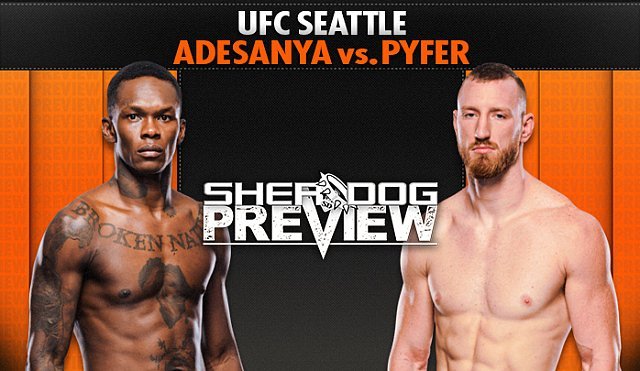
UFC Seattle exemplifies the “old lions vs. young lions” dynamic of sport as well as any Octagon card in recent memory.
For as long as sports in general and combat sports in particular have existed, the torch has been handed from one generation of champions to the next, usually through a series of direct confrontations. Still, the main and co-main events of this weekend’s Fight Night in the Pacific Northwest feature especially classic—and similar—versions of that story. Israel Adesanya and Alexa Grasso are both former champs, facing contenders in Joe Pyfer and Maycee Barber who were long expected to reach this point, but whose journeys were delayed by injuries and an untimely defeat or two. Nonetheless, time is on the side of the up-and-comers here, as there is a feeling, fair or not, that if Adesanya and Grasso lose here, they may never again be this close to regaining their titles.
Outside of those high-stakes contenders’ matchups, the rest of the main slate is rich with storylines, including a friendly farewell booking for a Washington State icon, a couple of all-action bangers and a clash of two intriguing middleweight prospects. Here is the preview for the main card of UFC Fight Night 271, also known as UFC Seattle:
Middleweights
BETTING ODDS: Adesanya (-130); Pyfer (+110)
Adesanya (24-5; 13-5 UFC) looks to snap the first losing streak of his legendary career here, and while his roster spot might well be safe even if he loses a fourth straight fight on Saturday, any last vestiges of relevance in the middleweight title picture are definitely on the chopping block. The decline of “The Last Stylebender” is a tale as old as sport. With a dazzling, bewildering game built on movement, timing and reflexes, it stood to reason that Adesanya’s performance would fall off quickly once those traits began to fade, but the reality is not quite as ugly as the three consecutive losses might imply. It isn’t as though Adesanya is suddenly losing to bad fighters; it’s simply that as his speed and durability have slipped, he is now susceptible to attacks he would have laughed off five years ago: Dricus Du Plessis managed to corral him and take him down repeatedly in a way that determined wrestlers like Derek Brunson and Kelvin Gastelum once struggled, while Nassourdine Imavov was able to catch him with clean power shots where big hitters such as Paulo Costa and Yoel Romero whiffed.
For all that, Adesanya is still elusive, with great lateral movement, smooth stance switches and hand fighting designed to frustrate, confuse and disrupt opposing strikers, and he is still effective with it. He has never had crushing one-shot power, but he can pile up the damage quickly, and most of his best highlight-reel finishes have featured him running foes onto his strikes, maximizing the kinetic energy of the collision at their expense. Also of concern is that as Adesanya has aged, and as opponents have become bolder about marching straight at him, his striking volume has declined. He was always a medium-output kickboxer, content to let the fight come to him, but the drop in output has made it harder for him to win close rounds.
Pyfer (15-3; 6-1 UFC) arrived in the UFC with unaccustomed hype, thanks to his pair of appearances on Dana White’s Contender Series. In his first shot in 2020, he succumbed to a freak injury, only to have White help him directly with living expenses while he recuperated. He returned in 2022 and splattered Osman Diaz, inspiring the boss to offer him a contract, then dismiss the rest of that episode’s winning fighters with the now-famous quote “be like Joe Pyfer” before stomping off. Since then, Pyfer has excelled, coming up short against Jack Hermansson in his first UFC headliner two years ago and dominating everyone else, aside from some early trouble against Abusupiyan Magomedov last October.
The 29-year-old Pennsylvanian’s approach has remained largely the same, taking advantage of his size, strength and athleticism. Pyfer is a disciplined boxer with good power who prefers to work from outside at a moderate pace, entering the pocket with clean two and three-piece combinations, sometimes accompanied by his powerful kicks. He is a solid wrestler, using fast entries from outside and emphatic takedown finishes, which feeds directly into the top-position grappling that is still his best weapon. Pyfer is suffocatingly heavy on top, dropping big punches and looking to advance to full mount or side control, where he can either continue to hammer away or apply a topside choke like the one he used to finish Abdul-Razak Alhassan.
Pyfer’s difficulties have tended to come against veteran opponents who do not wilt in the face of his physical onslaught: Hermansson withstood the early storm and rallied to win resoundingly, and even in the Gastelum fight, Pyfer was brought to a near-stalemate late by a shopworn and much smaller fighter. It isn’t so much that Pyfer gasses out—though he definitely does slow down—as that he seems to run out of ideas and lose control of the fight. Whether that is a tendency that he will shed as he gets more experience, or it’s simply part of his mental makeup as a fighter, remains to be seen, but we may learn a lot here as he takes the second five-round assignment of his career against a man who is about have his 15th.
This is a tough fight to predict, and the betting line reflects that. It’s easy to picture Pyfer’s gradual rise intersecting with Adesanya’s slow decline, resulting in him getting easy takedowns or maybe even catching the former champ with a big punch that he would have slipped with ease a few years ago. It’s also fair to wonder what Adesanya’s motivation level will be, in the final act of his remarkable career, without an easy path back to the title picture. If he is underprepared, if he is lackadaisical in the cage, Pyfer is absolutely the kind of dynamic offensive fighter who could punish him for it. However, if Adesanya is mentally engaged, and physically at least close to the man who faced Imavov 13 months ago, he should still have significant advantages over Pyfer in the kind of deliberate distance striking battle that both men prefer. And while Pyfer might well be able to get Adesanya onto the canvas, the only fighters who have really been able to keep him there and do him harm were Du Plessis and Jan Blachowicz, both of whom are very strong wrestlers and heavy top-position maulers.
The pick is that Adesanya has to weather some early adversity—getting caught cleanly on the feet, perhaps, or being taken down and dominated on the ground for a long stretch—but survives and pulls away late, showing his veteran poise and the depth of his striking arsenal en route to a decision win.
Jump To »
Adesanya vs. Pyfer
Grasso vs. Barber
Chiesa vs. Price
Erosa vs. Douglas
Abdul-Malik vs. Belgaroui
McKinney vs. Nelson
The Prelims
Flyweights
BETTING ODDS: Barber (-170); Grasso (+140)
Grasso (16-5-1; 8-5-1 UFC) much like Israel Adesanya in the main event, finds herself not that far removed from her title reign in terms of the calendar, but mired in the first losing streak of her career. Like Adesanya, she now faces a hungry young contender who sees her as a steppingstone—and a chance for redemption, since Grasso won their first meeting five years ago at UFC 258. Unlike Adesanya, Grasso has the added problem that the woman who dethroned her after their trilogy, Valentina Shevchenko, is still the champ, but at this point Grasso is far enough from another title shot that Shevchenko may well have retired or moved back up to bantamweight by the time it matters. In either case, the task in front of Grasso remains the same: beat Barber again and steal the momentum of her seven-fight win streak.
Grasso has come a long way from the 23-year-old prospect the UFC signed away from Invicta nearly a decade ago. That version of Grasso was a big, athletic, technically solid strawweight boxer who could pile up enough punishment to put away some foes but was otherwise capable of putting on dominant displays of combination punching and footwork against women who couldn’t take her down or match her volume on the feet.
After a couple of tough losses to women who were able to close the distance and outwrestle her, or at least crowd her and push her around, she made the decision to move up to 125 pounds. It was a brilliant move, as she won her first five fights at flyweight, culminating in her capturing the title in a shocking upset of Shevchenko three years ago at UFC 285, but even leaving aside the wins and losses, she has looked like a transformed fighter. Where the strawweight version of Grasso was, if not one-dimensional, at least a specialist who was dependent on style matchups to look her best, at flyweight she is one of the most well-rounded fighters on the roster. Where she was once deliberate in her approach and seemed to lack a fifth gear, perhaps guarding her gas tank after the grueling cut to strawweight, she is now able to push the pace as needed in five-round as well as three-round fights.
Most surprising of all, after being outwrestled and outmuscled by strawweight wrestlers Tatiana Suarez and Carla Esparza, Grasso has become a potent wrestler and grappler herself at 125 pounds, capable of pushing most of her opponents around and holding her own even against Shevchenko’s legendary horsepower. Grasso’s most recent outing, a unanimous decision loss to Natalia Silva at UFC 315 last May, was concerning because, while it was an odd fight and much more competitive than the 30-27 scores might imply, it was also the first time Grasso had been beaten in a pure striking contest.
Barber (15-2; 10-2 UFC) is now seven years and a dozen fights removed from the 20-year-old phenom who hammered Jamie Colleen Miller on Dana White’s Contender Series, then proclaimed her ambition to become the youngest UFC champ ever. (Note to young prospects: Don’t do that. One, it curses you. Two, it’s the first thing fans will remember every time you lose.) Her star came crashing back to Earth in back-to-back losses to Roxanne Modafferi and Grasso, but Barber then did a quietly admirable thing that few young prospects manage to do. She dusted herself off, kept getting better at fighting and started another win streak, to the point where about two years ago, ahead of her fight with Katlyn Cerminara at UFC 299, I had to ask myself, “Why do I still think of Barber as a busted prospect? She’s won five in a row and she’s still only 25 years old.”
Barber’s approach is mostly the same as it’s always been, only driven by better conditioning and greater experience. She is an aggressive, swarming offensive fighter who compensates for her average athleticism with a high motor and a very rough-and-tumble, physical style. She has become a cleaner boxer over the years, throwing a nice one-two and two-three in place of the flurries of hooks that once characterized her striking. She comes forward behind those boxing combinations as well as some decent kicks, always looking to close the distance to where she can either shoot for a takedown or corner her foe against the fence for some dirty boxing. Barber is a good wrestler and grappler; the comparison I keep coming back to is prime Diego Sanchez, who was happy to secure a conventional takedown into his opponent’s guard, but was equally happy to create a scramble, where his strength, motor and grappling instincts were usually enough to overwhelm his foes.
The question mark hanging over Barber, of course, relates to her fitness to compete; her main-event matchup against Erin Blanchfield last May was cancelled on the day of the fight after what appeared to be a horrible weight cut. That disappointment, and those shocking visuals, will probably stick in fans’ minds for a long time, but most of the real worry should be gone after she made weight without incident for UFC 323 in December, then won a hard three rounds against Karine Silva.
Assuming Barber is similarly good to go on Saturday, this feels like a very even matchup, but I still think the betting line is skewed. Grasso has lost two straight, but they were against the top two women in the division in Shevchenko and Silva, and they achieved it using tools and weapons that Barber doesn’t really have. It would be an easier call if this were a five-round fight, but even in a three-rounder, the pick is that Grasso fights off most of Barber’s takedown attempts, avoids serious trouble on the ground and outclasses her on the feet for a hard-fought decision win.
Jump To »
Adesanya vs. Pyfer
Grasso vs. Barber
Chiesa vs. Price
Erosa vs. Douglas
Abdul-Malik vs. Belgaroui
McKinney vs. Nelson
The Prelims
Welterweights
BETTING ODDS: Chiesa (-550); Price (+400)
In his self-declared retirement fight, Chiesa (19-7; 14-7 UFC), the winner of “The Ultimate Fighter” Season 15 and the last alumnus of that season still on UFC roster, will try to author a storybook ending to his career—with or without the willing assistance of Price, who steps up on six weeks’ turnaround and just one week’s notice for the injured Carlston Harris. The “Maverick” never quite completed the transition from Top 15 talent to serious title contender, but he has been a dangerous and reliably entertaining fighter for well over a decade in two of the deepest and most competitive divisions in the UFC, and he remains competitive even now. In a sport in which the vast majority of contender-level fighters must be shown the door after bottoming out on ugly losing skids, Chiesa carries a three-fight win streak into his swan song, with a chance to make it four straight in front of an adoring crowd in his home state.
Even at 38, Chiesa’s strengths and liabilities remain the same as ever. He is a big welterweight with a very long frame who is a much better offensive striker than his zero career knockouts might lead one to expect. He tries to leverage his physical gifts by employing a long, straight jab and some front kicks and calf kicks, but he quickly switches to an “all the way in” approach when shorter, quicker fighters collapse the pocket on him. In close, he has good knees and elbows and a strong clinch that serves as a springboard for his unorthodox wrestling. Like many other lanky wrestlers in MMA, Chiesa is capable of changing levels for a double-leg shot from outside, but shines at close range, where he can use his long arms to reach for a sneaky single-leg. He also excels at slide-bys and standing back takes, both of which feed directly into his wheelhouse as one of the greatest back control specialists and stranglers in UFC history.
Chiesa has always been a diverse and dangerous offensive fighter; the gap separating him from the very best of the best at 155 and 170 pounds is defense. Chiesa has always been very hittable on the feet and while he is incredibly tough and difficult to hurt badly, he can definitely lose fights by being outstruck. More problematic is his submission defense. Chiesa is capable of shocking dominance on the ground, but also prone to getting caught by less heralded grapplers at inopportune times. Even leaving aside the refereeing gaffe that led to his technical submission loss to Kevin Lee, more than half of Chiesa’s career defeats have been by tapout—three of them by nearly identical D’Arce chokes.
Not that any of that is likely to matter against Price (16-10, 2 NC; 8-10, 2 NC UFC). At 36, the stalwart Floridian is nearly two years younger than Chiesa but in terms of apparent wear and tear, he might as well be 56. Price is on a three-fight losing streak, including getting hammered in half a round by Nikolay Veretennikov just six weeks ago. He is 2-7 with one no contest in his last 10 fights, with the only two wins coming against similarly shopworn fighters in Alex Morono and Alex Oliveira.
Price is such a spent force at this point that it might be more productive to talk about what he used to be good at. At his best, “The Hybrid” was a shining example of the kind of action hero that blessed the welterweight division in the late 2010s, alongside former foes like Vicente Luque, Randy Brown and Morono. He was a big, athletic striker with a diverse arsenal of kicks, good power in his hands and a ton of defensive flaws that he overcame with toughness and by overwhelming foes with his offense. The same held true for his ground game; he was a sneakily good wrestler and opportunistic grappler who could be caught on the ground, but otherwise looked to get back to his feet as quickly as possible, maybe delivering a few well-placed punches or hammerfists on his way up.
All of those things are still true in theory, but the current version of Price is simply too physically shot to make it work anymore. His reflexes have slowed, his striking output has fallen off noticeably, and most importantly, his once incredible durability and cardio are fading fast. The betting line for this fight is very wide, but justifiably so, as it’s difficult to plot a path to victory for the underdog that doesn’t involve Chiesa making a horrible tactical error, or Price landing a harder single strike than we’ve seen from him in at least four or five years. Chiesa’s three-fight win streak includes two of the most shot fighters in the UFC at the time in Court McGee and Tony Ferguson, but Price fits perfectly alongside them. He will come out and do his best to ruin Chiesa’s special night, but on this kind of short notice, my guess is that he will have about two good minutes in him. After that, expect a vintage example of Chiesa’s jiu-jitsu prowess; the pick is Chiesa by first-round submission.
Jump To »
Adesanya vs. Pyfer
Grasso vs. Barber
Chiesa vs. Price
Erosa vs. Douglas
Abdul-Malik vs. Belgaroui
McKinney vs. Nelson
The Prelims
Featherweights
BETTING ODDS: Douglas (-280); Erosa (+240)
Erosa (31-12; 9-8 UFC) looks to bounce back from his loss to Melquizael Costa last May and start up a new win streak against the debuting Douglas (13-5), who arrives with the cachet of a Legacy Fighting Alliance title and a blistering knockout on Dana White’s Contender Series last September. “Juicy J” is a heartwarming success story, returning to the UFC in 2020 after being cut on two previous occasions, and finally finding success. Since his third signing, Erosa has gone 8-4 and been one of the most reliable postfight bonus magnets in the entire promotion—double bonuses in some cases, thanks to several of his opponents missing weight.
It’s difficult to pinpoint why Erosa is a fringe contender now, when during his first two UFC runs he was a sub-.500 fighter. He was, and remains, a very tall and lanky featherweight with huge power, a lethal front headlock series, and extremely porous defense. While he has dialed his aggression back from “rabid” to “merely psychotic,” seven of his 12 fights in this most recent Octagon stint have ended in first-round finishes. For a huge featherweight who fights at a furious pace, Erosa actually has an ample gas tank and excellent durability. It isn’t so much that he’s a glass cannon; it’s that a cannon that takes as many hits as Erosa does would be at risk of breaking no matter what it was made of.
Douglas is an interesting addition to the UFC, even if it feels inaccurate to call him a prospect. The 30-year-old Brazilian was a solid regional contender for years but lost badly to most of the next-level talents he faced, and seemed headed for a career as the kind of high-level journeyman who would probably never make it to the UFC except perhaps as a short-notice callup. However, the “Gunslinger” turned a corner a few years ago, rattling off five straight knockouts to win the LFA strap and draw the attention of the Contender Series’ titular head honcho. Douglas has always been a solid offensive striker with good power, and that power has improved noticeably—he had several one-shot walkoff knockouts in LFA to go with his starching of Cam Teague on DWCS.
The improvements in Douglas’ performances are mostly down to his defense and tactical acumen. He has always been a potent offensive fighter but was susceptible to skilled and determined opponents. He could be hit by the hitters and outwrestled by the wrestlers, and struggled to pull those fights away from the areas where his opponents had the advantage and towards his own strengths. It’s valid to wonder how much of the five-fight win streak is due to Douglas leveling up mid-career, as opposed to a drop-off in competition; I’m not at all sure I would favor him in rematches against Jose Mariscal or Isaac Thomson, two men who defeated him in regional shows and now fight in the UFC.
I’m leaning towards Erosa in this fight, and while that represents a pretty big upset pick, I think the line is way off here. Douglas hits very hard and is a fast starter, and could certainly be the latest guy to notch a first-round finish of Erosa, but again, that isn’t a given, or Erosa wouldn’t have made it three full rounds with Costa, one of the biggest punchers in the division. Erosa’s fights are always a nightmare to pick for all the same reasons they’re always a joy to watch, but unless he has fallen off a cliff overnight, this feels like a pick ‘em fight at best, so Erosa at better than 2-to-1 sounds like a bargain. I like him straight up here regardless of price; the pick is Erosa by Round 2 submission.
Jump To »
Adesanya vs. Pyfer
Grasso vs. Barber
Chiesa vs. Price
Erosa vs. Douglas
Abdul-Malik vs. Belgaroui
McKinney vs. Nelson
The Prelims
Middleweights
BETTING ODDS: Abdul-Malik (-120); Belgaroui (+100)
It’s a fun middleweight prospect bout and an old-school clash of styles as former college wrestler Abdul-Malik (9-0-1; 2-0-1 UFC) takes on Tunisian-Dutch kickboxing convert Belgaroui (9-3; 1-0 UFC). Abdul-Malik is undefeated, still just 28 years old and in possession of some rare physical gifts, but at this point in his development, he is mostly unrealized potential. The former Maryland Terrapin mat standout is fairly big for the division and an excellent athlete, with speed, balance, strength and explosion to spare. He is a good offensive wrestler, capable of shooting from the outside and chaining techniques as well as hoisting and launching foes from the clinch, but even a smaller, less athletic and less credentialed wrestler like Cody Brundage was able to outwrestle him for stretches. Once on the ground, he has frightening punches and elbows from top position, and is quickly turning into a dangerous grappler. He is a work in progress as a striker, with a basic repertoire of punches and kicks that he delivers with huge power but struggles to throw in combination, and his lack of head movement and defensive fundamentals has been papered over thus far by his natural speed and just a bit of luck.
Most concerning about Abdul-Malik’s UFC run is that despite facing four of the lowest-level middleweights in the promotion, and despite generally being in the driver’s seat throughout his fights, he has slowed significantly anytime he has had to fight past the first round. Part of that is probably due to his size and musculature, and likely to remain that way unless he undertakes a wholesale retooling of his physique, but much of it is due to his approach. Abdul-Malik’s wrestling and striking both revolve around big, dynamic movements that burn a lot of energy; with a little more seasoning, he may well learn to finish foes, and win rounds over foes whom he can’t quite finish, without depleting his fuel tank so badly.
Belgaroui doesn’t carry quite the same prospect shine as Abdul-Malik, at 33 and with a couple of losses in MMA under his belt already, including his first try on the Contender Series in 2023. However, he is a solid addition to the roster in his own right. Like his kickboxing forebear and fellow Teixeira MMA & Fitness exponent Alex Pereira, Belgaroui is an absolutely titanic middleweight, certainly the biggest one in the post-“Poatan” division. Also like Pereira, Belgaroui embraces the strengths and limitations of his huge frame with a very upright style, maintaining his preferred distance with front kicks, handfighting and deliberate but consistent lateral movement. While he does most of his best work at range, he reacts well to fighters who close the distance, either meeting them with uppercuts and hooks or initiating the clinch himself, where his size, leverage and knees up the middle make him a nightmare to deal with.
The expected vulnerabilities for a 6-foot-5 middleweight kickboxer are of course takedown defense and grappling. Belgaroui struggled on the Contender Series with Marco Tulio, who secured a couple of takedowns early, and then experienced good success striking with the bigger, better kickboxer for the rest of the fight, once Belgaroui had the threat of wrestling to worry about. That is certainly a path to victory for Abdul-Malik, who is a much better wrestler than Tulio and probably a harder hitter as well. However, considering Belgaroui’s surprising gameness in the wrestling and on the ground, which only stands to keep improving as he works with Teixeira and Pereira, and Abdul-Malik’s tendency to wear out and slow down even in fights he’s winning, I lean towards the upset. The pick is Belgaroui by knockout in the second round, probably after losing the first.
Jump To »
Adesanya vs. Pyfer
Grasso vs. Barber
Chiesa vs. Price
Erosa vs. Douglas
Abdul-Malik vs. Belgaroui
McKinney vs. Nelson
The Prelims
Lightweights
BETTING ODDS: McKinney (-170); Nelson (+140)
The main card opens with a likely barnburner between Washington native McKinney (17-8; 7-5 UFC) and Nelson (17-6-1; 5-5-1 UFC). McKinney is a wonderful anomaly and the author of some statistical fireworks we will probably never see again. In 25 career fights, “T.Wrecks” has been to the third round only once. In a dozen UFC bouts, he has never even been to the midpoint of Round 2. His last six fights—of which he has won four—have all ended before the midpoint of Round 1. He fights like he’s parked illegally outside the venue. Everyone knows exactly what’s coming, and in arguably the best division in MMA, it shouldn’t work. Yet it often does, and win or lose, that makes McKinney mandatory viewing in an era when UFC cards all start blurring, one into the next.
At the start of the fight, McKinney will dash across the Octagon at his opponent and throw either a flying kick, a flying knee or a blindingly fast flurry of punches. Before even waiting to see whether his initial assault lands, or to what effect, he usually launches into a power double-leg. He has a very fast shot and is capable of chaining to a single-leg and turning the corner, but the initial shot is calculated to bowl his opponent over and create a scramble, rather than securing a conventional takedown. The resulting collision offers ample opportunity for McKinney to take his opponent’s back or to grab a front headlock, which is how he manages so many submissions in under a minute. If he follows those steps and his opponent is still conscious and resisting, McKinney will repeat the whole process until his wheels fall off, which is usually quite soon.
And that’s it. That’s McKinney’s entire game. If it works within the first two and a half minutes of the fight, he has another highlight for the reel and possibly a bonus check. If it doesn’t work within that time span, he loses literally every time: McKinney has seven wins in the UFC, none longer than 2:17. What’s interesting is how he loses. It isn’t that he gasses out—though he certainly does that as well, especially if there’s a second round—it’s that he is so aggressive, so reckless and so defensively irresponsible that a fighter who manages to survive the initial blitz usually has no trouble finding McKinney’s chin or neck. Look no further than his fight against Drew Dober four years ago, which had more shifts in momentum than any three-minute fight in MMA history, but nonetheless swung further and further in Dober’s direction the longer it went.
Nelson is in many ways the perfect foil for McKinney. He is fairly aggressive himself, even if he is about to look like late-career Gegard Mousasi in comparison to his opponent on Saturday, but he has gotten much better about guarding his chin from shorter, quicker fighters, which is very relevant here. He can still be caught early—his lone loss in his last five fights was a first-round knockout by Steve Garcia—but he is much more tactical and measured than he was a few years ago. That has allowed him to become a bit of a builder, good at winning second and third rounds with a smart mix of distance striking, clinching and well-timed wrestling.
Still, at risk of oversimplifying, and with all due respect to Nelson’s underrated abilities, his skills are secondary here. Simply put, nobody can really prepare for Round 1 McKinney; they either survive it or they don’t. McKinney is a moderate favorite, but my preview co-host Keith and I both leaned toward the upset and I’m sticking with it here. Give me Nelson to weather the onslaught, even if McKinney wreaks enough havoc to win Round 1, and then have a surprisingly easy time with a tired and inert “T.Wrecks” en route to a Round 2 TKO.
Jump To »
Adesanya vs. Pyfer
Grasso vs. Barber
Chiesa vs. Price
Erosa vs. Douglas
Abdul-Malik vs. Belgaroui
McKinney vs. Nelson
The Prelims

