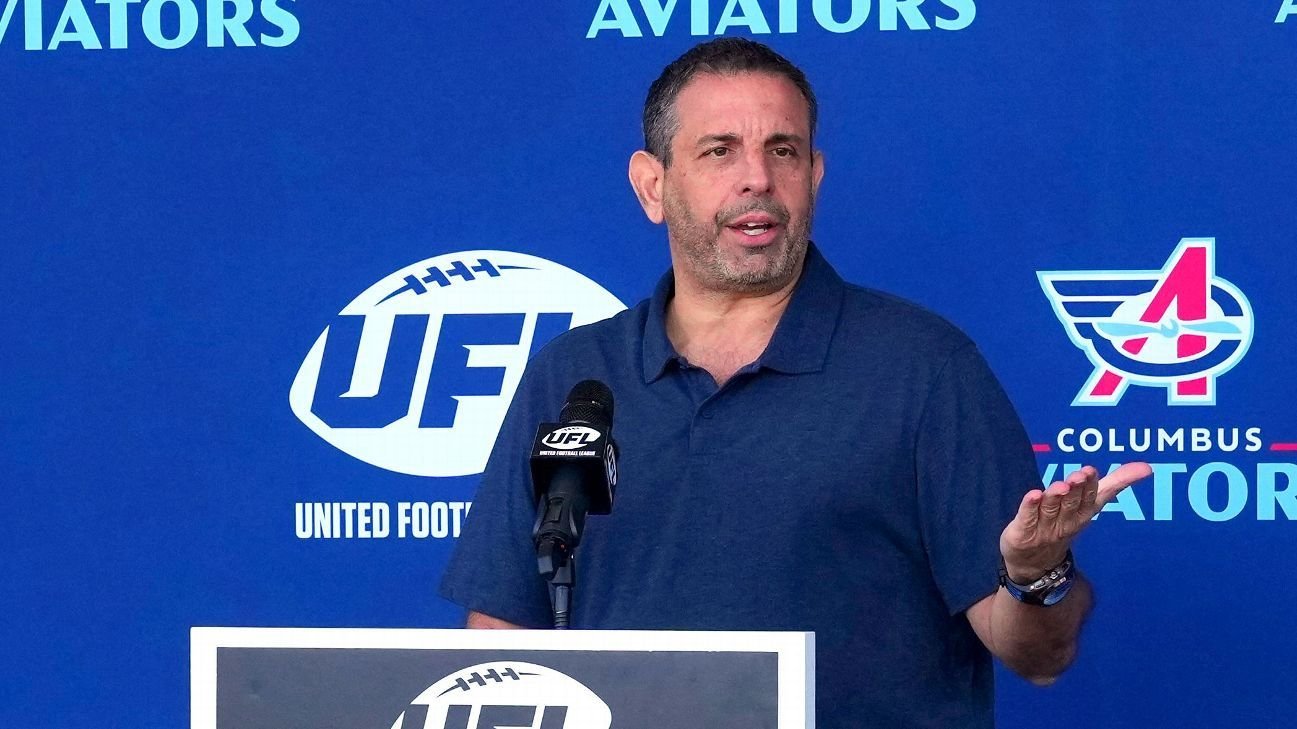
MIKE REPOLE IS calling from the plane that will take him to San Diego, site of an NCAA tournament game for his beloved St. John’s men’s basketball team. The night before, he had been holed up in the United Football League’s headquarters in Arlington, Texas, to oversee roster cuts for the league he invested in last summer. In between, he’ll focus on his decades-long quest to upend the sport of horseracing and, oh yeah, his ever-evolving day-to-day business that once sold two beverage companies to Coca-Cola for $10 billion.
“I’m watching film of Northern Iowa,” Repole shouts into the phone, referencing St. John’s first-round opponent. “What do you want to know?”
It’s not clear whether he’s joking.
Repole’s energy and range of interests have shaken up the UFL, which opens its third season Friday trying to earn a larger share of the nation’s spring sports attention. After joining the league with a mission to overhaul its business side, Repole has expanded into an sweeping role that president/CEO Russ Brandon calls the “managing partner of our operation.” The league’s future — and perhaps the hopes of spring football in general — rests in his always-moving hands.
Repole has been the primary force behind coaching changes for seven of the league’s eight teams. He orchestrated moves to three different markets, switched stadiums for two of its existing teams and personally directed two of the league’s most notable rule changes for 2026: a four-point field goal and a ban of the tush push short-yardage play.
League officials are greeted to a leadership text message at 6 most mornings, Brandon said. For some, the communication continues in the form of 25-30 texts per day with questions, ideas and reminders of the urgency Repole expects.
“It’s been eight months since I got here,” said Repole, who also owns the NOBULL athletic apparel brand that merged with Tom Brady’s TB12, “and I can tell you it’s more challenging, tougher than I thought, more enjoyable and more fun. I’m really, really enjoying the process of trying to change the whole vibe, energy, atmosphere and personality of the league.”
Phew.
The UFL’s opening game will take place at Louisville’s Lynn Family Stadium between the hometown Kings and the Birmingham Stallions. Repole hopes to announce it as the league’s first sellout.
“Just do me a favor,” he said with a laugh. “Don’t tell anyone that a sellout there is 14,800 fans.”
IN REVIEWING THE UFL’s first two seasons, Repole was intrigued by the relatively high-level football but repulsed to see much of it played in nearly empty college football stadiums. With the exception of the St. Louis Battlehawks, who have drawn an average of about 30,000 fans, games in the other seven markets usually drew between 5,000 and 12,000. Those games felt, Repole said, like the 2020 NFL and college football seasons that were played under COVID-19 restrictions.
Smaller venues, Repole decided, would make those attendance levels more entertaining in person and look better on television. The UFL would be better off making attendance comparisons with indoor sports, from basketball to hockey to lacrosse, complete with halftime concerts and other incentives to attend. Now, of the league’s eight home stadiums, six have attendance capacities under 25,000.
“What I’m thinking is arena football, but outdoors,” Repole said.
Since the spring football craze began with the 2020 return of the XFL, no one has found a path to profitability, much less long-term sustainability. Repole’s idea is clear: Success starts with an environment that paying customers want to experience. As Brandon put it: “Packed houses drive all of your other revenue streams.”
Putting Repole’s vision into reality required a staggering level of negotiating, paperwork and logistical planning in a short period of time. When Repole directed UFL officials to make the necessary changes, they doublechecked to confirm he meant for the 2026 season.
“If you would have told me then that we would be in all of these new venues,” Brandon said. “I would have told you, ‘That’s just not possible in one offseason.’ I would have given it a 1% chance. But it’s like Mike says, ‘If it’s a 1% chance, I like my odds.’ I mean, he’s a force of nature.”
AT THE SAME time, Repole was making clear to employees on the football side of the operation who they work for. The existing league ownership group remains intact, including actor Dwayne “The Rock” Johnson, entrepreneur Dany Garcia, Gerry Cardinale of RedBird Capital Partners, along with broadcasters Fox Sports and ESPN. But Repole said he quickly learned that the “business side and the football side, they merge.”
A majority of the UFL’s football changes this season came at Repole’s direction. For starters, the league changed, replaced or transferred seven of its eight head coaches in an effort to match the positions with natural connections to their markets. Repole called it an effort to elevate “team equity” within a centralized league.
The UFL hired and placed former college football stars as coaches in Birmingham (AJ McCarron), Louisville (Chris Redman) and Columbus (Ted Ginn Jr.). Former St. Louis Rams receiver Ricky Proehl became the Battlehawks’ coach, and former University of Houston coach Kevin Sumlin returned to the Houston franchise, where he was the Gamblers’ coach in 2022. The other three teams are helmed by established coaches — Anthony Becht (who moved from St. Louis to Orlando), Rick Neuheisel (Dallas) and Shannon Harris (Washington, D.C.).
Once hired, the coaches traveled to Repole’s home near Orlando, Florida, to have dinner. They’ve met with him regularly since. The UFL posted on social media a video of their first dinner together. Holding a glass of wine, Repole told the coaches: “Whether it’s teams, whether it’s players, whether it’s coaches, whether it’s me, we’re going to do things differently.”
“He’s all over the place,” McCarron said, “but I love that about him. I love the fact that he speaks his mind. And I think it’s refreshing and what’s needed in everyday life and sports. He’s great for this league, because you need ownership and the leaders to take the mindset of being willing to listen. He doesn’t act like he knows all the answers. And if he doesn’t know, he’ll listen. And that’s the best part to me.”
McCarron, for example, recently expressed concern about proposed changes to the Stallions’ uniforms that would feature gold jerseys at home. McCarron told Repole that the color would make it difficult to distinguish from visiting teams wearing white. Repole swapped the color schemes to give the Stallions maroon jerseys at home.
REPOLE’S VISION HAS extended to granular levels of the game. He said he was watching an NFL game last fall when Dallas Cowboys kicker Brandon Aubrey, a former spring league kicker in the USFL, hit a 64-yard field goal to a tie a game against the New York Giants and force overtime.
Thinking about the game afterward, Repole wondered why a field goal that long was worth the same as one much closer.
“That should be worth four points,” he said, describing his thought process at the time. “What if he was lining up to take a lead with that kick? What a moment that would be.”
Repole convinced Dean Blandino, the UFL’s head of officiating, to incorporate a four-point field goal for any kicks of 60 yards or more into the UFL’s rulebook. Blandino referenced it recently as the “Mike Repole field goal.”
This spring, Repole heard that the NFL’s deadline for rule change submissions passed without a proposal to ban the tush push. Within 36 hours, Repole made an addition to the UFL’s rule book: The tush push would be illegal.
“There had only been one tush push in the past three years of spring ball,” Repole said. “But you know what? We got ESPN and Fox and everybody talking about us.”
Publicly and privately, Repole has pushed for the kind of consistent high-scoring games that previous spring football operators have found elusive.
“Listen, the days of the Bears and the Giants playing a 6-3 game, I don’t want that,” he said. “I want 35-31. If I could make an over-under for every game, it would be 58.5, and I want the over. I want people to have fun and be talking about our games.”
Coaches who spoke with ESPN offered measured responses regarding the reality of that goal. Harris, who is entering his fourth season in spring football, noted that offenses historically start slow because of the relatively short training camp. McCarron pointed out that some rule changes designed to promote offense, including a prohibition against punting once the offense crosses the 50-yard line, could backfire.
“We’ve only been together for about a month,” McCarron said. “We all want to go out and put up 70 points. Based off the rules, you could see more scoring that way. Or you could not. It could work in the favor he wants or it could hurt, so that’s a question mark. We’ll see how it turns out.”
In either event, Harris said Repole has infused an energy that “has trickled down throughout the league.” Everyone, it appears, understands that their traditional football routine has been upended.
“I like to say if you’re right-handed, Mike makes you play with your left,” Brandon said. “And then you’re trying to make that left-handed layup. That’s what Mike makes you do. He makes you think differently.”

