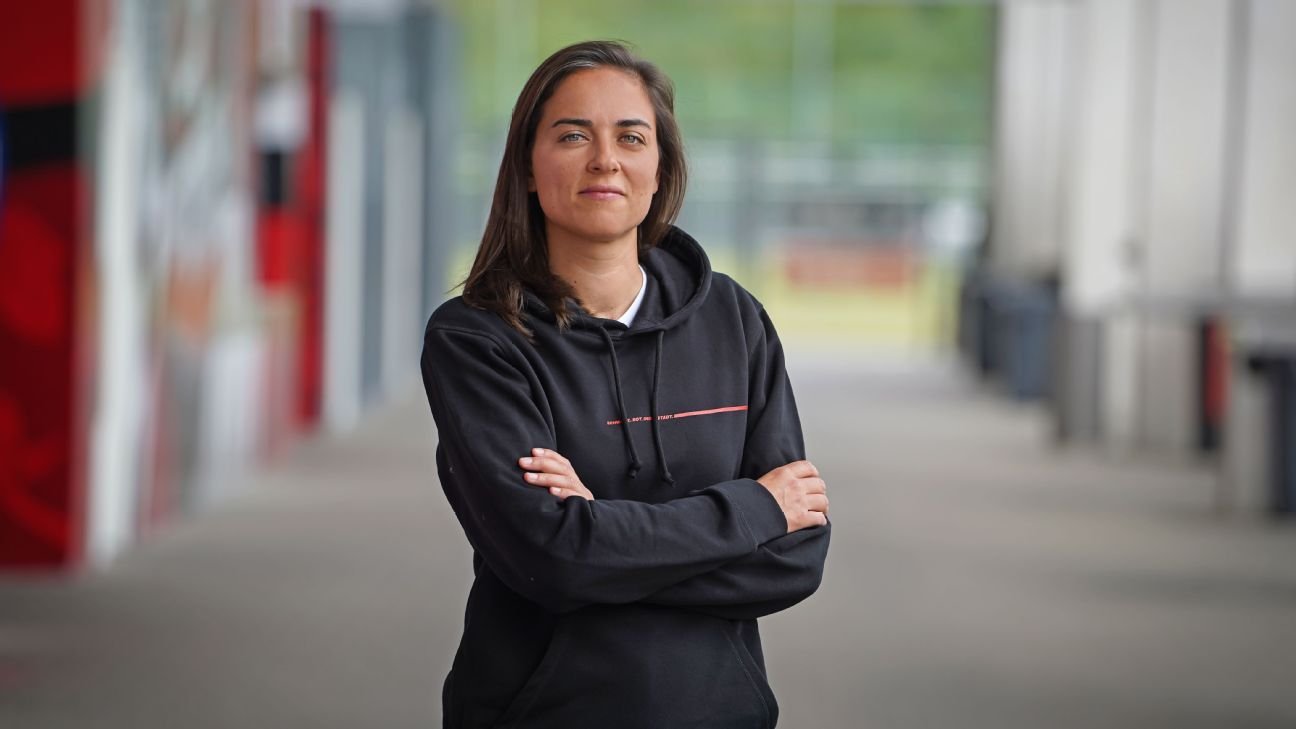
Sabrina Wittmann realized her pioneering status was finally peripheral news when her team, third-division German side FC Ingolstadt 04, hit a poor run of form in 2024-25.
Since replacing Michael Köllner in May 2024, her news conferences had been dominated by a series of similar questions. What was it like being the only woman head coach of a men’s professional soccer team in Germany? What was it like being a role model? Could she go into the changing room after a game? She grew used to these queries, offering the same answers, but finding it awkward in the spotlight.
When those questions finally ebbed away, replaced by criticism of Ingolstadt’s performances, she allowed a brief smile. She had gotten her wish: to be judged primarily on being a manager.
Wittmann was Ingolstadt’s under-19s coach before she made history by stepping into the top job on an interim basis, four matches before the end of the 2023-24 season. When she took the role, her first thoughts were not on the wider significance of her appointment, but on the team’s formation for the match vs. Mannheim in three days’ time. “The first thing was, do I stay with 4-2-3-1 or switch to 4-2-2-2? Do we have time?” she told ESPN.
Ingolstadt drew 1-1 with Mannheim, and it was only later that night she checked her social media. “I started to realize what was happening because I saw my face everywhere,” she said.
– How assistant managers handle players, personal ambition
– Could Wolfsburg, one of Germany’s historic clubs, face relegation?
– Picking the world’s best soccer players at every age group
Over those final four league matches, she won two and drew two while winning the Bayerischer Toto-Pokal, a regional cup. Wittman had done her part, but there were no promises she would keep the job on a full-time basis. On June 5, 11 days after the end of the season, she was called into Ingolstadt CEO Dietmar Beiersdorfer’s office. There was a bottle of wine on the table. She realized those gathered there were waiting to toast good news.
The players already knew they had a special coach. “I thought it was great how authentically she spoke in her first meeting [as manager] about how strange the situation was for her, because she’s no longer working with teenagers, but with adults,” former Ingolstadt forward Pascal Testroet told Donaukurier.
“The reason I kept the job was because the players told our management they wanted me to stay,” Wittmann said. “So one of the best things out of those four weeks [as interim] was knowing I was good enough as a person — not just as a football coach, but as a person — to lead a man’s team, while not trying to pretend to be somebody else.”
2:42
Kane reflects on Bayern Munich’s ‘really good’ win over Union Berlin
Harry Kane reacts to Bayern Munich’s 4-0 win over Union Berlin in the Bundesliga.
Wittmann, 34, was born in Ingolstadt, a town 50 miles north of Munich and where car manufacturer Audi is based. She grew up playing soccer and had ability, but it was a 2005 holiday in Calabria that kick-started her career in the sport. While playing on a hard court at the hotel with other guests, she caught the attention of legendary Germany striker Miroslav Klose.
“Naturally, it was a conversation among the guests. ‘We played football right in front of such a star,'” Wittman told Bild. “At some point, an acquaintance of ours urged him to tell my mom that I should play football for a club. Miro actually did … and that summer, I did indeed start playing football for SC Steinberg.”
At 16, she spent a year in the United States on an exchange program, living in Mount Sterling, Kentucky. Her high school coaches nudged her toward being a kicker in American football, but she instead pursued her love of soccer and combined that with coaching a younger side.
By 2009, she was coaching in the Ingolstadt academy in Germany. It was more a hobby — she had completed her high school diploma, enjoyed an apprenticeship at Audi and studied law (and later, sports science). But she kept returning to coaching, working her way to the top job.
When Wittmann first stepped into the dugout, Ingolstadt was inundated with worldwide media interest. “There were so many cameras and media,” she said. “That was something new in Ingolstadt, so I recognized, ‘OK, that’s something special.'”
Ingolstadt are established in the third tier, but they used to sit at the top table. From 2015 to 2017, Ingolstadt were in the Bundesliga. They were coached by Ralph Hasenhüttl (2013 to 2016) and had Germany’s Pascal Gross and United States international Alfredo Morales in their team. But they were relegated to 2. Bundesliga in 2017 and slipped to 3. Liga in 2021.
They remain a team with aspirations of moving up while realistic of their own financial constraints, and pride themselves on youth development. Wittmann has coached players from the U9s through the senior level. “When I coached the younger teams, I always had the feeling I’m playing with those dreams, so you do have doubts, but you have to be rational.”
That bond and understanding with the players helped her land the job on a full-time basis. “Sabrina works meticulously and has a very good approach to how she wants to play football,” midfielder Yannick Deichmann told TZ in August 2024. “We all trust and follow her unconditionally.”
“She knows what she wants, is ambitious and yet relaxed,” ex-Ingolstadt player Patrick Sussek told Kicker.
In the 2024-25 preseason, she stood in front of the senior team as their head coach, knowing their positive feedback to the board had played a big role in landing her the job. They talked about exercises and tactical shifts, but she also told them she would need to lean on them for support.
“Maybe sometimes I am softer than a man,” she said. “But when I was with the under-19s, a father [of one of the players] told me that the strength of a woman was something I should not lose. So I just try to be authentic to who I am, not to make myself extra hard or anything.
“It took me almost 15 years to coach a professional team. It’s not just about the knowledge that you add to yourself, but about your own confidence: Be authentic, stick to it and be patient.”
Wittmann hears negativity at matches and on social media but brushes it off. When her close friends hear her being criticized, they make a joke of it. “I try not to focus on that stuff, because if it comes down to conversations, nine out of 10 are really positive and one is negative,” she said. “The loudest [voices] are sometimes the most negative ones, but I try to focus on the nine that are positive.”
One of Wittmann’s first challenges in the role was to get her UEFA Pro Licence — a mandatory certificate for managers in Germany’s top three leagues. Until she was accepted into the program in January 2025, Ingolstadt were fined a one-off payment of €10,000 and a further €3,500 for every match she took charge. She juggled that course with her coaching duties, managing a team in transition — Ingolstadt lost 19 players in summer 2025. But in January, she got her license. “Dreams pursued — some achieved, new ones discovered,” she wrote on Instagram.
At the time, she wasn’t sure whether Ingolstadt would renew her contract, with the team close to the relegation zone. But through February, results improved and her future became clearer. On March 6, Ingolstadt announced Wittmann had signed a new contract. “Her authenticity, clear football philosophy and unwavering focus on the sustainable development of our team and players set her apart,” Beiersdorfer said. “Her many years of experience at FC Ingolstadt 04 [having] instilled in her an exceptional sense of identification with and responsibility for our club.”
In terms of personal role models, Wittmann admires Jurgen Klopp’s emotion and Pep Guardiola’s tactical attention to detail. She spends time studying Julian Nagelsmann and Thomas Tuchel. But she’s also aware there are young managerial hopefuls looking to her for inspiration.
“I knew I opened the door a little for women, and at the beginning, I was honestly afraid of closing the door quicker than I would like to,” she said. “But I told myself, and with the people around me who have my back, ‘Let’s just do and not talk much about it.’ And all the pressure that I felt at the beginning — you get used to it.”
She added: “I live in Munich, and I went to the [farmers’ market], and there was a 6-year-old girl there who wasn’t interested in football at all but was so happy that I had got the job.
“There are a lot of people who wish me well, but I know there are those who wish that things won’t happen in a good way. But I just try to be calm, and know if it works, it’s because I am who I am, and I wasn’t trying to be harder than I am.”
There are few women in Wittmann’s position. Nadine Keßler, UEFA’s head of women’s football, has highlighted the gender difference in Pro License holders. “In Europe, we have 75 times as many Pro License men’s coaches as female coaches. The DFB has the most balanced ratio — with 28 times as many male Pro License holders,” she said.
Union Berlin’s Marie-Louise Eta became the Bundesliga’s first woman assistant coach in 2023, and in 2017, Bibiana Steinhaus-Webb became the first woman referee in the Bundesliga. Inka Grings (SV Straelen) and Imke Wübbenhorst (Sportfreunde Lotte) coached in the fourth tier.
“I really feel honored, but I don’t like the word ‘role model,'” Wittmann said. “My best friends are doctors and working in hospitals; they are role models. I’m a football manager and I’m not saving lives, so it’s a big word for me. But if I can help young girls and boys become something, then that makes me proud. It took me a while to realize that, but I feel more confident believing that now.”
It has been another tricky season for Ingolstadt, but they are safe in 3. Liga. The hope is they’ll keep their better players this summer, and the youth system Wittmann helped craft is still producing impressive talents. All the while, Wittmann works with her close confidant, assistant coach Fabian Reichler, to plot their way to promotion. And along with being the first woman coach in German professional soccer, Wittmann is the youngest manager in the top three divisions. This isn’t her ceiling.
“One of the things I learned quickly was that if you lose three in a row, you feel s—ty,” she said. “But you have to give belief to everybody, so you fight. Regardless of whether you’re a man or a woman, if the players recognize you’re doubting yourself or not believing in what you’re doing, they’re going to trend that way too. So you fight and believe in yourself and your ability.”

