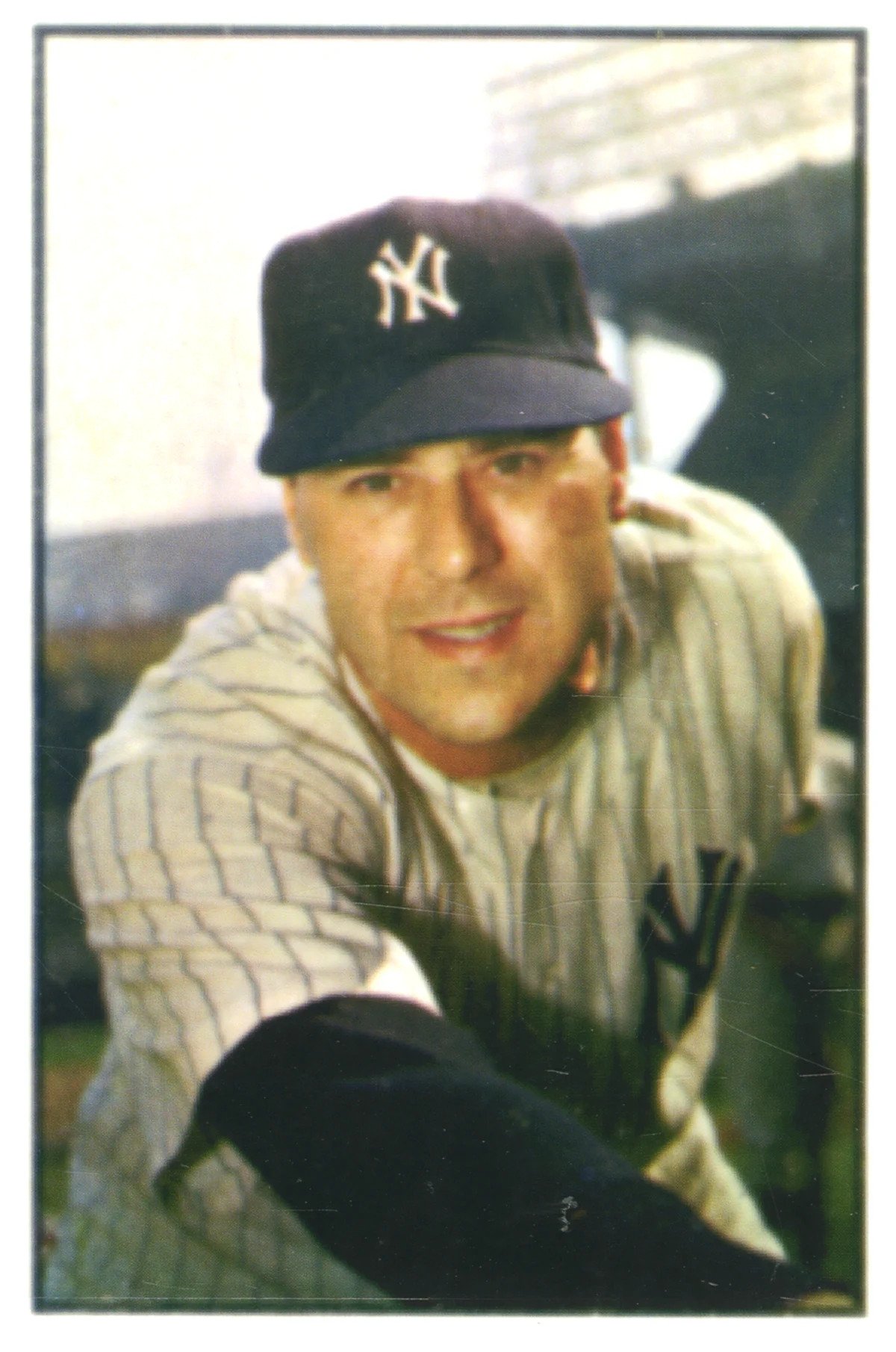
Vic Raschi did not have a long enough or fruitful enough career to warrant anything like a Hall of Fame induction or a number retirement from the Yankees. However, for several years, he was a very good pitcher for the Yankees in what was arguably their most dynastic era.
Today just so happens to be “The Springfield Rifle’s” birthday, so let’s take a look back at his life and career.
Advertisement
Victor John Angelo “Vic” Raschi
Born: March 28, 1919 (West Springfield, MA)
Died: October 14, 1988 (Groveland, NY)
Yankees Tenure: 1946-53
Born in Massachusetts, Raschi excelled at several sports in his youth including baseball, football, basketball, and even marbles, winning a state-wide tournament as a 10-year old. Baseball was the one he was best at, as he had a cannon for an arm. That ability along with the famous Springfield Armory in his home town got him his future nickname of “The Springfield Rifle.”
As a 16-year old, Raschi was spotted by Yankees’ scout Gene McCann. With the pitcher still in high school, the Yankees came to an agreement with him and his family. The team would pay for Raschi to attend college, with the Yankees getting the first chance to sign him upon him joining the professional ranks. Raschi decided he couldn’t pass up that opportunity and went to the College of William & Mary thanks to the Yankees before eventually signing a pro deal with them in 1941.
After two solid years in the minors, Raschi had to put his career on hold. He ended up missing the entirety of the 1943-45 seasons as he served in the military during World War II. Upon returning to baseball in 1946, he very quickly worked his way through the rest of the minors. Raschi pitched across Double-A and Triple-A that season, and was good enough to get called up by the Yankees that September. He made his MLB debut on September 23rd, allowing six runs in a complete game victory over the Athletics.
Advertisement
Following his 1946 debut, Raschi was hoping to make the team out of spring training in ‘47, but the team ended up demoting him back to the minors. Initially, he refused to report to his assignment with the Portland Beavers before relenting after cajoling from his wife and threats of banishment from the Yankees. As it would turn out, the demotion ended up being a godsend for the pitcher. Portland’s manager was Jim Turner, who in Portland and later as the Yankees’ pitching coach, helped unlock the speedy pitcher.
Raschi put up a very impressive start to the 1947 season in Portland, eventually earning that recall to the majors that he desired. Upon his recall, he hit the ground running in New York, putting up a 2.98 ERA over his first eight games, which included a couple complete game victories. He fell back to earth a bit down the stretch that season, but he did make two appearances out of the bullpen as the Yankees beat the Dodgers for the ‘47 World Series title.
While the Yankees as a team fell back to the pack in 1948, Raschi locked down his spot in the rotation, making 31 starts, and even getting down-ballot MVP votes. In 1949, he then put up what was, by some metrics, the best season of his career. His 121 ERA+ was the best of his career in ‘49, as he also won 21 games, cracking the 20 mark for the first time, which he would match the following two years. He was on the mound in the final game of the regular season, throwing a complete game win over the Red Sox to clinch the AL by just one game over Boston. He was then the winning pitcher in the series-clinching Game 5 win in the World Series against the Dodgers.
Over the next three years, Raschi remained a very good middle rotation arm. Over the course of 1948-52, he was named an All-Star four times and got MVP votes in all five seasons. He posted a 98-42 record over that time. The Yankees won the World Series in all of 1949-53, making Raschi a six-time champion. In 1950, he set the tone in that series by throwing a complete game shutout in Game 1 against the Phillies, with the Yankees narrowly winning 1-0. He probably wouldn’t have been named series MVP just for that game as it ended in a Yankees’ sweep, but you could certainly make the argument that his contribution was the most important. Across the 1950-53 triumphs in particular, he went 4-2 with a 1.42 ERA.
Advertisement
While he put up a season in 1953 that wasn’t unlike some of his previous ones, some of the Yankees’ brass decided he had taken a step back. As the team attempted to cut his pay, Raschi held out. Upon finally reporting to spring training, the team up and sold him to the Cardinals ahead of the 1954 season.
Whether or not his 1953 season was a down one, the rest of his career would definitely see him take a step back from his prime. Across the 1954-55 seasons, Raschi posted an ERA over five with the Cardinals and then the A’s. The 1955 season would be the final one of his playing career.
After retiring, he settled in his wife’s hometown in upstate New York. There, he ran a liquor store, did some baseball coaching, and spent time teaching elementary school. He eventually passed away in 1988 at the age of 69.
The Yankees’ various dynasties from the 1920s through the early 1960s were usually defined by the star hitters that often dotted their lineups. However, you still need good pitching to get over the hump, and Raschi was that on several very good Yankees’ teams.
See more of the “Yankees Birthday of the Day” series here.

