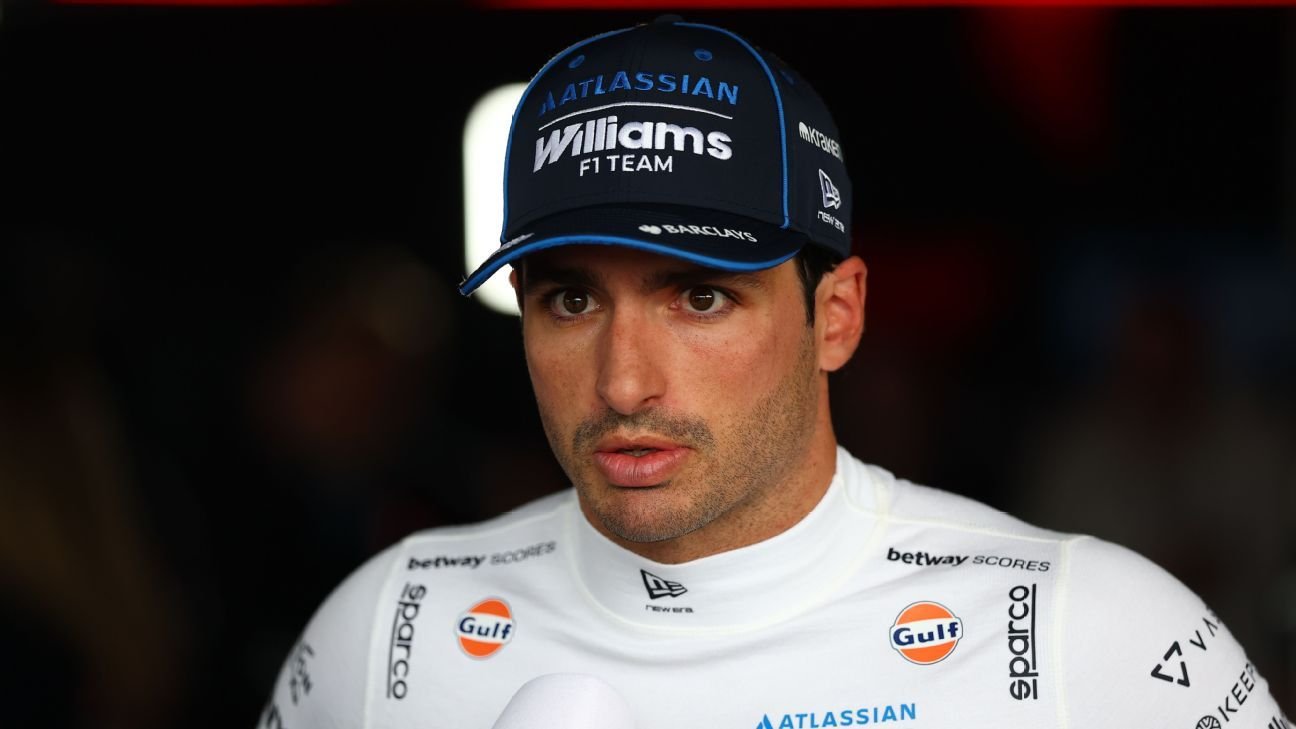
Carlos Sainz hit out at Formula 1 and its governing body FIA for ignoring driver warnings predicting the type of crash Oliver Bearman had at the Japanese Grand Prix, saying they resisted changes “because the racing is exciting.”
Bearman limped away from a 308 km/h smash into the barriers at Spoon corner after losing control of his car while closing in on Alpine’s Franco Colapinto at a much higher speed. Bearman escaped without any bone fractures, although he did sustain a right knee contusion.
Drivers have repeatedly cited concerns over the dramatic speed differences created by F1’s new hybrid engines, which give every car a battery boost to deploy around a lap.
With a month off racing now until the Miami Grand Prix due to the cancellations of two races in the Middle East, Sainz said Bearman’s crash should prompt changes to the rules around the battery deployment levels.
“Being honest with you, excited to see what FOM [Formula One Management] and the FIA come up with for the new regulations, I am hopeful that we’ll come up with something a bit better for Miami, given the fact that the accident with Ollie that we saw today, we’ve been warning them about this happening,” Sainz told Sky Sports F1.
“These kind of closing speeds and these kind of accidents were always going to happen, and I’m not very happy with what we’ve had up until now, and hopefully we come up with a better solution that doesn’t create these massive closing speeds and a safer way of going racing.”
Ahead of Japan’s race, F1 and the FIA agreed on a change to deployment levels for qualifying, aimed at stopping drivers having to harvest so much battery power through some of the circuit’s high speed corners. However, no changes have been made to the racing despite calls to do so.
– Oliver Bearman limps away from Japanese Grand Prix crash
– Kimi Antonelli secures second straight win for Mercedes at Suzuka
One effect of the new battery boosts has been an increase in back-and-forth yo-yo racing between drivers.
When asked if Bearman’s crash will help strengthen the cause of the drivers, Sainz said the sport’s rulemakers had prioritised the spectacle over driver safety.
“Yeah, that’s why I was so surprised when they said, ‘No, we will sort out qualifying and leave the racing alone, because it’s exciting’. As drivers, we’ve been extremely vocal that the problem is not only qualifying, it’s also racing, and we’ve been warning that this kind of accident was always going to happen.
“Here we were lucky there was an escape road. Now imagine going to Baku or going to Singapore or going to Vegas and having this kind of closing speeds and crashes next to the walls. We, as the GPDA, we’ve warned the FIA these accidents are going to happen a lot with this set of regulations, and we need to change something soon if we don’t want them to happen.
“It was 50G I heard, which is higher than my crash in Russia in 2015, I was 46G. Just imagine what kind of crash you could have in Vegas, Baku, etc. I hope it serves as an example and the [FIA and FOM] listen to the drivers and not so much to the teams and people that said the racing was OK, because the racing is not OK.”
The FIA has issued a statement confirming meetings will be held in April to address driver concerns.
“Following the accident involving Oliver Bearman at the Japanese Grand Prix and the contribution of high closing speeds in the accident, the FIA would like to provide the following clarifications,” the statement said.
“Since their introduction, the 2026 regulations have been the subject of ongoing discussions between the FIA, Teams, Power Unit Manufacturers, Drivers and FOM. By design, these regulations include a number of adjustable parameters, particularly in relation to energy management, which allow for optimisation based on real-world data.
“It has been the consistent position of all stakeholders that a structured review would take place after the opening phase of the season, to allow for sufficient data to be gathered and analysed. A number of meetings are therefore scheduled in April to assess the operation of the new regulations and to determine whether any refinements are required.
“Any potential adjustments, particularly those related to energy management, require careful simulation and detailed analysis. The FIA will continue to work in close and constructive collaboration with all stakeholders to ensure the best possible outcome for the sport and safety will always remain a core element of the FIA’s mission. At this stage, any speculation regarding the nature of potential changes would be premature. Further updates will be communicated in due course.”
Despite the rule changes to qualifying, drivers were still not satisfied with the experience of racing F1’s new cars over one flying qualifying lap.
Reigning world champion Lando Norris said it “hurts the soul” to feel his car losing so much power due to the phenomenon known as “super clipping”, which sees top speed drop as the hybrid engines harvest power for the battery despite the driver being flat out.

