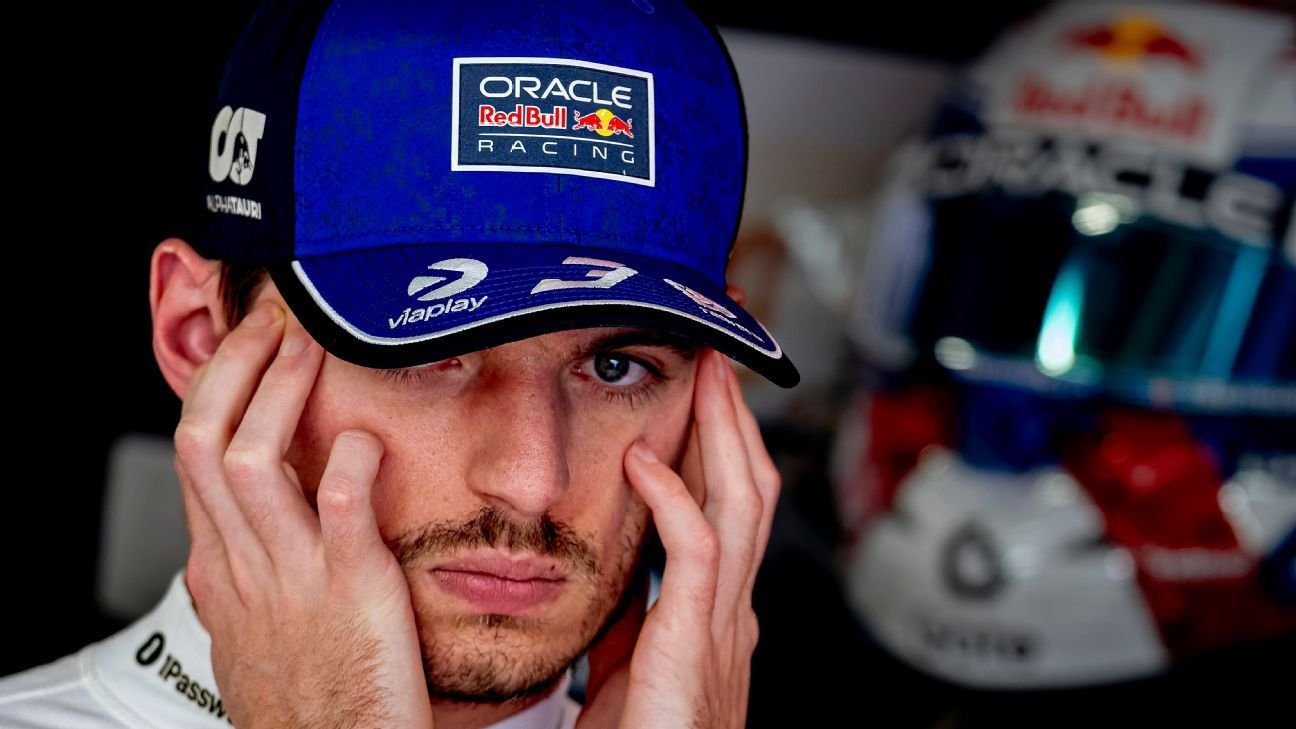
Max Verstappen‘s bombshell threat to quit Formula 1 seems shocking — and it is — but it’s also been a long time coming. And make no mistake: it absolutely is not just an idle threat from a driver upset he no longer has the best car.
The four-time world champion, who turns 29 in September, appears to be on the precipice of making that stunning decision — either retiring for good or, as sources have indicated to ESPN as another possibility, taking a sabbatical from Formula 1. The four-week break caused by the cancellation of two Middle East races is the beginning of a period that will decide his future.
F1’s biggest rule change ever, a move to hybrid engines featuring a massive and unprecedented emphasis on harvesting and then deploying battery-boosted electrical power, has infuriated Verstappen and seems to have moved him to the brink of this radical decision. He’s likened the new cars to Mario Kart, called them a “joke” and “anti-racing,” and said anyone who has enjoyed the back-and-forth overtakes now created by battery boosts doesn’t “understand what real racing is about.
To make matters worse, his Red Bull team also appears to be significantly off the pace. Verstappen labored to eighth position at Sunday’s Japanese Grand Prix after being eliminated from qualifying in Q2. His best result of the season so far is a sixth place at the curtain raiser in Australia.
To anyone who’s been following recently, the revelation might not seem new. Verstappen has hinted that his F1 career has a shelf life before, but gave the clearest insight into his current mindset across the Suzuka weekend, notably after the race.
Asked by BBC Radio Five Live if he might “walk away from F1 at the end of the year,” Verstappen responded: “That’s what I’m saying. I’m thinking about everything inside this paddock. Privately I’m very happy. You also wait for 24 races. And then you just think about is it worth it? Or do I enjoy being more at home with my family? Seeing my friends more when you’re not enjoying your sport?”
In the written media pen after Sunday’s race, he said: “Every day I wake up, I convince myself again [to keep racing]. And I try.”
It’s the closest he’s come to overtly saying he could walk away.
Around the same time on Sunday, Dutch media outlets closely linked to Verstappen started reporting similar with the word “retirement” prominently featured.
Comments he had made on Saturday after being eliminated from Q2 also went somewhat under the radar, when he cryptically had said there was “a lot of stuff also for me personally to figure out” about the next few races. He had cut an incredibly despondent figure that evening.
“I’m not even frustrated anymore,” Verstappen said after qualifying. “I’m beyond that, so that’s a bit … I don’t know the right word in English. I don’t know what to make of it, to be honest. Probably no words. I just cannot … I don’t get upset about it, I don’t get disappointed, frustrated by it anymore with what’s going on.”
The idea of Verstappen leaving F1 feels as tangible as ever. It would be a legacy-defining move for the Dutchman, walking away from the sport at the absolute peak of his powers.
There should be no sugarcoating the wider implications. The four-time world champion’s threat to leave feels like an existential crisis for F1’s new era of car, a ruleset the sport has desperately tried to control the narrative around since the beginning of the year. The sport faces a new reality now — unless something remarkable changes in the next few months — that these rules might be remembered as being so bad they made one of the sport’s greatest ever drivers walk away before his 30th birthday.
Is he serious?
Absolutely serious, that has never been clearer. And, crucially, there are also ways of getting out of his existing contract. Verstappen’s deal with Red Bull — reportedly worth around $70 million a year — runs until 2028. It was a bumper extension signed shortly after he had won his first title in 2021.
The specifics of that contract have been newsworthy before. Much of the focus across the first half of last year was whether Red Bull’s slow start might help Verstappen trigger a performance-related clause in the summer break, which coincided with rumors of a move to Mercedes — rumors Mercedes boss Toto Wolff actively helped to keep alive. As it turned out, he went into the break third, which did not trigger the clause, and then delivered an astonishing second half of the season that saw him miss out on a fifth title by just two points. A future Mercedes move appeared to be dead in the water come the end of the season, but Wolff is a longtime admirer of Verstappen, and still regrets being beaten to his signature by Red Bull all those years go.
Sources have told ESPN a similar exit clause exists for 2026, one that was specifically added with F1’s new regulations in mind, given Verstappen’s longstanding apprehension about them. Various reports state that he has a mechanism to leave his existing deal if he is not first or second in the competitive order come the middle of the year. Given Red Bull’s early struggles, it would take a miraculous set of circumstances to not have that route out of his contract available to him.
That clause was added to allow him to assess the competitive order under the new rules and be able to make a decision on his future based on that. The assumption, of course, was that he would still be enjoying racing, and this would merely facilitate a move elsewhere on the grid. Now, though, that clause appears to be Verstappen’s ticket to an early escape from the sport.
Sources have suggested to ESPN that Verstappen is leaning more toward a sabbatical rather than a full-blown retirement, but there’s never a guarantee of a return once a driver leaves — even for one as good as him. Setting foot in the paddock again would require that any potential time away would result in him missing F1, and given his mood for the entirety of 2026 (and a not-insignificant portion of 2025, too), there’s no guarantee of that, either.
Verstappen could name his price to come back with any of the sport’s top teams, but that is with the assumption he would ever want to race elsewhere if he did decide to come back. Verstappen has a long affiliation with and affinity for the Red Bull company that gave him his route into the sport in the first place.
The nature of Red Bull’s F1 contracts also mean he could step away from racing while still honoring his deal with the company as an ambassador or in another role, and sources have told ESPN that option would also be open to him. Both Daniel Ricciardo and Sergio Pérez were offered, and turned down, similar options when they left the company’s F1 teams in recent years, although neither had the benefit of leaving on their own terms.
However long he decided to leave and regardless of whether he remained affiliated with Red Bull, Verstappen would be walking away from a significant chunk of money, but he addressed this during his BBC Five Live interview on Sunday, too.
“As a kid, this is what I wanted to do, and back then I had no idea what I was going to achieve and how much money you make,” he said. “You never think about that as a kid. And it’s also not about that. I want to be here to have fun and have a great time and enjoy myself. At the moment that’s not really the case.”
Why is he so disillusioned?
Verstappen has been open to an early exit from Formula 1 for a long time. Even as early as 2021, after winning his first championship, he said in his first media interviews that one world title was all he had ever really wanted to win. The rest, it seemed, was a nice bonus.
The Dutchman has never seemed like someone who wanted to follow the example set by fellow multiple world champions Lewis Hamilton and Fernando Alonso of racing into his 40s. When he hit his 200th race start at the 2024 Dutch Grand Prix, Verstappen was asked if he would contest another 200: “No,” he said, “we are past halfway [point] for sure, but it’s been already an incredible ride.”
The concept of a Formula 1 career spanning decades has never appealed to Verstappen. That’s perhaps not surprising when you remember that, at 17, he was the youngest driver to ever start a race, a year before he became the youngest driver to ever win a race at the 2016 Spanish Grand Prix, on his Red Bull debut. We are months away from the 10-year anniversary of that victory.
His recent forays into sports car racing have given a good indication into his state of mind on racing. Red Bull allowed him to race at the Nürburgring last year when it was worried he might leave the team altogether. He raced there again earlier this month and will compete at the Nürburgring 24 Hours in June — an outlet for the Red Bull man to simply find some joy in motor racing again.
Life has changed significantly for Verstappen, too. He and his long-term girlfriend Kelly Piquet welcomed their first child last year, and his Suzuka interview with the BBC hinted at how a life spent racing around the world has become less and less appealing as he’s gotten older. That is a sacrifice everyone in Formula 1 makes, but for the drivers, it seems significantly easier when they’re having fun.
This has become the crucial bit of the equation, and is why F1’s new generation of cars are the key factor in where his mind is right now.
It would be easy to frame his growing disillusion as a driver simply eating sour grapes from no longer winning. Red Bull has embarked on its own engine project this year, and despite what had looked like an encouraging preseason, it appears to be a long way behind Mercedes’ class-leading hybrid power unit. Verstappen’s chances of winning a fifth world title with Red Bull this year seem as close to zero as you can get, and the prospect of closing the gap in coming seasons is impossible to predict.
But framing Verstappen’s mood as simply as a reaction to that competitive situation would be wrong. As early as 2022, he was voicing his concern over these regulations. He repeatedly stated his doubts over F1’s move toward a 50-50 split between internal-combustion and electrical power. He was saying that even when he knew the clauses of his contract would allow him to join the best team a year into the regulation change.
That 50-50 power split was key to getting Audi to commit to joining the sport as a new manufacturer. On paper, that was a glorious triumph for the sport’s attempts at remaining relevant to the automotive industry, but that same split in the hybrid engines has been at the heart of the massive negativity the cars are generating inside the paddock.
Fans still seem split on the regulations, while driver complaints have been numerous. Love them or hate them, it’s undeniable that both qualifying and racing have changed significantly with the new rules, which demand an unprecedented level of focus on charging and then deploying battery power around every single lap.
Verstappen’s complaints have been the most newsworthy, but there have been plenty of other memorable soundbites. Reigning world champion Lando Norris said F1 has gone from its best cars in 2025 to its worst in 2026. Alonso has called the series “the battery world championship” and said the extreme lifting and coasting required through high-speed corners (essential for charging batteries) is now so straightforward that Aston Martin’s hospitality chef could drive his car without any issue.
The Japanese Grand Prix hardly quietened the noise around the new cars. Charles Leclerc, arguably F1’s best qualifier, complained about the format on Saturday at Suzuka, saying “it’s a f—ing joke” that the cars no longer rewarded risk because of the demands of the electrical elements of the hybrid engines. Leclerc has publicly defended the cars previously, having been one of the stars of the thrilling back-and-forth battles we have seen created by the battery boosts across the opening three weekends.
0:34
Leclerc ‘still convinced’ new F1 cars are good for racing
Charles Leclerc reflects on his third-place finish at the Japanese Grand Prix.
Suzuka also highlighted a genuine safety concern, as Oliver Bearman crashed out while having to avoid the Alpine of Franco Colapinto ahead of him. Different levels of battery power available to each driver meant the Haas had a closing speed of nearly 50 mph. Grand Prix Drivers’ Association head Carlos Sainz later criticized F1 and the FIA for not listening to drivers’ repeated warnings over that type of crash, and said the sport had not done anything “because the racing is exciting.”
Verstappen is far from alone in expressing his distaste for the cars, but his criticisms have carried the most weight given the wider implications around his general mindset. The sport’s decision-makers appear to have agreed privately now that significant changes are needed to tweak the formula, but it remains unclear how a significant change can be made without creating further problems down the line, or whether F1 can even get all of the relevant shareholders together to force through anything meaningful.
Can Verstappen be convinced to stay?
Red Bull boss Laurent Mekies suggested his team simply need to deliver a better car to keep Verstappen beyond 2026.
“We are having zero discussions about those aspects,” Mekies said on Sunday of the prospect of Verstappen leaving. “We have a lot of work to do, but I’m sure by the time we give him a fast car, he will be a much happier Max.
“And by the time we give him a car that he can push and make the difference with, he will also be a happier Max. So, honestly, that’s 100% of our discussions right now, is that.”
Clearly, Verstappen has not been happy with the current situation at Red Bull. After the Chinese Grand Prix, Verstappen invited Mekies and his longtime race engineer Gianpiero Lambiase to fly home with him on his private jet — sources told ESPN it was unprecedented for that to happen. Another described it as a chance for frank and honest talks between Verstappen and the key members of his race team to address their shocking start to the new campaign.
While Red Bull delivered an incredible turnaround in the second half of 2025 with an upgrade at September’s Italian Grand Prix, there are growing doubts internally at the team about whether it is in better or worse shape since the sudden departure of long-time boss Christian Horner last July. Undoubtedly, an improvement to the situation at Red Bull would help quiet some of the noise in Verstappen’s head.
But on Sunday night in Japan, Mekies also alluded to the more important part of the puzzle, at least in the short term.
“As per the regs, as you know, they are coming with some good aspects and more tricky aspects,” he said. “And as a sport, with the other teams, we will meet in the break to see how we can tweak them to make things better.”
Those potential tweaks now appear to be absolutely fundamental in deciding what Verstappen does next. F1 now has four weeks to focus on addressing its engine concerns. It is a tricky situation, and the process for what follows is not set in stone.
For Verstappen, his desire is clear. He has previously said “they know what to do” when it comes to the changes needed, and his assertion that the new rules are like all-electrical series Formula E “on steroids” is the clearest indication of which part of the rules he would like change. If it was up to him, he would likely scrap the electrification part entirely, and he’s not alone there.
Many senior figures within the paddock ESPN has spoken to agree the rules are fundamentally flawed by the 50-50 split, and an unanswered question is how far rule changes can tip that split back in favor of traditional combustion power with both unanimous agreement between shareholders and without creating unintended consequences down the line. F1 and the FIA will be able to force through changes on safety grounds to address concerns over the incident between Bearman and Colapinto, should a clear path be found there, but the sport’s decision-makers are wary of any other knee-jerk reactions made after just three races of a rule change that is meant to run until 2030.
Verstappen has said he hopes there are significant changes for 2027, but even here there are no guarantees. F1’s governance presents a tricky hurdle in more general change, as the sport will need to convince manufacturers who invested heavily in that very 50-50 energy split to move away from it — as ever in F1, those doing best are often the most reluctant to enforce significant change.
“It depends on what they decide for next year,” Verstappen said earlier on in the Suzuka weekend, in one of his slightly less candid moments about his current mindset. “For this year, I think they’re trying their best, but it’s also political, which I fully understand of course from other manufacturers — rightly so.”
Of course, F1 would not and should not be cowed by the whims of one driver, either, even one as good as Verstappen. He is on the extreme end of the scale when it comes to the criticisms the cars have garnered, and the sport is consistent in its messaging that fans are enjoying the new type of racing we’ve seen in 2026 so far. Whether everyone feels that way is another debate entirely, but F1 has been stubborn in its view that critics of the new formula need to be patient. F1 boss Stefano Domenicali, who has been in constant communication with Verstappen over his growing frustrations, told fans and the media to “keep calm” about the new formula ahead of the season.
But these rules might forever be linked to Verstappen’s name should they prompt him to walk away. What better blanket statement for any critic of the new rules than to point to one of the greatest drivers of all time — a driver who has, quite literally, forced the rules around wheel-to-wheel racing to be rewritten during his incredible career — simply hanging up his helmet and deciding he doesn’t want to do it any more.
So, in the context of Verstappen’s future, the next months seem to be a crucial period for F1, indeed. Most alarmingly of all is that there does not seem to be an easy or obvious solution to stop the four-time world champion’s seemingly imminent and inevitable departure.

