Just like with the pitch clock, the advent of robot umpires did not break Major League Baseball. The automated ball-strike system (ABS) debuted in the major leagues Wednesday after years of testing in the minor leagues, and in the 47 games since, exactly 94 calls have been overturned. Some were egregious, others by literal millimeters. The general consensus, based on in-stadium fan reaction and seamless integration into television broadcasts: Not only does ABS work, it makes the game better.
Skeptics and holdouts remain — just as they do with the pitch clock two seasons after it was added. Unlike the complaints about the pitch clock that mostly concern one’s personal preferences, the criticisms of ABS are rooted in math and logic. The system’s margin of error (approximately 1/6th of an inch, according to the league) is larger than some of the calls being overturned. And if the system is as good and accurate as the league says, does it not make sense to utilize it for all ball-strike calls?
The latter issue particularly will be adjudicated over time. For now, though, the novelty, speed and presentation of ABS are hits with fans — and plenty of players, too. The 175 challenges issued, signaled by a hitter, catcher or pitcher with a double tap to the head immediately following the pitch, have run smoothly and efficiently. Even better, the three-dimensional graphic tracking a pitch’s tail into or out of the strike zone is deeply engaging, a little mystery box that more often than not reveals itself in an important moment.
The end goal is fairness — the game being decided not by what the umpire necessarily believes but by a set, standard strike zone for each player: 17 inches wide and at 27% of a player’s measured height (bottom) to 53.5% (top), with the ball’s location for ABS purposes measured on a plane 8.5 inches behind the front of the plate rather than anywhere in a theoretical three-dimensional zone.
What makes this version of ABS so convincing is it passes the eye test. That was always the burden of proof for any robot umpiring system, whether it’s fully integrated or challenge-based. It needs to avoid calls that look wrong. And so far, even with a dozen challenges to pitches falling within that stated margin of error — and 42 total decided by less than a half-inch — ABS is holding up its end of the bargain.
In its honor, then, a baker’s dozen superlatives from the first four days of ABS, the latest baseball innovation to get off to a good start.
There are moments that offer a pretty good sense that something new is going to work. This feels like one for ABS. The Cincinnati crowd’s reaction was thunderous. And the situation itself – twice it salvaged a bases-loaded opportunity. This system plays. pic.twitter.com/vS0TYzBX6H
— Jeff Passan (@JeffPassan) March 29, 2026
In the bottom of the sixth inning of the Cincinnati Reds’ game Saturday against the Boston Red Sox, with the bases loaded and two outs, home plate umpire C.B. Bucknor rung Suárez up on a called third strike on a 1-2 count. Suárez tapped his head, stepped out of the box and saw the pitch just miss the zone — a win for him.
On the very next pitch from Boston right-hander Ryan Watson, one that was about an inch off the plate, Bucknor punched him out once more. And just like the previous time, Suárez challenged and it was overturned.
“Outside! The loudest cheers of the game,” Reds play-by-play man John Sadak said, noting Cincinnati had hit a pair of home runs, “come on back-to-back challenges!”
Suárez wound up grounding out on a full-count pitch, a rather anticlimactic end to an electric at-bat. Turns out that only one player has salvaged his at-bat with an ABS challenge and then homered later in the same at-bat: New York Yankees star Aaron Judge.
The full-count sweeper Seattle Mariners reliever Cooper Criswell unleashed against Cleveland Guardians hitter C.J. Kayfus on Sunday night tilted with an unholy 19 inches of horizontal movement — a bigger break than the width of the plate. Raleigh, the MVP runner-up, caught the pitch at the very top corner of the zone and within a second tapped his head.
No, this wasn’t a particularly high-leverage situation. Seattle led, 7-0, at the time of the pitch. And even more, it was extraordinarily close — nicking the edge of the zone with 0.2 inches to spare. Between a fraction of the ball clipping the zone and having the gumption to challenge a high-strike call that catchers usually don’t, Raleigh deserves credit. He made a decisive choice, and it was the right one.
Matt Wallner took this pitch with the bases loaded and two outs then challenged the strike call. pic.twitter.com/s8kkNd8X9i
— Codify (@CodifyBaseball) March 29, 2026
The diameter of a baseball in the major leagues is somewhere between 2.86 and 2.94 inches. The Rico Garcia pitch Wallner, a Minnesota Twins outfielder, challenged Sunday afternoon was 4.8 inches inside the zone — more than a ball and a half, in parlance often used by players pre-ABS to describe calls that didn’t go their way.
That said, the reason Wallner challenged made at least a little sense: The Twins and Baltimore Orioles were tied at 5 in the seventh inning. Minnesota loaded the bases. And it was a full-count pitch. If ever there’s an ideal time to challenge, it’s in that sort of situation. Credit is due to Garcia, too, for making Wallner’s challenge look so feeble: He unleashed a monster of a front-hip sinker, starting the ball toward Wallner only to watch it run back over the plate, a la Greg Maddux — except at 98 mph.
Biggest Miss: Tripp Gibson
In the seventh inning of a game the Toronto Blue Jays trailed 6-2, George Springer stared at an 0-2 splitter from A’s reliever Elvis Alvarado and thought he had worked the count to 1-2. Gibson, an umpire with more than a decade of experience, punched him out. It was an exceptionally bad call, the sort for which ABS was conceived to overturn, and it did in spectacular fashion: The pitch was 4.3 inches off the outside corner — 1.3 inches more than any other pitch called a strike thus far, according to ESPN Research.
The successful challenge went for naught, as Springer swung through a 99.4-mph fastball for the third strike. It served as a good reminder nonetheless for Gibson and all other umpires really: In the ABS era, obvious mistakes will be replayed and laughed at. There’s no excuse for such excessive failures, and for all the excellent work umpires typically do, their mandate is clear: Avoid at all costs the excessively bad miss.
The Challengingest Team: Minnesota Twins
Wallner isn’t the only one. The Twins have called for 11 challenges over their first three games. Their batters went 4-for-6 — a smashing success compared to other hitters — while their catchers went 3-for-5.
Perhaps it was the umpiring. Maybe the Twins are among the teams that do not care to pocket a challenge for a break-glass-in-case-of-emergency situation late in games. (Each team receives two at the beginning of the game and retains them upon a successful challenge.) Whatever the case, Minnesota is followed by the Los Angeles Angels (5-for-9) and Chicago White Sox (4-for-9), with Colorado (1-for-2) not challenging until its third game.
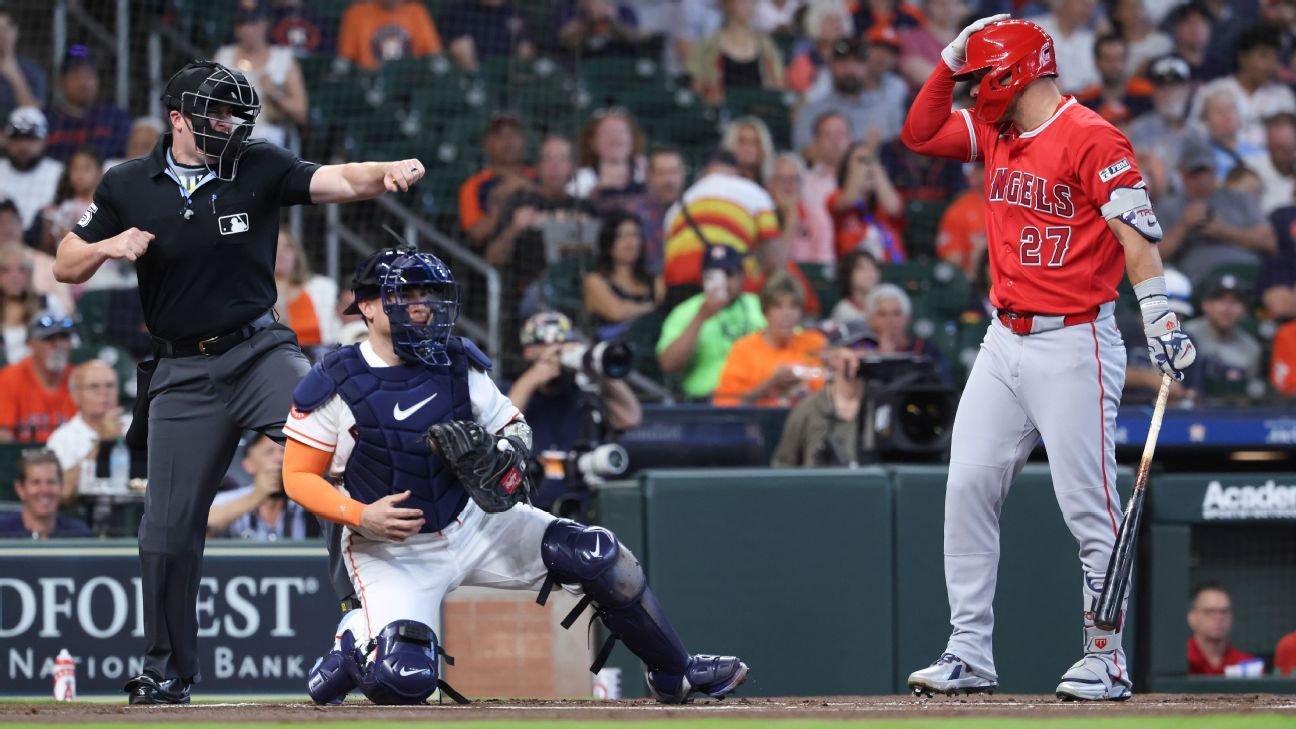
The Challengengiest Player: Mike Trout
For much of the 2010s, Trout was universally regarded as the best baseball player on the planet. Recent years have been unkind to him health-wise, which is why seeing him act with such confidence at the plate was a welcome sign.
Over the first three days of challenges, Trout asked for more than any player: four total, three of them successful. He has always commanded the zone and could wind up being one of the biggest beneficiaries if he can continue to use ABS to work himself into hitters’ counts. Nobody in baseball had a better first five days of the season than Trout.
Most Trustworthy: Catchers
Salvy teaching Doug Eddings the bottom of the strike zone.
Over and Over and Over again.
But Eddings refuses to learn. 😂 pic.twitter.com/UxKxL56jqi
— Rob Friedman (@PitchingNinja) March 28, 2026
Teams spent much of the offseason and spring training devising plans to use ABS. When would they challenge was a primary question, yes, but who would challenge was even more imperative. The clear answer, at least in the early going, is catchers. Kansas City’s Salvador Perez was the early star, going 4-for-4 in challenges — all of them on low fastballs, three of the four around a half-inch away from being out of the zone. Perez’s peers joined him in the overturn party. More than half of challenges so far have come from catchers, who successfully overturned 59 of 92 calls, a 64.1% success rate. Compare that to hitters, who went 33-for-78, or just 42.3%.
Allergic to Challenges: Pitchers
Those conversations among teams almost all settled on the same conclusion: The worst person to challenge is the one standing 60 feet, 6 inches from home plate. Of the 175 challenges issued, only five came from pitchers — and just two were successful.
Both were impressive. The first came from A’s reliever Hogan Harris, who fired an inside fastball with runners on first and second and none out in the bottom of the eighth, holding a 6-3 lead. The pitch, called a ball, looked like it made the count 2-1. Instead, upon its overturn (0.3 inches), Harris was ahead 1-2.
The other scenario was even higher leverage: With the tying run at the plate in the bottom of the ninth, Baltimore closer Ryan Helsley twirled a full-count slider originally called a ball. He tapped his hat and, like Harris, was right by 0.3 inches. Without that call, it’s first and second with one out. With it, Helsley was just one out from a save, which he later secured.
Most Popular Count: 2-2
The count with the most challenges so far is 2-2, which makes some sense. The specter of an at-bat ending on a pitch is likely to push batters and pitchers both in the direction of challenging two-strike situations. This list is likely to stabilize over time, with other counts moving toward the top of the leaderboard — particularly 1-1. After being behind 1-2, batters over the last five years have slashed .170/.225/.270. Following a 2-1 count, on the other hand, they’re at .235/.388/.400. One pitch, nearly a 300-point OPS difference. Another count likely to increase in frequency of usage: 2-1, with a 450-point spread between the OPS after 2-2 vs. 3-1.
Here are the total number of challenges by count:
2-2: 27
0-0: 25
1-1: 22
3-2: 19
0-1: 16
2-1: 13
1-2: 13
0-2: 11
3-1: 10
1-0: 10
2-0: 6
3-0: 3
Favorite Inning to Challenge: 6th
Another one that’s likely to shift over time. The busiest half-inning by a long shot is the top of the ninth, with 20 challenges alone there. Because the bottom of the ninth often is not played, it’s not nearly as busy.
Here are the total number of challenges by inning:
6th: 26
7th: 25
9th: 24
8th: 20
4th: 18
5th: 18
1st: 15
2nd: 14
3rd: 11
10th: 4
Best Pitch to Challenge: Four-Seam Fastball
There’s an exception for hitters when it comes to challenging, and it’s the ol’ reliable heater. Hitters have challenged 26 four-seamers, and they’ve gotten them right 65.4% of the time — 17 of 26. The two-seam fastball, meanwhile, has been brutal for hitters, catchers and pitchers alike: just 11 of 33 challenges have been successful.
Here are the total number of challenges by pitch, with overturns:
Four-seam fastball: 40 of 60 successful
Two-seam fastball: 11 of 33
Slider: 11 of 25
Cutter: 6 of 15
Changeup: 9 of 14
Sweeper: 9 of 14
Curveball: 6 of 11
Splitter: 2 of 3
It was a perfect situation for a challenge: Bottom of the seventh, tying runner at the plate, 2-2 count. With left-handed hitter Victor Scott II at the plate, Tampa Bay catcher Nick Fortes set up for reliever Garrett Cleavinger to throw a sweeper off the plate. Cleavinger yanked it — and still managed to land the pitch on the inside corner. Missing a location by nearly 2 feet was a near automatic ball pre-ABS. But this system is not about hitting a spot; landing a pitch in the strike zone is more important. And when Fortes tapped his head, it wound up changing a full count into a strikeout.
If anyone is going to bring showmanship into ABS, it’s Arozarena, the Seattle Mariners outfielder with a propensity to sign autographs in between innings. In the bottom of the second inning Saturday, Cleveland’s Joey Cantillo ripped a slider low and inside. Arozarena was certain he had drawn a walk when he started jogging to first base, only for home plate umpire Nestor Ceja to punch him out. Arozarena didn’t believe it. He turned back around, took off his shin and elbow protectors and started jogging toward first base — at which point the scoreboard showed the pitch missing by a whole 0.2 inches. It was the baseball equivalent to a no-look pass: While the embarrassment of missing one is high, nailing it like Arozarena did, as if he unequivocally knew, will buy him more opportunities going forward.

